Alpha Metallurgical Resources (AMR): Logistics and supplier posture investors need to price in
Alpha Metallurgical Resources operates as a coking-coal producer that monetizes through bulk sales to domestic and export customers, supplemented by purchased coal for blending and contractual export logistics. The company sells mined coal, contracts third parties for transportation and terminal services, and carries multi-year unconditional purchase obligations tied to equipment, fuel, rail freight and export terminal capacity. Investors should value AMR not only as a commodity producer but as a company whose earnings are tightly coupled to a small set of logistics counterparts and fixed contracting commitments.
For a fast look at related supplier and counterparty intelligence, visit the research hub at https://nullexposure.com/.
How AMR makes money and where counterparty risk sits
Alpha’s top-line is driven by coal sales; the company reported Revenue TTM of $2.129 billion with EBITDA of $136.6 million in the latest trailing period. Capital and operating performance are sensitive to two structural factors: transportation concentration and contractual purchase obligations. The company moves roughly 90% of coal by rail and negotiates agreements for rail, truck, barge and terminal services for exports. Those logistics relationships are therefore operationally critical and economically material to margin and shipment cadence. The filings show negative operating and net margins on the latest trailing data, underscoring that logistics cost shocks feed directly to profitability.
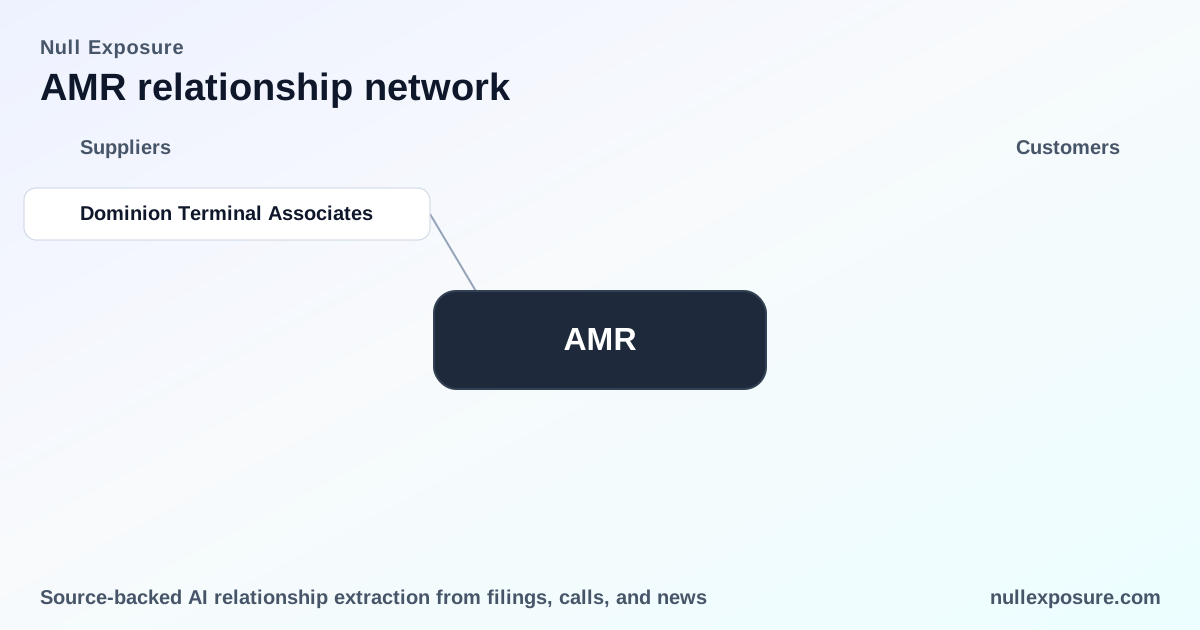
The single listed supplier relationship: Dominion Terminal Associates
Dominion Terminal Associates is a terminal operator used by AMR for export loadings. According to an FY2026 earnings call transcript posted on March 9, 2026, Dominion Terminal Associates scheduled a four-week planned outage beginning in March for equipment upgrades; AMR’s management indicated they planned for the downtime and did not expect material negative impacts from the outage. (Source: FY2026 earnings call transcript on InsiderMonkey, first seen 2026-03-09.)
A company filing of purchase obligations for 2025 explicitly assigns $48,432 for DTA funding within a larger schedule of unconditional obligations, signaling a funded, contracted relationship rather than ad hoc terminal usage. (Source: company filing disclosures for unconditional purchase obligations, 2025 schedule.)
What the documented constraints tell investors about AMR’s operating model
The relationship-level and company-level constraint evidence together reveal a compact operating profile investors must price.
-
Concentration in geography and carrier: AMR transports most produced coal by rail and identifies CSX Transportation and Norfolk Southern as primary carriers in filings covering years ended December 31, 2024. That construct yields route concentration and exposes throughput to carrier-specific capacity and labor issues. (Source: company filings, years ended December 31, 2023–2024 disclosures.)
-
Criticality of service providers: The company states that 90% of coal volume moves by rail and that many operations are serviced by a single rail carrier, which the company characterizes as a material operational risk. This underlines that rail service reliability is first-order to revenue realization. (Source: risk disclosures in company filing for year ended December 31, 2024.)
-
Contracting posture and spend profile: AMR carries unconditional purchase obligations that include equipment, diesel, rail freight and export terminal costs, totaling sizable commitments across 2025–2027 (the disclosures list a $190,493 obligation in 2025 overall, with the DTA element noted above). These obligations establish a fixed-cost floor and demonstrate multi-year contractual lock-ins. (Source: company filing on unconditional purchase obligations, 2025 schedule.)
-
Role diversity and outsourcing: Filings show AMR both buys and sells coal (it purchases coal for blending) and contracts third parties to operate certain mines under oversight but without day-to-day control—creating operational leverage but also counterparty execution risk. (Source: company operational disclosures, 2024 filings.)
Where a constraint excerpt explicitly names a counterparty, it is presented as such: for example, the unconditional obligation entry that calls out DTA funding in 2025 is relationship-specific evidence linking AMR’s balance of obligations to Dominion Terminal Associates.
Why these features matter for valuation and counterparty diligence
-
Price sensitivity to logistics shocks is elevated. When 90% of product relies on rail and a handful of terminal windows, a short outage, rail congestion, or a labor stoppage converts directly into lower shipments and quarterly revenue loss. Management’s guidance that a planned DTA outage will not be material is reassuring operationally, but investors must watch realized shipments and export tonnage after the outage window closes to validate that claim. (Source: FY2026 earnings call transcript, March 2026.)
-
Contractual spend makes downside stiffer. Multi-year unconditional obligations create fixed cash demands that reduce margin flexibility during commodity down-cycles. The numeric obligations disclosed for 2025–2027 are a balance-sheet leash investors need to model explicitly. (Source: company purchase obligation schedules.)
-
Counterparty concentration is a negotiating lever for counterparties and for AMR’s risk managers. A single-rail-carrier dependency gives carriers asymmetric bargaining power on service levels and freight rates when capacity tightens. Conversely, visible terminal funding commitments like the DTA line item indicate AMR has negotiated plated capacity rather than purely spot access—useful intelligence for suppliers evaluating whether AMR is a committed long-term counterparty. (Sources: company filings; DTA funding schedule.)
For detailed partner monitoring and to model cash exposure from logistics commitments, see practical research at https://nullexposure.com/.
Practical actions for investors and supply-chain counterparties
- Require post-outage shipment verification: check exported tonnage and vessel loading records for the quarter following the DTA outage to validate management’s assertion of no material impact.
- Stress-test scenarios for rail disruption: model a 10–30% reduction in rail shipments over one quarter and quantify the P&L and working capital impact given AMR’s purchase obligations.
- For counterparties (terminals, carriers, equipment sellers): clarify payment terms and operational contingencies in contracts with AMR, and price in concentration risk where AMR is a major buyer or where AMR depends on a single provider.
Final read and next steps
Alpha Metallurgical Resources is a commodity producer whose margin trajectory is tightly coupled to logistics execution and contractual commitments. The Dominion Terminal Associates engagement—documented outage with an explicit funding line in AMR’s purchase obligations—illustrates how terminal availability and funded access sit at the center of export capability. Active monitoring of carrier service levels, port terminal schedules, and the company’s unconditional obligations is essential for any investor underwriting AMR’s earnings or any supplier negotiating exposure.
For ongoing supplier risk profiles and counterparty monitoring tools, visit the research portal at https://nullexposure.com/.