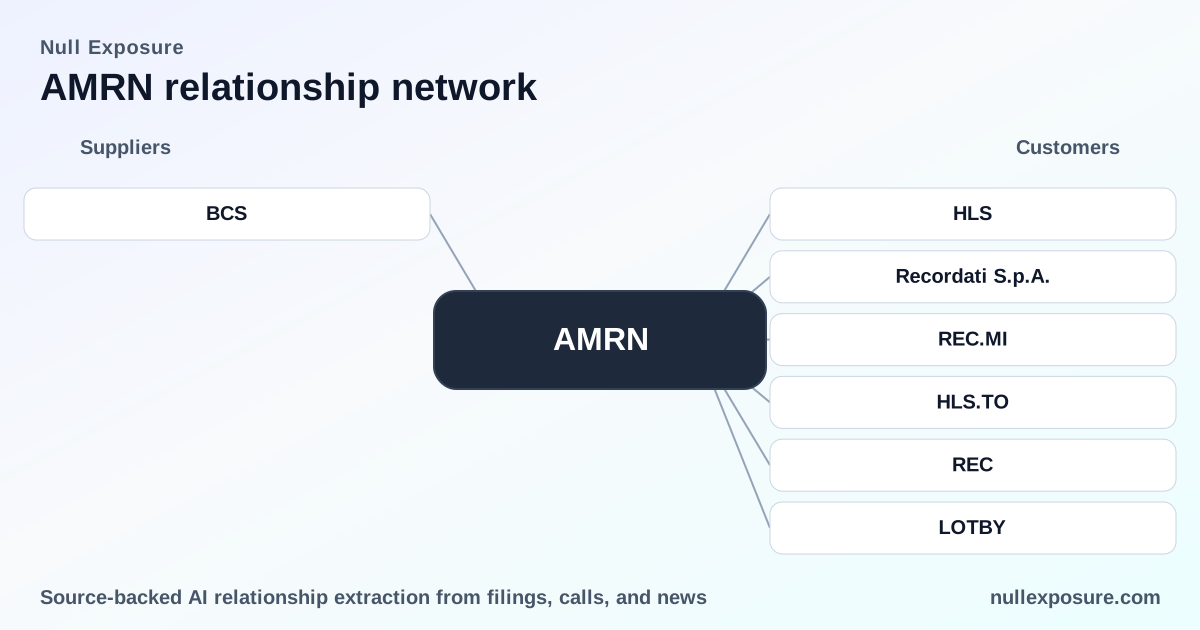
Amarin Corporation PLC (AMRN): Supplier Relationships, Constraints, and Strategic Implications for Investors
Amarin operates a single-product commercial franchise built around VASCEPA, outsourcing all manufacturing and packaging steps to contract manufacturers and international API suppliers. The company monetizes primarily through U.S. and ex-U.S. prescription sales of VASCEPA while managing a capital-intensive supplier base via long-term purchase commitments and regulatory-dependent obligations that tie near-term liquidity to supply continuity. Investors should evaluate Amarin not as an integrated manufacturer but as a commercial-stage drug sponsor whose margins, supply continuity, and strategic optionality are heavily shaped by third‑party supplier agreements.
Explore supplier exposure and analysis tools at https://nullexposure.com/.
What Amarin’s supplier posture means for returns and risk
Amarin’s operating model is straightforward: product economics are driven by VASCEPA sales, while product availability and cost structure are outsourced. This yields several predictable characteristics:
- Contracting posture: long-term commitments. Amarin plans purchases more than a year ahead and maintains long-term supply agreements to secure API and encapsulation capacity. This reduces short-term spot risk but raises fixed-cost and contingent-liability exposure.
- Criticality and materiality to commercial continuity. Suppliers are mission-critical; inability to secure API or finished product would have a material adverse effect on VASCEPA commercialization and revenues.
- Global footprint and regulatory dependence. The supply chain includes multiple FDA-approved international suppliers, requiring active regulatory coordination and contingency planning across jurisdictions.
- Outsourced manufacturing model. Amarin has no in‑house manufacturing capacity and relies entirely on contract manufacturers, making contract terms, quality control, and supplier relationships principal operational levers.
- Substantial contractual spend. Public disclosures record total contingent and contractual obligations in the high tens to low hundreds of millions—an explicit balance‑sheet and operational constraint.
These are company-level signals drawn from Amarin’s public disclosures and filings.
The one named relationship in the public record: what it means for suppliers and strategy
Amarin’s public relationship results return a single named external advisor: Barclays. According to an earnings call transcript, Barclays is acting as Amarin’s exclusive advisor to explore value-enhancing strategic opportunities, a mandate that can include M&A, divestiture, or alternative commercial transactions that would materially affect supplier commitments and counterparty management. (Source: Q4 2025 earnings call transcript via SahmCapital, 2026-02-25 — https://www.sahmcapital.com/news/content/amarin-corp-q4-2025-earnings-call-transcript-2026-02-25)
Barclays — advisor on strategic options
Barclays has been appointed as Amarin’s exclusive financial advisor to assist the board and management in evaluating potential value‑enhancing strategic opportunities, a relationship disclosed on Amarin’s earnings call in February 2026. The engagement signals active consideration of transactions that could change the company’s supplier obligations or restructure commercial exposure. (Source: SahmCapital transcript, 2026-02-25 — https://www.sahmcapital.com/news/content/amarin-corp-q4-2025-earnings-call-transcript-2026-02-25)
How the constraints profile shapes supplier counterparty risk and negotiation leverage
Amarin’s constraint set—derived from company disclosures—lays out the practical negotiating landscape for suppliers and investors alike. Presenting these as company-level characteristics:
- Long-term contract orientation (high confidence). Multiple excerpts confirm that Amarin enters long-term supply agreements and makes purchasing decisions more than a year in advance, meaning suppliers with capacity gain revenue visibility but also long lead‑time commitment obligations.
- Global supplier base (moderate confidence). The company maintains multiple U.S. FDA‑approved international API suppliers, encapsulators, and packagers to support ex‑U.S. commercialization, which reduces single-source concentration but increases regulatory complexity.
- Material dependency on suppliers (high confidence). Disclosures state that supply failures would cause a material adverse effect on VASCEPA commercialization—this elevates supplier criticality in investor risk models.
- Outsourced manufacturing and service mix (high confidence). Amarin has no in‑house manufacturing; all clinical and commercial production is contract‑manufactured, and certain operational inputs (e.g., prescription estimates) are sourced from third‑party analytics providers like Symphony Health.
- Active, mature supplier stage (high confidence). Multiple active agreements exist; Amarin continues to negotiate supply alignment with market demand, implying active supplier management rather than one-off arrangements.
- Scale of contractual obligations (very high confidence). The company disclosed $160.8 million in contingent obligations tied to regulatory approvals in Europe, plus approximately $63.6 million in future contractual purchase obligations, and a previously recorded liability of $7.8 million related to renegotiated supply agreements—these figures are meaningful for working capital forecasting and counterparty exposure.
Together these points define a supplier ecosystem that is strategically important, costly to replace at scale, and central to any valuation scenario for Amarin.
Investment implications: where investors should focus
- Valuation sensitivity to supply continuity. Given VASCEPA’s revenue centrality, any supplier disruption will compress revenues and further pressure margins. Model downside scenarios should incorporate multi‑month supply interruptions and the cost of alternate sourcing.
- Deal risk and upside tied to Barclays engagement. The Barclays advisor relationship elevates the probability of a strategic transaction that could reshape contractual liabilities (for example, asset sale, licensing, or partnership), which would directly affect supplier commitments and potential termination or assignment clauses.
- Balance sheet and contingent liability monitoring. The disclosed contingent obligations and purchase commitments require ongoing attention—investors must track regulatory milestones and renegotiation outcomes that could crystallize cash outflows.
- Operational concentration trade-offs. Outsourcing reduces capital expenditure but increases counterparty and regulatory risk; investors should treat supplier health, capacity, and regulatory status as core variables in any diligence.
If you want a concise supplier impact memo tailored for portfolio scenarios, see https://nullexposure.com/ for tailored analyses and monitoring tools.
Practical next steps for investors and operators
- Review supplier contracts’ termination, assignment, and force majeure language as part of transaction or downside planning.
- Monitor regulatory approval milestones tied to contingent obligations and the progress of any strategic review led by Barclays.
- Conduct counterparty stress testing: estimate the cost and timeline to qualify alternative API suppliers and encapsulators under FDA scrutiny.
- Maintain a rolling update on Amarin’s filings and earnings transcripts to capture any expansion of advisor engagements or supplier disclosures.
Interested in detailed counterparty exposure maps and contract‑level stress testing? Visit https://nullexposure.com/ for analyst-grade supplier intelligence and scenario modeling.
Bottom line
Amarin is a commercial-stage pharmaceutical company whose economic fate is concentrated in a single product and outsourced manufacturing chain. The supplier profile is characterized by long-term, material commitments and substantial contingent liabilities, while the appointment of Barclays as exclusive advisor signals active consideration of strategic alternatives that could materially alter supplier obligations. For investors and operators, the key variables are supply continuity, the crystallization of contingent obligations, and the outcome of the strategic review—each of which will decisively influence cash flow, valuation, and contractual counterparty dynamics.