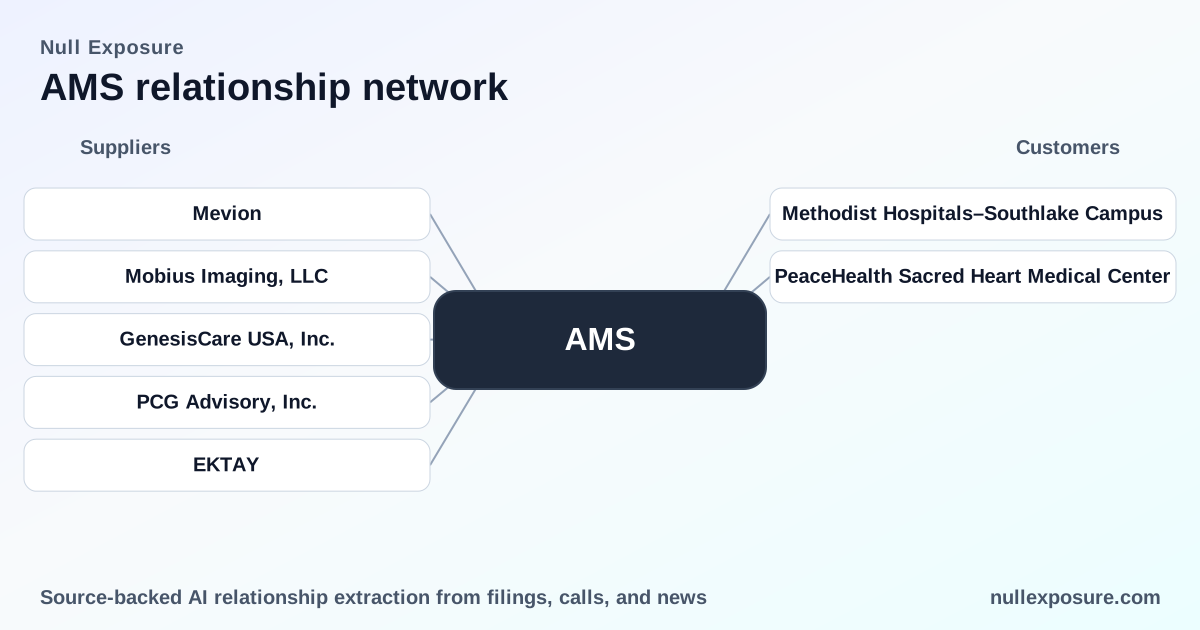
American Shared Hospital Services (AMS): Supplier Map and Commercial Risks for Investors
American Shared Hospital Services (AMS) rents radiosurgery and radiation therapy equipment to healthcare providers and monetizes primarily through equipment rentals, long-term service agreements, and usage-based service charges. The company’s revenue mix blends upfront prepaid service commitments for proton beam therapy with monthly, usage-tied contracts for Gamma Knife, LINAC and other systems, while a concentrated vendor base drives meaningful related-party exposure. For a quick overview of supplier relationships and contract risk, visit https://nullexposure.com/ to explore supplier intelligence and counterparty context.
Executive summary
- Business model: AMS operates as a capital-light operator of specialized radiotherapy assets, collecting rental and service revenue while outsourcing manufacturing and certain maintenance functions to device makers.
- Monetization levers: long-term maintenance prepayments, monthly usage billing, and capital commitments to equipment purchases and upgrades.
- Key risks: supplier concentration (notably Elekta), multi-year service obligations with prepayments, and mid-single-digit to double-digit millions in capital and service commitments that affect cash flow flexibility.
What the supplier list tells investors about AMS’s operating posture AMS’s disclosed supplier relationships reveal a clear operating pattern: equipment acquisition is concentrated among a small set of manufacturers, while service delivery is split between long-term contracted support and monthly usage-based billing. Company-level commitments reported in the 2024 Form 10-K include multi-million-dollar purchase and service obligations and total service commitments over $13 million, signaling material cash commitments to suppliers over the next several years. The combination of prepaid maintenance (contractual annual prepayments) and monthly usage billing creates a hybrid cash flow profile—some predictability from prepayments and variable revenue tied to patient volumes.
Supply concentration and criticality
- Concentration: AMS purchases the majority of its equipment from Elekta, which creates concentrated supplier risk and related-party transaction exposure. This concentration increases negotiating dependence and operational coupling between AMS and its primary equipment manufacturer.
- Contracting posture: Contracts are a mix of long-term agreements (e.g., multi-year maintenance support with fixed prepayments) and usage-based service contracts billed monthly as service is performed—producing both committed and variable spend.
- Maturity and timing: At least one maintenance contract for the PBRT unit runs through April 2026, demonstrating active, near-term contractual obligations that are already in place.
Supplier relationships: what each counterparty contributes Every named relationship below is discussed with direct source context for investor diligence.
Mevion
- Mevion provides maintenance and support for AMS’s proton beam radiation therapy (PBRT) unit under a multi-year maintenance and support agreement that runs through April 2026 and includes annual prepayment requirements. (Source: AMS Form 10‑K, FY2024.)
- This is a long-term service relationship with prepaid cash obligations, reflecting both contractually committed spend and technical dependency on the Mevion platform. (Source: AMS Form 10‑K, FY2024.)
Mobius Imaging, LLC
- Mobius Imaging is a contracted service provider for AMS’s equipment maintenance commitments; the 2024 Form 10‑K lists Mobius alongside Mevion and Elekta as parties that carry out service commitments. (Source: AMS Form 10‑K, FY2024.)
- The relationship is described as part of operational service delivery for imaging and therapy support, placing Mobius in the company’s ongoing service-provider roster. (Source: AMS Form 10‑K, FY2024.)
Elekta
- Elekta is the primary manufacturer for AMS’s Gamma Knife and other radiation therapy equipment and is a related-party counterparty for equipment purchases, upgrades, and service commitments; AMS reports significant related-party transactions and installation commitments with Elekta. (Source: AMS Form 10‑K, FY2024.)
- Elekta represents the single largest supplier concentration, driving equipment procurement exposure and recurring costs to de-install, upgrade, and maintain high-value systems. (Source: AMS Form 10‑K, FY2024.)
GenesisCare USA, Inc.
- In FY2017 AMS acquired a 60% interest in the Southern New England Regional Cancer Center and Roger Williams Radiation Therapy LLC from GenesisCare USA, Inc. for $2.9 million, a transaction recorded in company histories and financial reporting. (Source: SimplyWallStreet company profile referencing FY2017 transaction.)
- This historical deal illustrates AMS’s strategy of acquiring operator interests and partnering with large clinical operators as channels for deploying its equipment footprint. (Source: SimplyWallStreet / transaction history, FY2017.)
PCG Advisory, Inc.
- PCG Advisory is listed in AMS’s investor relations contact details for the company’s third-quarter 2025 financial results (press release context), indicating the firm’s role in investor communications rather than as an equipment or service supplier. (Source: GlobeNewswire / Manila Times press release summarizing AMS Q3 2025 results.)
- The relationship is communications-oriented and should be viewed as part of management’s market-facing interface rather than operational supply risk. (Source: GlobeNewswire press release, Q3 FY2025.)
Constraints and what they imply for financial and operational risk
- Contract type: AMS operates with a blend of long-term prepaid maintenance agreements (e.g., Mevion Service Agreement) and usage-based monthly service contracts for Gamma Knife and LINAC systems. This mix yields both committed cash outflows and revenue tied to patient throughput.
- Relationship roles: The company’s suppliers fall into two functional buckets—manufacturers (Elekta and others providing hardware) and service providers (Mevion, Mobius) that execute maintenance and uptime responsibilities.
- Spend scale and concentration: Company-level disclosures list total service commitments of approximately $13.1 million and related-party purchase/install commitments totaling roughly $18.6 million as of December 31, 2024, placing AMS in a meaningful spend band that can influence capital allocation and liquidity. These figures are corporate signals about capital intensity and vendor risk.
- Lifecycle and maturity: Certain service agreements are active and extend into 2026, creating near-term obligations that affect working capital and free-cash-flow profiles.
Investment implications and risk-reward framing
- Upside drivers: AMS’s model benefits from recurring service revenue and high barriers to entry for specialty radiosurgery equipment, which supports stable utilization if clinical partners maintain patient volumes.
- Downside risks: Supplier concentration with Elekta, multi-year prepayments and multi-million-dollar commitments reduce operational flexibility; equipment downtime or contract disputes would be immediately impactful given AMS’s reliance on manufacturer support and third-party service providers.
- Governance and ownership: High insider ownership (~45%) aligns management and shareholder interest but also means relatively low institutional float, which can amplify stock volatility around operational events.
If you are mapping counterparty risk or evaluating AMS’s vendor exposures in detail, start with the company’s Form 10‑K for FY2024 and the referenced press releases for Q3 FY2025 — and for a focused supplier-intelligence workflow, visit https://nullexposure.com/ to see consolidated relationship evidence and contract flags.
Final take American Shared Hospital Services runs a capital-intensive, vendor-dependent rental and service business in a concentrated manufacturer ecosystem. Investors should weigh recurring revenue stability against concentrated supplier exposure and multi-million-dollar contractual commitments that tighten liquidity levers. For an actionable supplier risk view and ongoing monitoring, explore supplier profiles and contract signals at https://nullexposure.com/.