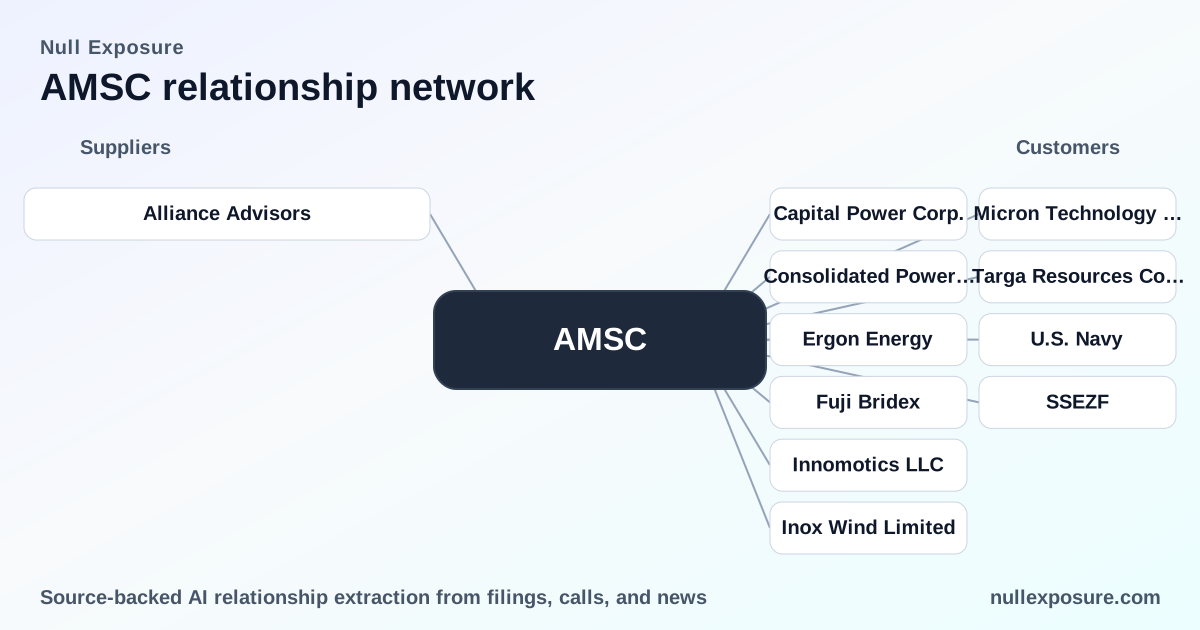
American Superconductor (AMSC) — supplier relationships, operating posture, and what investors should price in
American Superconductor sells megawatt-scale power resiliency solutions and captures revenue through equipment sales and recurring services tied to power electronics and grid resiliency projects. The company monetizes through productized hardware and associated services for utility and industrial customers, supported by investor relations and external advisors that help manage market-facing communications. This profile focuses on supplier-facing relationships that affect contract execution, market access, and stakeholder engagement.
Explore deeper supplier and counterparty signals at https://nullexposure.com/.
Key business drivers and financial context AMSC operates in a capital-intensive, project-oriented segment of industrial power equipment. The company reported TTM revenue of $279.4M and a gross profit of $86.3M, with a profit margin of 46.7% and EBITDA of $22.46M (latest reported figures through the quarter ended 2025-12-31). Market valuation metrics include a market cap of $1.47B, trailing P/E 10.16, and an analyst target price of $52.33. Institutional ownership is high at ~70.9%, and the stock carries elevated volatility with beta 3.08. These are the practical inputs investors and counterparties use to set contract terms and assess counterparty credit and execution risk.
- Revenue model: Product sales plus services/maintenance for grid and industrial clients.
- Capital and margin profile: High gross margins but modest operating margin (operating margin TTM ~6.2%), consistent with hardware sales plus project and service variability.
- Market signals: High institutional ownership and elevated beta imply that market perception and liquidity are material to contract pricing and supplier decisions.
If you want a consolidated view of supplier connections and risk implications, start here: https://nullexposure.com/.
Supplier relationships found in public records The dataset for AMSC on supplier relationships is focused and specific. Below are every relationship item surfaced in the available results, presented with a plain-English summary and source reference.
Alliance Advisors — FY2025 press notice (Investor Relations contact) Alliance Advisors is listed as the investor relations contact for AMSC’s FY2025 earnings communications, with Nicol Golez and contact numbers cited in public announcements; this indicates AMSC engages a third-party IR firm to manage earnings releases and investor communications. A StockTitan report referencing the FY2025 notice captured the IR contact details on March 9, 2026 (source: StockTitan news item, 2026-03-09).
Alliance Advisors — FY2026 press notice (Investor Relations contact) A separate StockTitan item repeats Alliance Advisors as the IR contact for the FY2026 earnings notice (also recorded March 9, 2026), again listing Nicol Golez and the firm’s phone contact; this confirms a continuing supplier relationship for investor relations across fiscal periods. (source: StockTitan news item, 2026-03-09).
What these supplier links mean for counterparties and investors Both relationship entries show that AMSC outsources investor-relations execution to Alliance Advisors, a specialized communications supplier. That is not a technical supplier for manufacturing but a governance- and market-facing supplier that affects disclosure cadence, messaging, and therefore market reaction to operational results. For counterparties evaluating AMSC as a customer or partner, the presence of a retained IR firm signals an organized, repeatable approach to external communication — useful when aligning delivery schedules with market expectations.
Operating model constraints and company-level signals There were no explicit constraint excerpts tied to the supplier relationships in the provided results; present company-level signals instead:
- Contracting posture: AMSC’s product focus on megawatt-scale systems implies long sales cycles and project-level contracting with milestone payments, acceptance testing, and service-level guarantees. This creates supplier terms that favor staged payments and performance-based milestones.
- Concentration and criticality: Institutional investors hold a large proportion of stock (~70.9%), which concentrates market influence and raises sensitivity to disclosure events; counterparties should expect rigorous governance around financial reporting and investor queries.
- Maturity and repeatability: The repeated IR engagement across fiscal periods demonstrates maturity in external communications, reducing execution risk on investor-facing milestones but not substituting for manufacturing or supply-chain reliability.
- Financial resilience signals: Positive profit margin and healthy gross profit suggest ability to fund operational commitments, but high beta and EV/EBITDA (~66) indicate elevated market valuation multiple variability that suppliers should price into contract terms.
Risk and upside for suppliers and buyers
- Risk: Project execution risk and timing are the primary counterparty concerns because long-cycle hardware projects produce cash-flow timing variability. Suppliers should secure performance guarantees or staged payments. Market sensitivity is an operational risk: rapid share-price moves can complicate counterparty negotiations when equity-linked terms are present.
- Upside: AMSC’s niche in grid resiliency and high reported profit margins create premium pricing power for specialized suppliers. Institutional ownership and professional IR support help keep communications consistent, which benefits counterparties relying on predictable disclosure patterns.
Actionable investor and operator moves
- For investors: Monitor AMSC’s quarterly cadence and IR releases closely, as the company uses external IR advisors to shape market expectations; adjust exposure for volatility given beta >3.0 and the divergence between trailing and forward P/E.
- For suppliers and counterparties: Structure contracts with milestone payments and acceptance criteria, and factor in potential disclosure-driven schedule changes that can influence project timelines.
Further due diligence and where to go next
- Review AMSC’s most recent investor release and earnings call transcripts to align commercial milestones with disclosure timelines.
- Map supplier payment terms against project milestones to limit timing risk.
Explore a full supplier-risk profile and continuous monitoring at https://nullexposure.com/.
Bottom line AMSC runs a specialized, project-oriented business with strong institutional ownership and a deliberate approach to investor communications via retained IR suppliers. The supplier relationships disclosed are targeted at market communications rather than direct manufacturing supply, which reduces operational supply-chain exposure but elevates the importance of disclosure discipline for market-sensitive counterparties. For both investors and operators, the policy is clear: price for project timing, insist on milestone-based payments, and monitor IR-driven communication windows as a proxy for short-term market risk.
If you want ongoing supplier relationship tracking and analytical context for sourcing and counterparty risk, visit https://nullexposure.com/ for subscription options and custom alerts.