AMERISAFE (AMSF): Reinsurance is the Product — and the Risk
AMERISAFE writes workers’ compensation insurance and monetizes by underwriting small to mid-sized employer risks, collecting premiums and investing float while ceding portions of extreme losses to the reinsurance market. Underwriting income, investment income and disciplined reinsurance buying drive returns; reinsurance counterparties and liquidity facilities determine capital efficiency and loss-bearing capacity. For an investor evaluating supplier concentration and counterparty risk, the reinsurer roster and the structure of treaties are the primary operational levers to watch. Learn more about counterparty mapping and supplier risk at https://nullexposure.com/.
Reinsurance shapes capital efficiency and loss volatility
AMERISAFE’s business model depends on predictable premium flows and the ability to transfer large-loss volatility to reinsurers. The FY2024 Form 10‑K discloses a layered ceded program: a multi‑year treaty covers a middle layer while other layers are renewed annually, which creates a hybrid contracting posture that balances term stability with re-price flexibility. This structure produces several operational characteristics investors should internalize:
- Contracting posture: The company operates with a mix of long‑term (multi‑year) and annual treaties; long‑term placement reduces short‑term renewal risk for the core layer, while annual layers allow re‑pricing after adverse loss experience. (FY2024 Form 10‑K)
- Criticality: Reinsurance is described explicitly as critical to the business, so counterparty failure or material reductions in capacity would directly impair AMERISAFE’s ability to write or retain risk. (FY2024 Form 10‑K)
- Role and services: AMERISAFE is a net purchaser of reinsurance to reduce net liability and to protect against catastrophic losses, and it uses third‑party annuity providers to manage long‑duration claim liabilities—so suppliers include both reinsurers and annuity issuers, plus an external auditor for controls. (FY2024 Form 10‑K)
- Maturity and activity: The company’s relationships are operational and active—its independent auditor, Ernst & Young LLP, audited internal controls as recently reported—indicating current, ongoing supplier engagement rather than legacy or dormant arrangements. (FY2024 Form 10‑K)
These facts create a profile where counterparty credit quality and treaty design are first-order investment risks for AMERISAFE shareholders.
Who AMERISAFE relies on — counterparties and what they do
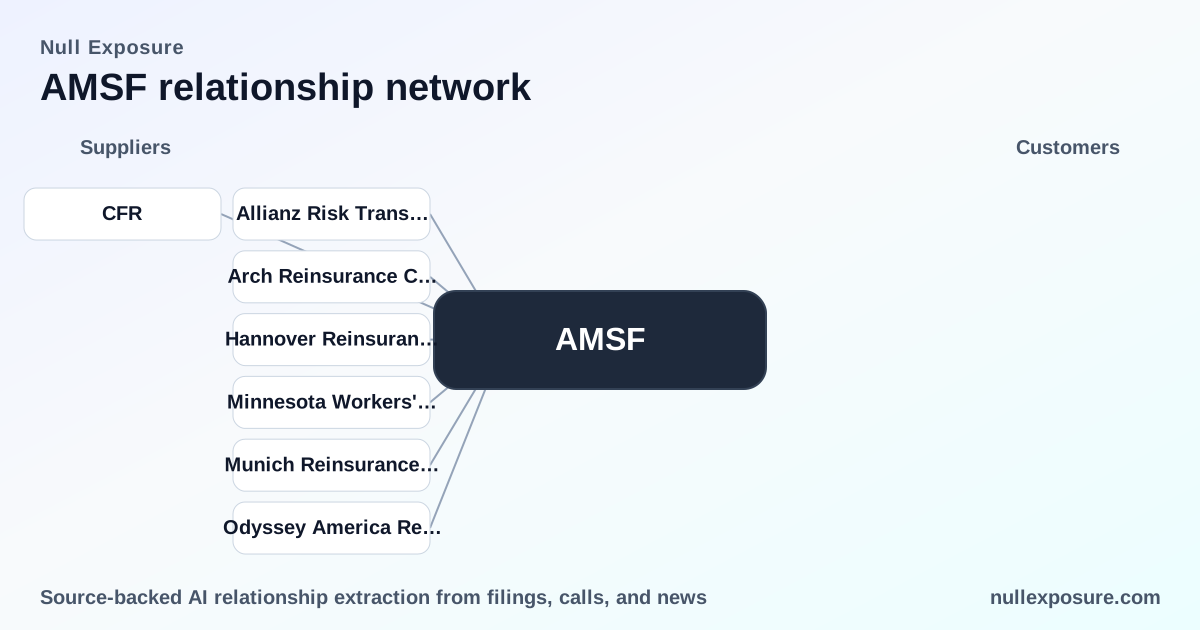
Below are the counterparties named in AMERISAFE’s disclosures and a plain‑English take on each relationship.
-
Allianz Risk Transfer AG (Bermuda): AMERISAFE reports recoverables of $5.963 million from Allianz Risk Transfer AG in its FY2024 reinsurance receivables table, reflecting Allianz’s role as a rated reinsurer on ceded layers. According to AMERISAFE’s FY2024 Form 10‑K, Allianz Risk Transfer AG is listed with an A+ A.M. Best rating. (FY2024 Form 10‑K)
-
Arch Reinsurance Company: Arch is recorded with $25.502 million of amounts recoverable as of December 31, 2024, indicating a material reinsurance exposure to Arch on ceded loss layers. The company lists Arch Reinsurance Company with an A+ rating in the FY2024 Form 10‑K. (FY2024 Form 10‑K)
-
Hannover Reinsurance Ireland Limited: Hannover Reinsurance Ireland is disclosed with $51.330 million recoverable at year‑end 2024, the single largest ceded receivable on the schedule, signaling a highly material placement with Hannover for AMERISAFE’s ceded program. (FY2024 Form 10‑K)
-
Minnesota Workers' Compensation Reinsurance Association (MWCRA): MWCRA is listed with $8.576 million recoverable and is noted as not rated (NR), which highlights a mix of rated and non‑rated counterparties in the ceded portfolio. (FY2024 Form 10‑K)
-
Munich Reinsurance America, Inc.: Munich Reamerica appears with $8.512 million recoverable, placing Munich among the mid‑sized counterparties supporting AMERISAFE’s excess‑of‑loss treaties. (FY2024 Form 10‑K)
-
Odyssey America Reinsurance Corporation: Odyssey is shown with $4.048 million recoverable and an A+ rating, representing another investment‑grade reinsurer involved in AMERISAFE’s ceded program. (FY2024 Form 10‑K)
-
Frost Bank (Covenant / Liquidity provider): In FY2026 filings and a TradingView summary of AMERISAFE’s SEC 10‑K, the company renewed a $20.0 million line of credit with Frost Bank to ensure access to additional liquidity. This is a short‑term liquidity backstop rather than a reinsuring counterparty, and it underpins working capital and claim‑timing needs. (TradingView report summarizing AMERISAFE SEC 10‑K, March 2026)
Each of these relationships is disclosed in AMERISAFE’s FY2024 Form 10‑K except Frost Bank, which is described in subsequent reporting on the credit facility renewal.
Concentration, credit quality and what to watch next
The recoverables schedule in the FY2024 filing demonstrates concentration in a small number of rated reinsurers—most notably Hannover Re Ireland and Arch—so defaults or rating actions at any of those firms would have immediate balance‑sheet implications. The presence of both A+ rated global reinsurers (Hannover, Arch, Munich, Allianz, Odyssey) and a regional, not‑rated association (MWCRA) produces a blended counterparty profile: high average credit quality with pockets of rating and structural diversity.
Investors should monitor four dynamic variables:
- Renewal outcomes on the annual layers, which determine short‑term cost of reinsurance and hence underwriting margins. (Disclosure: FY2024 Form 10‑K notes certain layers are renewed annually.)
- Reinsurance recoverable trends and any delayed recoverable payments following large loss years, which would strain capital and liquidity.
- Credit rating actions among major reinsurers, given the material recoverable amounts concentrated with a handful of counterparties.
- Availability and terms of AMERISAFE’s Frost Bank line as a liquidity buffer for claim settlement timing; renewal terms can affect solvency headroom. (TradingView coverage, March 2026)
For more counterparty maps and supplier risk analysis, visit https://nullexposure.com/ to see how these dependencies translate into investor exposures.
Investment implications and final verdict
AMERISAFE’s economic model is underwriting‑driven but reinsurance‑enabled: underwriting discipline and investment income produce profits, but the company relies on a concentrated set of reinsurers and an active blend of multi‑year and annual treaties to stabilize catastrophic volatility. The largest single recoverable exposure to Hannover Re Ireland and sizeable placements with Arch and other A+ reinsurers are central to capital adequacy and loss absorption.
From a portfolio perspective, this positions AMERISAFE as a mid‑cap specialty insurer with attractive returns on equity but nontrivial counterparty concentration risk embedded in ceded receivables. Active monitoring of treaty renewals, reinsurer credit health, and the Frost Bank liquidity line is required to assess forward‑looking underwriting resilience.
If you track supplier risk for insurance investments, review the AMERISAFE counterparty disclosures directly and compare treaty timelines and recoverable aging; Nullexposure maintains continuous mapping of these supplier relationships—see more at https://nullexposure.com/ for deeper analysis and comparable supplier dashboards.