Amerant Bancorp (AMTB): what counterparties tell investors about funding, operations and execution
Amerant Bancorp operates as a regional bank holding company that earns net interest margin from lending and treasury activities and fees from deposit, payment and wealth services; it monetizes through interest income on a diversified loan book and ancillary fees, while selectively accessing capital markets for equity and wholesale funding to manage liquidity and growth. This review focuses on the supplier, underwriting and service-provider relationships that materially shape Amerant’s funding profile, cost structure and operational resilience. For an on-demand supplier intelligence view of public companies, visit https://nullexposure.com/.
Key investment thesis in one paragraph
Amerant is a mid-cap regional bank with a capital-light fee layer and interest-rate sensitive funding mix; recent equity issuance and continuing Federal Home Loan Bank (FHLB) borrowing show management balancing capital adequacy and liquidity while outsourcing core processing to reduce operating leverage. The bank’s supplier map is concentrated among investment banks for capital raises, a major vendor for core processing, and government-sourced wholesale funding — a profile that supports growth but creates concentration and operational dependency risks that investors must price.
Who sits across the table with Amerant — a relationship roll call
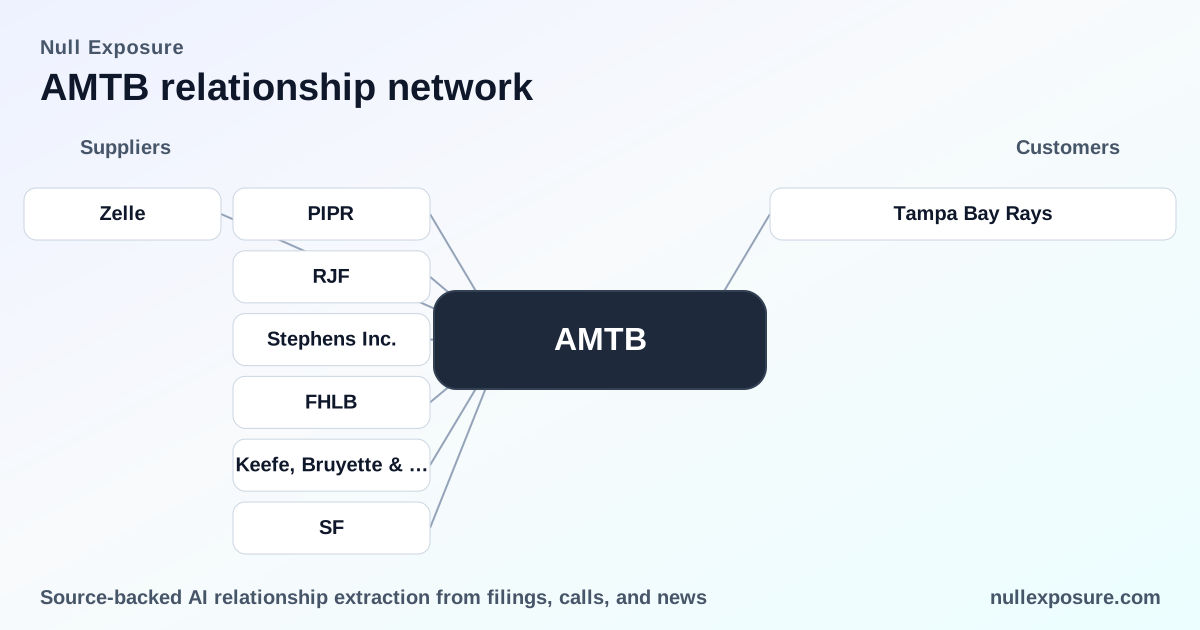
Below are every counterpart identified in public coverage and filings in our results set, each with a concise plain-English summary and source.
Piper Sandler & Co. (PIPR)
Piper Sandler acted as a joint book-running manager on Amerant’s $165 million common-stock offering in late September 2024, a role that positioned the firm to underwrite and distribute Amerant equity in the capital raise. (BizWire and related press coverage, Sept 25–27, 2024; TBBW Magazine coverage, Oct 1, 2024)
Stephens Inc.
Stephens Inc. served alongside Piper Sandler as a joint book-running manager on the same $165 million offering, sharing primary responsibility for pricing and market placement of the shares. (BizWire release and syndication, Sept 25–27, 2024)
Raymond James & Associates / RJF
Raymond James participated as a co-manager on the offering and is listed in multiple press summaries as part of the syndicate, contributing distribution capacity to the deal. (BizWire and syndicated press, Sept 25–27, 2024; TBBW Magazine, Oct 1, 2024)
Keefe, Bruyette & Woods, A Stifel Company (KBW / Stifel)
Keefe Bruyette & Woods (a Stifel company) is identified as a co-manager on Amerant’s common-stock closing, supporting placement into institutional channels that target bank-focused investors. (Closing press coverage, Sept 27, 2024)
Zelle
Amerant offers Zelle as part of its consumer and business digital banking services, integrating the peer-to-peer payments network into retail deposit and payment channels to retain customers and generate deposit-related activity. (Q4 commentary and product disclosure, FY2026 press/earnings coverage)
Federal Home Loan Bank (FHLB)
Amerant maintains significant outstanding advances from the FHLB (hundreds of millions), and management disclosed active repayments of long-term FHLB advances as part of a push to reduce higher-cost wholesale funding. The FHLB is a core wholesale lender and an explicit funding counterparty. (Company filings and FY2024–FY2026 commentary; earnings press release and The Globe and Mail summary, FY2026)
Best Practice Institute (BPI) / Best Practice Institute (Most Loved Workplace)
Amerant has been certified repeatedly as a “Most Loved Workplace” by Best Practice Institute through 2025, a reputation signal used in employer branding and talent retention communications. (Globe/syndicated press and Manila Times coverage, Oct 2025/2026 syndications)
Note: the results contain multiple syndicated entries and repeated mentions for the underwriting syndicate members (Piper Sandler, Stephens, Raymond James, KBW/Stifel). Each firm listed above is documented across the September 2024 offering launch and closing notices in company-distributed press and market syndications.
What the relationship map implies about Amerant’s operating model
- Contracting posture is long-term and selective. Multiple evidence excerpts show Amerant has multi-year outsourcing agreements and long-dated lease commitments, indicating intentional, durable vendor commitments rather than short-term spot arrangements.
- Concentration of critical services. The company outsourced core processing to a single large vendor (documented in filings), creating a single-vendor operational dependency that reduces variable costs but increases concentration risk if transition or service disruption occurs.
- Funding mix blends government-sourced wholesale borrowing and capital markets. FHLB advances form a material part of funding, while equity issuance via joint book-running managers provides shore-up capital when needed.
- Maturity profile is managed actively. Filings show FHLB advances with maturities into 2028–2029 and disclosed repayments of long-term advances, indicating active liability management rather than passive roll-over.
- Spend profile includes material, recurring obligations. The 18‑year triple-net lease at an initial $7.5 million annual rent (with escalators) is a multi‑million annual contractual spend, consistent with a mid-market corporate real-estate cost base. This places the company in the $1m–$10m recurring spend band for property commitments.
Operational and risk takeaways investors should price
- Operational dependency on a single core provider increases execution and transition risk; verify vendor SLAs and continuity planning in diligence. The company publicly acknowledges a multi-year outsourcing arrangement completed in November 2023.
- Funding concentration is a liquidity lever. FHLB advances remain a significant counterparty relationship and therefore a monitoring point for liquidity stress scenarios; management has signaled repayment activity to reduce reliance on higher-cost wholesale funding.
- Underwriting relationships are recent and repeatable. The use of regional and bank-specialist underwriters (Piper Sandler, Stephens, Raymond James, KBW/Stifel) demonstrates access to capital markets and investor channels targeted to bank investors; that capability supports future capital flexibility.
For deeper tracking of these counterparties and their activity with Amerant, see our platform at https://nullexposure.com/ — the supplier view highlights counterparties, contract duration and public evidence across filings.
Bottom line
Amerant’s supplier and counterparty set is compact and highly consequential: a handful of underwriters executed a near-term equity raise, the FHLB supplies core wholesale liquidity, and a single large vendor runs critical back-office infrastructure under long-term contract. These relationships materially reduce short-term operating risk and improve capital access, while concentrating exposure — a profile that rewards active monitoring of vendor performance, funding maturities and the bank’s capital issuance cadence.