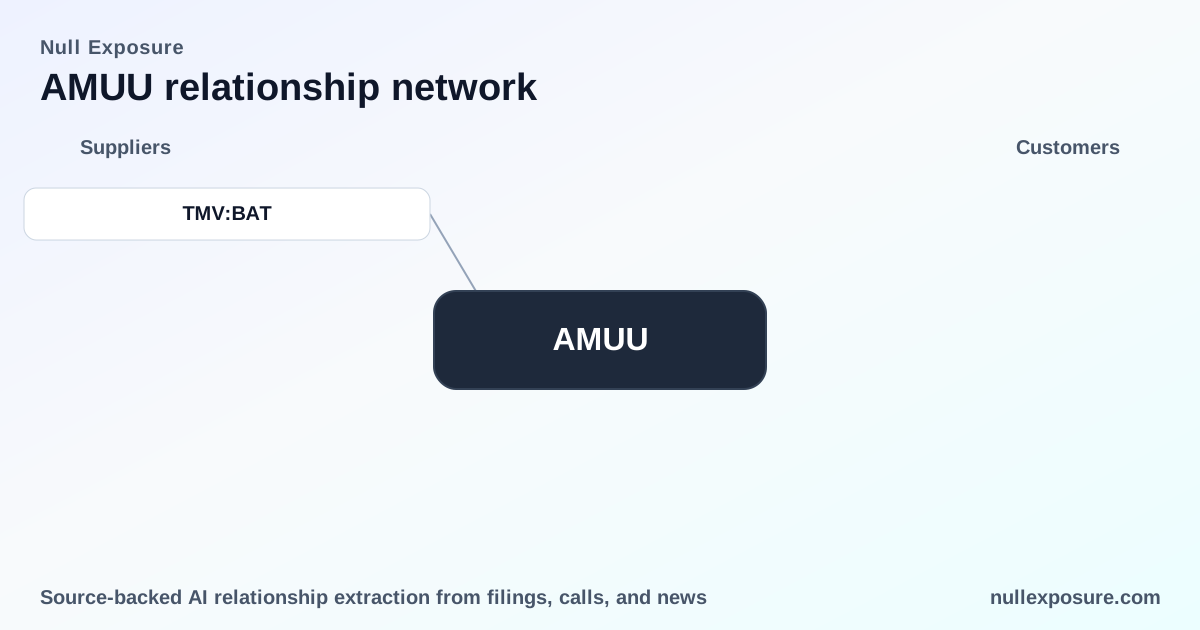
Direxion’s AMUU: How a single-stock 2x ETF changes the supplier map
AMUU is a product-led supplier relationship: a single-stock, daily‑reset, 2x leveraged ETF that directly monetizes through issuer economics—management fees, bid/offer spread capture via market‑making, securities lending and creation/redemption activity tied to Authorized Participants. For investors and counterparties the commercial picture is simple: exposure is concentrated, liquidity is provisioned by market intermediaries, and revenue flows scale with assets under management and trading volume. If you track issuer concentration and product lifecycle risk, AMUU is a high-leverage, single-name instrument that deserves active monitoring. Learn more at https://nullexposure.com/.
Why this matters to investors and counterparties
Direxion’s launch of an AMD‑focused 2x fund changes where liquidity, counterparty and operational risk sit in the prime brokerage and market‑making ecosystem. A product that targets 200% of a single equity’s daily return shifts day‑to‑day hedging onto dealers and APs, compressing intraday capital and margin demands for counterparties while amplifying tracking and rebalancing needs for the sponsor. For operators evaluating supplier relationships, the relevant questions are not theoretical: who provides hedge capacity, how deep is intraday liquidity in AMD, and how will sponsors handle large flows during volatile moves in the underlying?
A practical next step for modelers and compliance teams is to track trade volumes and AP concentration, and to stress test hedging costs under large directional moves in AMD. If you want structured monitoring of these relationships and market signals, visit https://nullexposure.com/ for an institutional view.
What the public coverage shows about the relationship
The coverage set for AMUU is concentrated on the fund sponsor, Direxion, and on product description and market positioning. Direxion is the issuer and sponsor of AMUU, and the product is described universally as a 2x daily AMD bull fund. Multiple market outlets carried the same launch narrative and product mechanics in early March 2026.
- Direxion is the issuer and sponsor of AMUU; a company announcement reported by Yahoo Finance describes the new funds—Direxion Daily AMD Bull 2X Shares (AMUU) and Direxion Daily AMD Bear 1X Shares (AMDD)—as vehicles for traders seeking leveraged daily exposure to AMD. (Yahoo Finance, March 2026) https://finance.yahoo.com/news/direxion-launches-2-leveraged-amd-003114053.html
- ETF Trends covered AMUU repeatedly in its leveraged/inverse channels, noting that AMUU is positioned for traders seeking 2x exposure to AMD and that the fund “looks to generate 200% of the daily performance” of AMD common stock. (ETF Trends, March 2026) https://www.etftrends.com/leveraged-inverse-channel/amds-star-continues-shine-semiconductor-peers/
- A commentary piece from Sahm Capital reiterated the same product mechanics and ticker identification for AMUU in late‑2025/early‑2026 coverage. (Sahm Capital) https://www.sahmcapital.com/news/content/advanced-micro-devices-latest-meltdown-heightens-speculative-fervor-for-direxions-amuu-amdd-etfs-2025-11-26
These sources together confirm sponsor identity, strategy (2x daily on AMD), and the market positioning toward traders seeking leveraged single‑name exposure.
Operational signals and business‑model constraints (company‑level)
With no direct constraints excerpts provided, present these as company‑level signals that shape supplier risk and partner expectations:
- Concentration risk: The product is single‑name (AMD), so sponsor economics and counterparty exposure are tightly correlated to one equity’s liquidity and volatility. This increases reputational and operational sensitivity at the company level.
- High rebalancing frequency: Daily leverage requires daily re‑hedging, which raises dealer and AP operational load and amplifies intraday financing needs for the sponsor’s market‑making counterparties.
- New product maturity: Coverage shows a recent launch cadence (early 2026 activity); newly launched funds typically have uncertain initial AUM and liquidity profiles, increasing short‑term execution and distribution risk.
- Market‑facing contracting posture: The issuer model relies on authorized participants and market makers rather than long‑term procurement contracts; counterparties are commercial and short‑lived, not captive suppliers.
- Criticality profile: For retail traders and speculators the product is attractive; for institutional balance‑sheet holders it is non‑core. Operational criticality is therefore concentrated for market‑makers and APs during stress events.
These are company‑level signals to guide counterparty diligence and operational readiness rather than relationship‑specific contractual clauses.
How that translates into risk and commercial priorities
For business teams and research desks, these operational signals convert to three clear priorities:
- Liquidity and hedging capacity: Confirm which dealers are providing delta and gamma hedges and stress test their capacity under two‑standard‑deviation AMD moves; hedging costs will materially affect net sponsor economics.
- Counterparty concentration: Track counterparty lists and AP concentration; a small set of market makers carrying most of the hedging load is an operational single point of failure.
- Distribution and flow volatility: Monitor order‑flow patterns post‑launch; rapid inflows or outflows create acute rebalancing demands that increase execution costs and potential tracking divergence.
If your team needs continuous monitoring or tailored counterparty analysis for leveraged single‑name funds, NullExposure can help surface the exact market signals and supplier relationships. Start here: https://nullexposure.com/.
Relationship-by-relationship evidence (exhaustive)
- Direxion — The sponsor and issuer of AMUU; public announcements and sector coverage state that AMUU is the Direxion Daily AMD Bull 2X Shares, designed to produce 200% of AMD’s daily performance, and was launched alongside a bear counterpart (AMDD). See the formal launch coverage in Yahoo Finance (March 2026) and multiple ETF Trends articles (March 2026) that describe product mechanics and market positioning. https://finance.yahoo.com/news/direxion-launches-2-leveraged-amd-003114053.html | https://www.etftrends.com/leveraged-inverse-channel/amds-star-continues-shine-semiconductor-peers/ | https://www.sahmcapital.com/news/content/advanced-micro-devices-latest-meltdown-heightens-speculative-fervor-for-direxions-amuu-amdd-etfs-2025-11-26
Final take: what operators should do next
AMUU is a focused, sponsor‑driven instrument that concentrates market and operational risk into short‑dated hedging cycles and into the dealer/AP network. For investors and operators evaluating supplier relationships, prioritize near‑term monitoring of AUM flows, counterparty lists and hedging counterparties, and embed AMD liquidity stress tests into your vendor assessment. For continuous tracking and relationship analytics that surface these exact operational stresses, visit NullExposure and begin a targeted review: https://nullexposure.com/.
Bold action and precise monitoring are required: single‑name, leveraged products amplify exposures rapidly and shift the burden onto counterparties who must prove day‑one capacity.