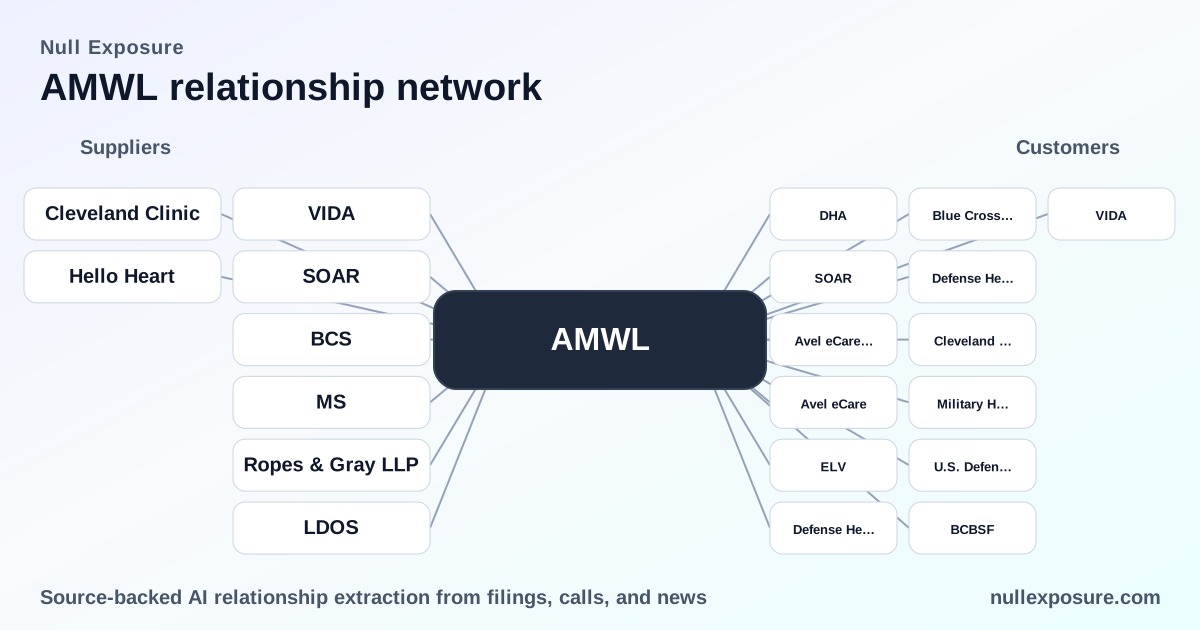
American Well (AMWL) supplier relationships: who powers its platform and what investors should know
American Well operates a telehealth platform that monetizes through platform licensing, professional services and transaction-based virtual care sold to payers, health systems and employers. Investors should evaluate revenue exposure to recurring platform contracts versus episodic care fees, the company’s reliance on third-party clinical and technology providers, and the resulting operational and cyber risk profile; the latest public financials show trailing twelve‑month revenue of $249.3M and an EBITDA loss of $60.1M, underscoring a capital-constrained growth posture. For a concise vendor exposure map and supplier intelligence, visit https://nullexposure.com/.
Why supplier relationships matter for Amwell’s business model
Amwell’s product is a multi-sided healthcare delivery platform: technology (SaaS) plus embedded clinical services. That business model creates two supplier dynamics investors must watch. First, technology and data handling are outsourced elements of the stack, so third-party developers and infrastructure providers are operationally critical. Second, clinical delivery is delivered through a chain of contracting relationships—Amwell sells to contracting entities that then source physicians—so care availability and compliance depend on partner networks, not Amwell alone. These characteristics drive concentration risk (a small number of large partners can move platform economics), legal and cyber risk (outsourced storage/transmission of sensitive data), and integration risk when Amwell adds capabilities through M&A or specialist vendors.
The company’s public disclosures also show it routinely uses external advisors and law firms for transactions and capital markets activity, signaling a mature but cost-intensive corporate operating posture that prioritizes strategic partnerships and outsourced execution. For investors tracking supplier exposure in detail, start with the supplier map below and then review contract renewals and security attestations. Learn more about supply exposure monitoring at https://nullexposure.com/.
Company-level operational constraints that affect supplier risk
- The company relies on third-party development services for application development and functionality delivery, creating dependence on external engineering capacity and SLAs.
- Amwell outsources important aspects of storage and transmission of client and member information, increasing cyber-security and vendor-management requirements and elevating remediation costs if incidents occur.
- The clinical supply chain is layered: Amwell contracts with PC entities that in turn contract physicians to provide virtual care, creating subcontracting complexity that affects quality control and contract enforceability.
These constraints are company-level signals about contracting posture (outsourced, partner-led), criticality (high—data and clinical delivery), and maturity (uses external advisors and counsel for transactions).
Detailed supplier relationships investors should track
Vida
Vida is cited as an integrated partner used to address inappropriate GLP‑1 utilization as a digital companion; this represents a clinical content and care-management integration that expands Amwell’s value proposition in chronic disease and medication stewardship, noted in the Q4 2025 earnings transcript published in March 2026. (Source: Q4 2025 earnings transcript / The Globe and Mail, March 2026)
SOAR
SOAR is referenced as a partner to manage musculoskeletal (MSK) costs, illustrating Amwell’s strategy of embedding specialized cost-management solutions into its care pathways to improve outcomes and lower claims for payers, per the company’s latest earnings remarks. (Source: Q4 2025 earnings transcript / The Globe and Mail, March 2026)
Barclays
Barclays served as Amwell’s exclusive financial advisor on prior acquisition transactions, underscoring the company’s use of major investment banks to execute M&A and strategic financing efforts—transactions reported in 2021 that shaped Amwell’s product mix. (Source: FierceHealthcare reporting on Amwell M&A, FY2021)
Ropes & Gray LLP
Ropes & Gray acted as legal counsel to Amwell on those same transactions, which signals institutional legal support for deal execution and regulatory compliance during strategic consolidation events. (Source: FierceHealthcare reporting on Amwell M&A, FY2021)
Morgan Stanley
SEC filing material filed in early March 2026 lists Morgan Stanley in administrative/transfer agent or filing contexts related to equity class identification, reflecting Morgan Stanley’s role in capital-markets activity associated with Amwell’s NYSE‑traded class A common stock. (Source: SEC filing reproduced on StockTitan, March 2026)
Leidos
Leidos is a delivery partner in a staged launch of a full solution across the Military Health System, indicating Amwell’s route to scale through large systems integrators and government health contracts that provide diversified revenue opportunities outside commercial payers. (Source: Finviz news roundup referencing FY2025 partnership activity)
Cleveland Clinic
Cleveland Clinic works with Amwell to provide specialty second opinions, illustrating how marquee clinical partners extend Amwell’s clinical credibility and enable higher-acuity digital services beyond general telemedicine. (Source: Finviz news roundup referencing FY2025 partnership activity)
Hello Heart
Hello Heart is integrated for cardiometabolic care, which shows Amwell’s approach of combining third‑party clinical programs to broaden chronic‑care offerings and deepen per‑member engagement. (Source: Finviz news roundup referencing FY2025 partnership activity)
What investors and operators should monitor next
- Contract concentration and renewal timing. Large payer or system partners can drive meaningful revenue swings; monitor renewal dates and margin terms.
- Third‑party security posture. Because Amwell outsources storage and transmission of patient data, investors must track vendor SOC reports, breach disclosures, and remediation costs.
- Clinical sourcing and quality controls. The subcontracting model (PC → physician) introduces regulatory and quality risk; watch operational KPIs like visit completion, escalation rates, and provider credentialing metrics.
- Transaction cadence and advisor use. Continued reliance on banks and law firms for M&A implies strategic expansion through deals; follow deal announcements and the integration roadmap.
- Financial discipline. With a modest market capitalization (~$93M) and ongoing losses, the company needs either margin improvement or financing to scale partnerships profitably.
Final takeaways for investors
American Well’s supplier network is deliberate: clinical specialists and third‑party digital programs expand clinical depth, while banks and law firms support dealmaking and capital activity. That model accelerates product breadth but creates outsized operational and cyber reliance on external vendors. Investors should focus on partner-level economics and contractual safeguards — renewal cadence, SLAs, security attestations and clinical quality metrics — because these determine whether platform revenue scales into profitability.
If you want a concise supplier exposure briefing and ongoing monitoring for American Well and its peers, start here: https://nullexposure.com/. For tailored reports or a supplier risk deep dive, visit https://nullexposure.com/ and request an engagement.