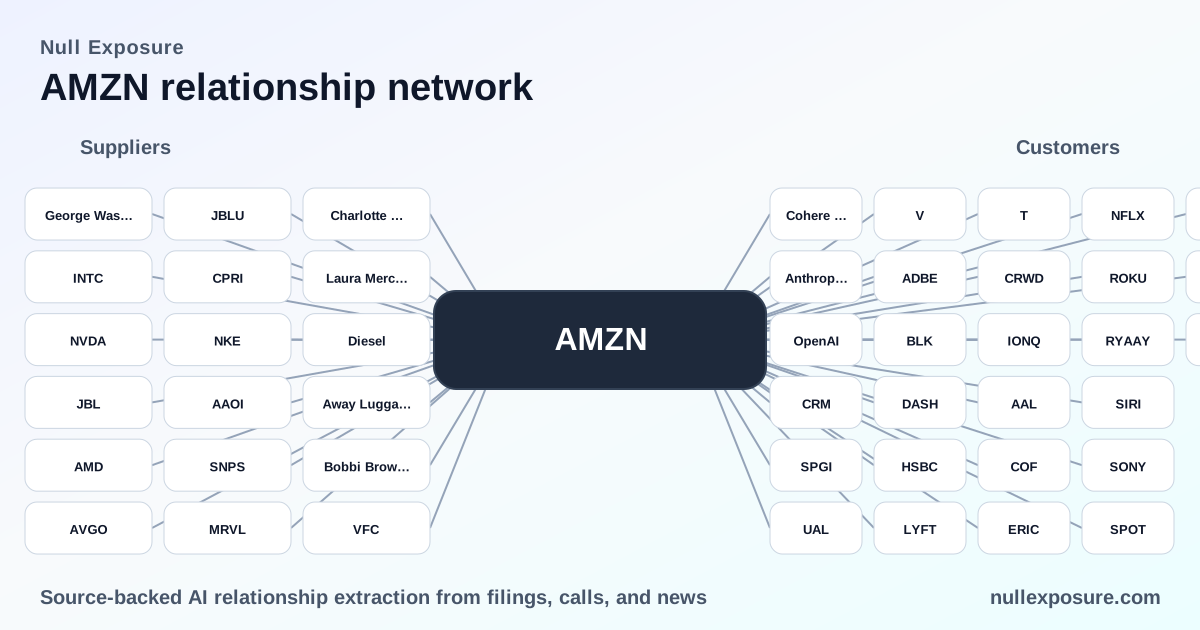
Amazon (AMZN) supplier relationships: what recent disclosures mean for investors
Amazon monetizes by operating a vast two-sided retail marketplace, a dominant cloud services platform (AWS), and high-margin advertising and subscription services; it drives growth by expanding third‑party selection, integrating branded supply, and vertically integrating hardware and infrastructure where scale demands. Recent disclosures show Amazon increasing marketplace assortments across beauty and fashion while simultaneously deepening strategic hardware and chip vendor relationships for AWS — a dual play that supports top‑line assortment growth and capital‑intensive cloud scaling. Learn more about supplier mapping and risk signals at https://nullexposure.com/.
Why those supplier mentions matter now
Amazon’s supplier signals in recent calls and news items tell two connected stories. On the retail side, management is prioritizing assortment expansion — adding hundreds of new beauty and fashion brands to capture higher-margin categories and reduce dependence on competing platforms. On the infrastructure side, Amazon continues to source critical compute and hardware from leading chip and contract manufacturing partners to fuel AWS’s AI and data center roadmap. These are complementary revenue drivers: assortment growth boosts marketplace monetization and advertising, while hardware and chip relationships support AWS scale and margin expansion.
The company’s public constraints also shape the operating model: Amazon generally keeps short-term commercial relationships with most vendors (no single vendor >10% of purchases in 2025), yet it signs very long-term energy contracts (weighted-average duration ~16 years) to secure infrastructure economics. Amazon is both a buyer at scale and a manufacturer/use-of-contract-manufacturers in hardware supply chains, which creates a hybrid procurement posture that reduces some supplier risk while concentrating criticality in advanced technology partners. Explore supplier overviews and research tools at https://nullexposure.com/.
Line-by-line: every relationship cited in the recent results
Charlotte Tilbury
Amazon announced expansion of beauty selection that includes Charlotte Tilbury as one of the new US brands added in 2025, reflecting a strategy to capture premium beauty customers via marketplace assortment. According to Amazon’s 2025Q4 earnings call, the company added more than 400 new beauty brands in the US, including Charlotte Tilbury.
Laura Mercier
Laura Mercier was likewise named among the 2025 beauty additions, underlining Amazon’s push into established prestige cosmetics to broaden category depth and advertising inventory. This was disclosed on Amazon’s 2025Q4 earnings call.
Bobbi Brown Cosmetics
Bobbi Brown Cosmetics is included in the same expansion of US beauty brands, indicating Amazon is courting legacy prestige labels to strengthen marketplace credibility in makeup and skincare. The mention comes from the 2025Q4 earnings call.
Diesel
Management listed Diesel as part of new fashion brand additions in 2025, a sign Amazon is expanding branded fashion assortments to compete on traffic and higher-margin categories. This detail was shared on the 2025Q4 earnings call.
Away Luggage
Away Luggage appears in management’s list of fashion entrants for 2025, which supports the thesis that Amazon is selectively onboarding travel and accessory brands to capture omnichannel spend. The source is the 2025Q4 earnings call.
Converse
Converse was called out as a new fashion brand addition in 2025, reinforcing Amazon’s strategy of adding recognizable footwear labels to bolster apparel and subcategory depth. This came from the 2025Q4 earnings call.
Michael Kors
Michael Kors featured among the fashion brands Amazon added, signaling continued traction with accessible luxury brands that drive higher average order values. The 2025Q4 earnings call included this mention.
Nike
Nike was named in the list of new fashion brand additions, highlighting Amazon’s ongoing efforts to host major sportswear brands and capture branded footwear and apparel demand. Amazon cited this on the 2025Q4 earnings call.
The North Face (VFC)
The North Face (inferred ticker VFC) was included among the new fashion partners, underscoring Amazon’s focus on outdoor and performance apparel as part of expanding fashion assortment. The reference appears in the 2025Q4 earnings call.
JetBlue (JBLU)
Amazon noted dozens of commercial agreements already signed, explicitly naming JetBlue as a partner for commercial services, reflecting B2B relationships outside of retail that leverage Amazon’s cloud and services capabilities. This was stated during the 2025Q4 earnings call.
NVIDIA (NVDA)
Management confirmed continued collaboration with NVIDIA as a chip partner for AWS infrastructure, reflecting ongoing dependence on advanced GPU suppliers for AI workloads. The comment comes from Amazon’s 2025Q3 earnings call.
Intel (INTC)
Intel was referenced alongside other chip partners as part of Amazon’s sourcing for compute, indicating Amazon’s multi‑vendor approach to diversify processor supply. The mention derives from the 2025Q3 earnings call.
AMD (AMD)
AMD was named together with Intel in discussions of chip partners, signaling Amazon’s use of multiple CPU/GPU suppliers to meet heterogeneous compute requirements. This appeared in the 2025Q3 earnings call.
Jabil Inc. (JBL)
A third‑party news profile positioned Jabil as a behind‑the‑scenes hardware manufacturer that serves large customers including Amazon, implying Amazon sources contract manufacturing for some hardware and device programs. This context comes from an ad‑hoc news piece discussing Jabil’s FY2026 positioning.
Applied Optoelectronics Inc. (AAOI)
A March 2026 StocksToTrade article attributed Applied Optoelectronics’ improvement to customer demand from Amazon, indicating Amazon’s pull through for optical and networking components in its infrastructure buildout. The reference is from a StocksToTrade news item in early March 2026.
Synopsys (SNPS)
A FinancialContent piece noted hyperscale companies like Amazon require advanced Synopsys tools to design custom AI silicon, highlighting Amazon’s in‑house chip design activity and vendor reliance on EDA suppliers. This was reported in a March 2026 industry article.
Marvell Technology (MRVL)
SiliconANGLE reported that Marvell’s revenue strength reflected custom AI processor work for enterprise customers such as Amazon Web Services, showing Amazon’s role as an end customer for specialized silicon. This appeared in a March 2026 SiliconANGLE story.
Broadcom (AVGO)
A March 2026 finviz market note tied Amazon’s large AI-related capital plans to demand for chipmakers like Broadcom, illustrating market recognition that Amazon’s capex drives vendor revenue. The mention is from a finviz.com news summary.
George Washington University
A MarketBeat filing flagged Amazon Data Services’ $427 million acquisition of George Washington University’s Virginia campus as a sign of AWS capacity expansion through real estate and infra investment, supporting longer‑term capacity plans. This was covered in a MarketBeat alert in 2026.
What this cluster of relationships signals for investors
- Category expansion + monetization: Adding hundreds of beauty and fashion brands increases addressable ad inventory and third‑party take rates, which supports higher-margin revenue streams.
- Infrastructure concentration: AWS relies on a set of advanced chip, EDA, optical, and contract manufacturing partners to scale AI capacity; these relationships are critical for performance and timing.
- Hybrid contracting posture: Company disclosures show generally short commercial vendor terms across merchandise supply, but explicit long‑dated energy contracts and strategic infrastructure investments signal selective long-term commitments where economics or availability is strategic.
- Supplier concentration tradeoff: While no single vendor accounted for 10% of purchases in 2025 (a fragmentation signal), Amazon also recognizes material suppliers and occasional single-source dependencies for content, licensing, and specific technology components.
Bottom line and next steps
Amazon’s disclosures demonstrate a deliberate two-track supplier strategy — aggressive marketplace assortment expansion to grow higher-margin retail and advertising revenue, and deep, strategic procurement of chips, optics, manufacturing, and real estate to scale AWS. For investors, the key questions are execution on premium category merchandising, timing of AWS capacity build, and whether supplier bottlenecks for advanced silicon or contract manufacturing create short-term supply constraints.
For a deeper read on supplier exposure and operational risk, visit https://nullexposure.com/. If you want a tailored supplier risk brief or portfolio impact memo, start your research at https://nullexposure.com/ and request a custom report.