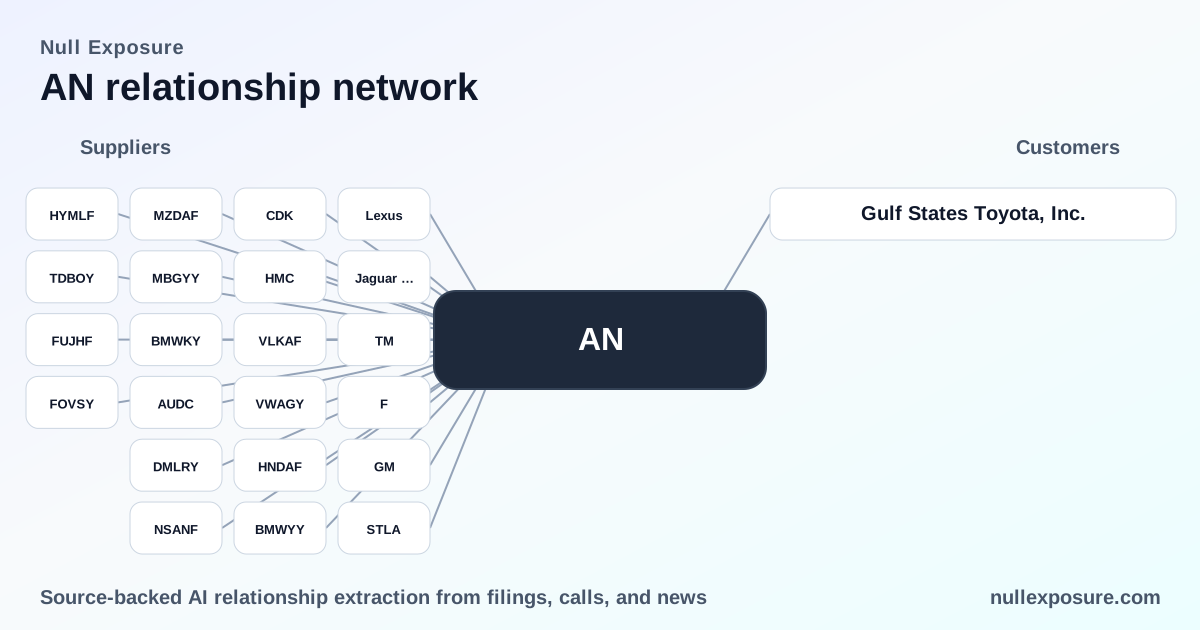
AutoNation (AN) — supplier relationships and what they mean for investors
AutoNation operates the largest franchised automotive retail platform in the United States, buying new vehicles from global manufacturers and selling them through a national network of retail franchises and service centers. The company monetizes through vehicle retail margins, parts and service revenues, and financing-related activities, while leveraging scale to secure favorable purchase terms and captive finance arrangements. AutoNation's supplier model is vertically focused on franchise relationships with major OEMs and distributors, and those ties are central to revenue throughput and working capital dynamics. For a broader vendor-risk view and supplier mapping, visit https://nullexposure.com/.
How to read AutoNation's supplier map as an investor
AutoNation sources roughly 89% of its new vehicle inventory from a consistent set of manufacturers; that concentration defines both its competitive moat and its principal vendor risk. The company operates under framework agreements with major vehicle manufacturers and distributors, purchases substantially all new vehicles through those channels at prevailing franchise prices, and carries significant receivables tied to manufacturer/distributor interactions (reported receivables of $230.6m at year-end 2025). Those facts translate into a highly operationally critical and material supplier base, exposed to manufacturer credit stress and pricing power. For an interactive supplier dashboard, see https://nullexposure.com/.
What the filing and recent coverage reveal about the operating model
AutoNation’s public filings and recent earnings commentary consistently describe a contract posture built on long-term framework agreements rather than short ad-hoc purchases. This contracting approach creates predictable supply flows but concentrates economic dependence on a finite set of OEMs. Key operating-model signals for investors:
- Contracting posture: Framework-level agreements with most major manufacturers and distributors, giving AutoNation stable access but limited supplier diversification in practice.
- Concentration and materiality: The company flags concentration risk explicitly—manufacturer distress would be materially adverse to the business.
- Role and criticality: AutoNation functions both as a distributor and as a retailer in the franchise system; manufacturers are the critical upstream partners.
- Scale and spend intensity: Receivables from manufacturers/distributors exceed $200m, indicating 100m+ spend band relationships and meaningful working-capital exposure.
These characteristics suggest a mature supplier ecosystem where negotiation leverage and credit relationships influence margin volatility and balance-sheet funding.
Relationship roll call — every supplier referenced in the source material
Below are the suppliers and OEM relationships mentioned across AutoNation’s filings, Q reports and earnings call coverage. Each entry is a plain-English note with a concise source reference.
Toyota (including Lexus)
AutoNation lists Toyota (and Lexus) among the core brands that collectively represent a majority of new-vehicle sales, reflecting substantial inventory sourcing from Toyota’s network. According to AutoNation’s 2025 Form 10‑K and related SEC commentary, Toyota/Lexus are integral to the Import and Premium Luxury segments (FY2025–FY2026 reporting).
Source: AutoNation 2025 Form 10‑K and related SEC Q reports summarized by TradingView and the company’s FY2026 segment descriptions (filed Feb–Mar 2026).
Lexus
Lexus is included as part of AutoNation’s Premium Luxury segment, which AutoNation uses to organize high-margin retail franchises. TradingView’s reporting of AutoNation’s 10‑K highlights Lexus as a core premium brand (reported Mar 2026).
Source: TradingView summary of AutoNation SEC 10‑K (Mar 9, 2026).
Ford
Ford is a core Domestic-brand supplier for AutoNation and shows up in store expansion commentary; AutoNation reports Ford among the brands representing the bulk of new-vehicle sales. TradingView and the company’s Q‑reporting list Ford as a principal domestic partner (FY2025–FY2026).
Source: AutoNation 10‑Q and TradingView coverage of that filing (reported Mar 2026).
General Motors
GM is cited alongside other major domestic OEMs as a primary source of new vehicles sold by AutoNation, forming part of the company’s Domestic segment and contributing to the reported 89% core-brand concentration.
Source: AutoNation 2025 Form 10‑K and TradingView Q‑report coverage (Feb–Mar 2026).
Stellantis
Stellantis supplies multiple makes that AutoNation sells under its Domestic segment; the company enumerates Stellantis in both 10‑K and earnings previews as a principal manufacturer partner.
Source: AutoNation 2025 Form 10‑K (filed Feb 2026) and related news coverage (Mar 2026).
BMW
BMW is part of the Premium Luxury lineup and is explicitly called out in AutoNation’s segment descriptions as a core manufacturer for new-vehicle retail.
Source: TradingView coverage of AutoNation’s SEC disclosures and the 2025 10‑K (Feb–Mar 2026).
Mercedes‑Benz (Mercedes)
Mercedes‑Benz is grouped in the Premium Luxury segment and cited in growth and expansion narratives, including new store rollouts.
Source: AutoNation SEC 10‑K summaries published by TradingView and earnings transcript coverage (Mar 2026).
Audi
Audi is categorized under AutoNation’s Premium Luxury segment and listed among the manufacturers represented in the company’s retail footprint.
Source: TradingView and Intellectia coverage of AutoNation’s FY2026 segment disclosures (Mar 2026).
Jaguar Land Rover
Jaguar Land Rover appears as a Premium Luxury brand that AutoNation retails through franchised locations and is mentioned in SEC filing summaries of segment composition.
Source: TradingView’s summary of the AutoNation 10‑K and Intellectia’s earnings preview (Mar 2026).
Volkswagen (including Audi and Porsche)
Volkswagen and its group brands are part of the 89% core-brand concentration that supplies AutoNation’s new-vehicle inventory. The Form 10‑K lists Volkswagen among the manufacturers that constitute the bulk of new-vehicle purchases.
Source: AutoNation 2025 Form 10‑K (filed Feb 14, 2026).
Honda
Honda is listed among the core import brands and figures in AutoNation’s Import segment representation, supplying a meaningful share of new vehicles sold.
Source: AutoNation 2025 Form 10‑K and TradingView summaries (Feb–Mar 2026).
Hyundai
Hyundai is included in AutoNation’s Import segment listings and cited in FY2026 reporting as a supplier brand for franchised retail.
Source: TradingView and Intellectia coverage of the company’s segment disclosures (Mar 2026).
Nissan
Nissan is named in AutoNation’s Import segment description and identified as one of the manufacturers that comprise the company’s import-brand sourcing base.
Source: Intellectia’s earnings preview summarizing the AutoNation segment definitions (Mar 2026).
Subaru
Subaru is part of the Import-brand mix called out in AutoNation’s segment descriptions and appears across company filings and news coverage.
Source: TradingView and Intellectia summaries of FY2026 segment commentary (Mar 2026).
Mazda
Mazda is mentioned in the company’s expansion notes (new stores) and appears as a retail brand in AutoNation’s market-growth disclosures.
Source: Earnings call transcript coverage and InsiderMonkey transcript notes referencing 2025 store openings (reported Mar 2026).
CDK
CDK surfaces in the earnings commentary as the counterparty in a 2024 business-interruption insurance recovery; AutoNation adjusted EPS to exclude CDK-related recoveries ($40m pretax Q2, $80m full year). That item affects reported adjusted profitability but not core OEM sourcing.
Source: AutoNation Q4 2025 earnings call transcript summarized by InsiderMonkey (Mar 2026).
Key investment takeaways and risk framing
- Supplier concentration is structural. Roughly 89% of new-vehicle sourcing is clustered among a defined set of OEMs, which creates both negotiating scale and systemic counterparty risk.
- Contracts are framework-level and institutional. Framework agreements with major manufacturers provide operational continuity but limit diversification of supplier risk.
- Working-capital sensitivity is real. Large receivables from manufacturers/distributors indicate material short-term balance-sheet exposure and potential earnings sensitivity to manufacturer payment terms or distress.
- Operational execution drives margin capture. Store rollouts (e.g., Ford/Mazda, Audi/Mercedes, Toyota) and service/parts penetration determine how well vehicle volume converts into sustainable margins.
If you want a vendor-risk heatmap built from filings and call transcripts, start here: https://nullexposure.com/.
What investors should do next
AutoNation’s positioning is defensible on scale but exposed to OEM credit and pricing cycles; investors should monitor manufacturer credit health, receivables trends, and the cadence of framework renewals. For ongoing supplier monitoring and detailed relationship analytics, explore the platform at https://nullexposure.com/.
Bold, documented supplier concentration and framework contracting make AutoNation a textbook case where operational scale is advantage and vendor concentration is the principal downside to manage.