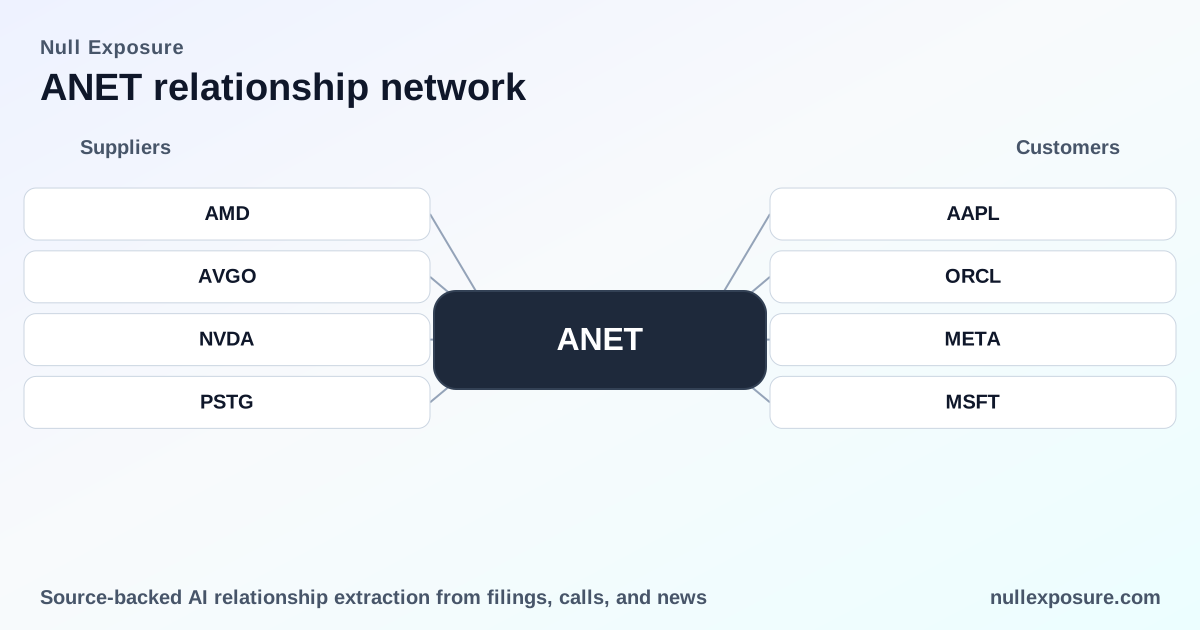
Arista Networks (ANET): Supplier relationships, operational constraints, and what investors should price in
Arista Networks designs and sells high-performance switches and software for cloud, datacenter and HPC customers, monetizing through hardware sales, recurring software subscriptions and support contracts that capture both product and lifecycle margins. Revenue depends on volume hardware cycles plus a growing, higher-margin software and services attach rate, and the supplier base — contract manufacturers, merchant silicon vendors and systems partners — directly shapes product availability, cost structure and time-to-market.
Explore supplier intelligence and counterparty risk for your portfolio at https://nullexposure.com/.
Why suppliers are a strategic lever for Arista, not a peripheral cost
Arista outsources the bulk of its assembly to third-party contract manufacturers while retaining design and system software control. That operating posture produces two financially important signals: first, Arista carries significant non-cancellable purchase commitments that lock in future cost exposure; second, the company accepts a hybrid procurement model where some inputs are secured long-term and others are purchased on a spot or order-by-order basis.
According to Arista's public disclosures referencing December 31, 2024, the company reported $3.1 billion of non‑cancellable purchase commitments, with $2.8 billion due within 12 months and $0.3 billion beyond 12 months, underscoring the scale and near-term concentration of committed spend. The company also states that its contract manufacturers “typically fulfill our supply requirements on the basis of individual orders” and that it does not have long-term guarantees with many third‑party manufacturers, signaling mixed contracting terms across the supply base.
Operationally, Arista’s products are manufactured primarily in Malaysia, Vietnam and Mexico, and it also procures some products directly from China, while leasing offices and data centers across North America, Europe, Asia and Australia—a footprint that exposes the company to APAC production risk, regional logistics, and cross-border policy effects. These elements translate to material and partially critical supplier relationships that are central to gross margin stability and delivery lead times.
Explore partner-level exposure and counterparty detail at https://nullexposure.com/.
What the 2025 Q4 earnings call reveals about key partners
Arista’s latest public commentary during the 2025 Q4 earnings call names a small set of ecosystem partners repeatedly; these mentions are strategic signposts for product positioning in the AI and hyperscale market.
AMD (AMD)
Arista listed AMD among “leading companies that create the modern AI stack,” positioning AMD as part of the technology ecosystem Arista targets and integrates with for AI-optimized deployments. According to Arista’s 2025 Q4 earnings call (filed March 2026), AMD is cited alongside other AI-stack players, indicating partnership relevance to Arista’s target customer and solution set.
Broadcom (AVGO)
Broadcom was named in the same list of AI-stack contributors, placing the company within Arista’s supplier and partner landscape that underpins modern datacenter architectures. The 2025 Q4 earnings call explicitly mentions Broadcom in this context, signaling interoperability or component-level engagement.
NVIDIA (NVDA)
Arista stated explicitly that it “interoperates with NVIDIA, the recognized worldwide market leader in GPUs,” which confirms direct technology-level interaction with NVIDIA hardware and the importance of GPU-driven workloads to Arista’s product positioning. This comment comes from the 2025 Q4 earnings call and highlights NVIDIA’s role in Arista’s target AI and cloud use cases.
Pure Storage (PSTG)
Pure Storage was also enumerated among leading companies in the AI stack during the 2025 Q4 earnings call, indicating a strategic alignment with storage vendors that form the complementary layer to Arista’s switching and networking offerings.
Each of these company mentions comes from Arista’s 2025 Q4 earnings call (March 2026), and collectively they show Arista positioning its products around the AI hyperscaler ecosystem rather than relying solely on traditional networking incumbents.
Operating constraints, counterparty signal and what they mean for risk
The publicly disclosed constraints present a clear operating profile:
- Contracting posture: Arista operates with a mix of long-term non‑cancellable purchase commitments and spot-based contract manufacturing orders, which creates predictable committed spend on the one hand and pricing and capacity exposure on the other. (Disclosure: $3.1 billion of non-cancellable purchase commitments as of December 31, 2024.)
- Geographic concentration: Manufacturing is primarily in Malaysia, Vietnam and Mexico, with procurement from China also noted; leases and operations span NA, EMEA and APAC, indicating global operational reach and corresponding geopolitical and supply-chain risks.
- Materiality and criticality: The non-cancellable commitments and the statement that a significant portion of cost of revenue is paid to contract manufacturers mark supplier relations as material to Arista’s P&L; vendor-supplied merchant silicon and certain sole-source components are explicitly called out as critical inputs.
- Relationship role and maturity: Arista subcontracts manufacturing to third parties and outsources logistics and some cloud services, implying matured supplier relationships but also operational dependence on external providers’ cybersecurity and performance.
- Spend scale: The company-level signal is large-scale spend; the reported purchase commitments place supplier engagement firmly in the >$100m band.
These constraints collectively mean investors should price in near-term fixed obligations to suppliers, execution risk from component concentration, and ongoing margin sensitivity to semiconductor pricing and logistics costs.
Investment implications and monitoring checklist
Arista enjoys strong operating margins and high return on equity (Operating margin TTM ~41.5%, ROE ~31.4%) and trades with premium multiples, reflecting growth expectations from AI and cloud networking. The company’s supplier signals put a few concrete items on any investor or operator watchlist:
- Monitor changes to non‑cancellable commitments and the split between committed and spot purchases, since committed spend locks exposure to component price moves.
- Track supplier concentration on merchant silicon and any movement toward or away from sole‑source relationships, because those are critical single points of failure.
- Watch geopolitical developments in APAC and Mexico that could affect factory output and freight, as a majority of manufacturing sits in those regions.
- Observe partnership statements with NVIDIA, AMD and Broadcom for evidence of joint go-to-market or co-engineering, which would strengthen Arista’s competitive moat in AI networking.
For detailed partner-level analytics, see https://nullexposure.com/.
Bottom line
Arista’s supplier posture is strategic and material: the company combines significant committed purchasing with flexible contract-manufacturer execution, a global manufacturing footprint concentrated in APAC and Mexico, and explicit interoperability with leading AI-stack vendors such as NVIDIA, AMD, Broadcom and Pure Storage. For investors, the tradeoff is clear — exposure to supply-chain and component concentration risk is balanced by the structural growth opportunity of AI-driven datacenter networking. Active monitoring of purchase commitments, sole-source components, and partner integrations will be the decisive signals for both downside protection and upside capture.
If you want a deeper supplier-risk briefing or bespoke counterparty analysis for portfolio decisions, start here: https://nullexposure.com/.