ANGI as a Supplier Partner: where the value flows and where the risks live
Angi Inc. operates a consumer-facing marketplace that connects homeowners to independent service professionals and monetizes through pre-priced Services bookings, Ads & Leads, and related platform fees. Revenue is driven both by direct consumer transactions and by selling lead distribution and advertising to pros; costs are materially influenced by payments to third‑party professionals and infrastructure/hosting expenses, which compress gross margins. For investors evaluating ANGI as a supplier relationship, the critical questions are contract durability, infrastructure concentration, and how strategic partnerships (like Alexa integration) translate into measurable demand.
Learn more about supplier risk and exposure at https://nullexposure.com/.
How ANGI makes money and how suppliers fit into that model
Angi’s operating model is a classic two‑sided marketplace: consumers buy or request services through the platform and the company engages independent professionals to fulfill those services, while also monetizing attention via ads and lead sales. Company disclosures identify Services revenue as primarily domestic and pre‑priced, and show that the company pays independent third‑party professionals for work performed under service arrangements—an explicit cost line that affects net revenue. According to recent audit language, ANGI recognizes both its role as platform and the operational reality of paying third‑party providers, which influences reporting and margins.
Company filings also disclose a critical services agreement with IAC that governs a suite of corporate services (legal, finance, risk management, investor relations, IT/infosecurity, and others) through September 29, 2025 with automatic one‑year renewals, a contractual posture that establishes dependence on a related-party service provider for core corporate functions. The company’s infrastructure costs have increased materially: filings note a rise in hosting fees (about $6.2 million tied to a migration of data to a third‑party computing platform) which increased Ads & Leads cost of revenue and highlights concentration and vendor dependency in hosting. These facts drive three operating constraints investors should treat as structural: contractual dependency on an incumbent services provider (IAC), infrastructure concentration in third‑party hosting, and a margin profile sensitive to payments to independent professionals.
The supplier relationships to track right now
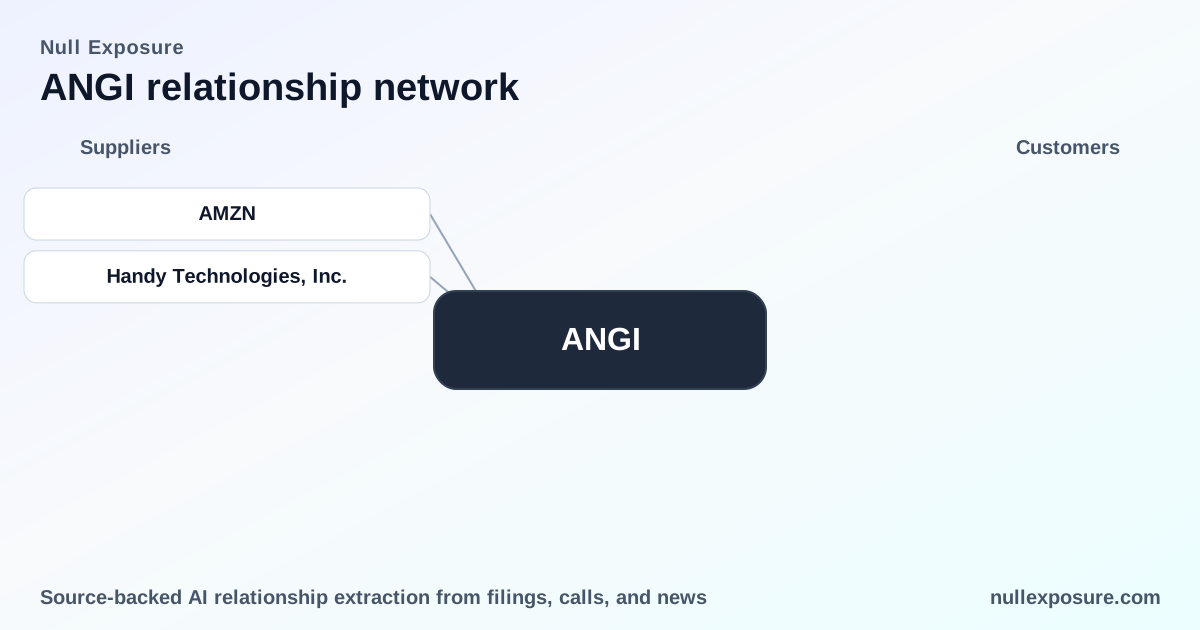
Amazon — a headline partner with voice integration
ANGI announced a commercial deal tied to Amazon Alexa on its Q4 2025 earnings call, signaling a strategic distribution and discovery channel for home services through voice platforms. According to ANGI’s Q4 2025 earnings call (filed March 2026), management stated: “We’ve announced a deal with Amazon's Alexa,” which creates a new consumer touchpoint for service requests. (Source: ANGI Q4 2025 earnings call, March 2026)
Handy Technologies — breadth of on‑demand labor capacity
ANGI Homeservices acquired Handy in 2018 to incorporate Handy’s nationwide gig worker network of service professionals, intended to fill unfulfilled consumer demand and expand product breadth and reach. The acquisition was publicly announced in a GlobeNewswire release on October 11, 2018 describing Handy’s role in expanding the company’s ability to meet consumer demand via gig professionals. (Source: GlobeNewswire press release, October 11, 2018)
Both relationships are strategic in different ways: Amazon for distribution and discovery, Handy for supply-side capacity and rapid fulfillment.
(If you are benchmarking supplier concentration and contractual terms for investment due diligence, see more detailed supplier exposure tools at https://nullexposure.com/.)
What the constraint signals tell investors about operating risk
ANGI’s public disclosures surface constraints that are material to valuation and operational resilience:
-
Contracting posture and criticality. The company disclosed a services agreement with IAC that provides a broad slate of corporate services through September 29, 2025 with automatic one‑year renewals; this is a critical, active, and contractually mature relationship that supports core functions (legal, audit, treasury, etc.). (Source: company filing/service agreement disclosure.)
-
Service‑provider role is central. Multiple disclosures classify third parties as service providers and make clear that ANGI’s revenue model is tied to payments to independent professionals; the reporting change around net revenue recognition for pre‑2023 service arrangements underscores that payments to pros directly affect top‑line presentation and margins. (Source: ANGI financial disclosures/audit commentary, Dec 31, 2024 reporting.)
-
Infrastructure concentration drives cost volatility. Management cited a $6.2 million increase in hosting fees attributable in part to migrating data to a third‑party computing platform, a concrete example of how outsourcing infrastructure creates variable cost pressure in Ads & Leads cost of revenue. That migration is an operational lever that both raises near‑term cost and signals continuing vendor concentration risk. (Source: company quarterly disclosure on hosting fees and platform migration.)
These constraints collectively indicate high operational leverage: small shifts in lead volumes, hosting fees, or professional payout rates will have outsized impact on gross margins and free cash flow.
Investment implications and action points
-
Monitor partner economics, not just logos. The Amazon Alexa tie is strategically valuable for customer acquisition, but investors must see evidence of conversion uplift and unit economics improvement before repricing upside. (Source: Q4 2025 earnings call.)
-
Assess host/vendor concentration and renewal terms. The IAC services agreement provides core corporate services and is contractually binding through 2025 with renewals; its criticality creates single‑counterparty risk that should be modeled into downside scenarios. (Source: company services agreement disclosure.)
-
Watch revenue recognition and margins net of pro payouts. Changes to net revenue reporting and the explicit linkage of payments to independent pros mean headline revenue growth can mask unit economics deterioration; prioritize metrics that reflect net revenue per fulfilled job and gross margin after pro payouts. (Source: company audit and revenue disclosure language.)
For a systematic supplier exposure view designed for investors and operators, visit https://nullexposure.com/ for tools and reports.
Final takeaways and what to watch next
ANGI is a marketplace whose valuation depends on the durability of its supply network, the effectiveness of new distribution channels (Alexa), and control over infrastructure costs. The company’s contractual relationship with IAC is a critical governance and operational dependency; hosting migrations and payments to independent professionals are immediate levers that have moved costs already. Investors should track cadence of Alexa‑driven demand, integration outcomes from Handy, the IAC agreement renewal posture as 2025 approaches, and quarterly changes in hosting and cost of revenue lines. For practical supplier risk scoring and scenario analysis for ANGI, see the supplier intelligence suite at https://nullexposure.com/.