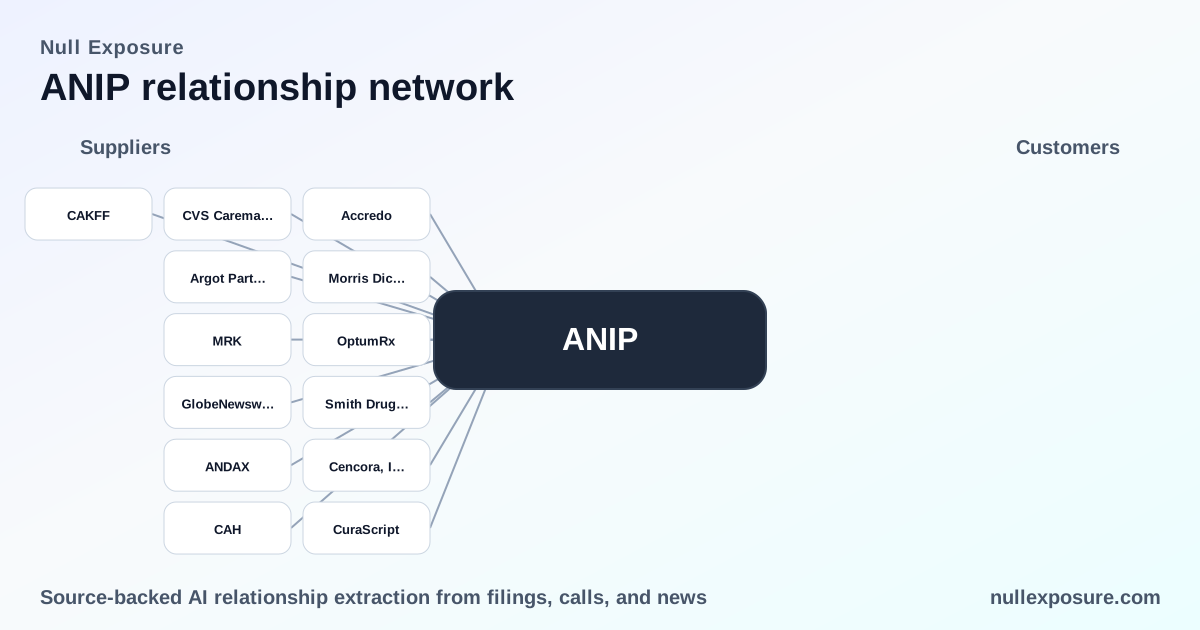
ANIP supplier relationships: distribution partners, IR agencies, and royalty counterparties
ANI Pharmaceuticals operates as a specialty pharmaceutical company that monetizes through product sales distributed via major wholesalers and specialty pharmacies, licensing and royalty arrangements (notably with Merck on Cortrophin Gel), and outsourced manufacturing relationships. Revenue comes from finished-product commercialization and blended royalty streams while cost and supply risk are concentrated in third‑party manufacturers and a small set of distribution channels. For a deeper look at counterparties and how they affect operational resilience, visit https://nullexposure.com/.
Why the supplier map matters to investors
ANI’s commercial model is built on three pillars: acquiring product rights, outsourcing manufacturing, and scaling sales through national wholesalers and specialty pharmacies. That creates a highly levered operating profile where upstream supply continuity and downstream distribution access directly drive revenue stability and margin realization. The company’s disclosures show reliance on a handful of channel partners and third‑party manufacturers, a mix of long‑term and short‑term contractual commitments, and sourcing that spans domestic and international vendors — all factors that should be considered when modeling downside scenarios or forecasting organic growth.
- Concentration risk: ANI conducts business with the three major U.S. wholesalers and several national specialty pharmacies, which concentrates go‑to‑market exposure.
- Supply dependency: The company confirms dependencies on third‑party manufacturers and single qualified API sources, elevating delivery and price risk.
- Revenue composition: Sales are a combination of direct product revenue and royalties (the Merck royalty on Cortrophin Gel is an explicit example of recurring royalty economics declared by management).
Explore supplier analytics and counterparty intelligence at https://nullexposure.com/ to integrate these inputs into your operating model.
Relationship-by-relationship read (what investors need to know)
Accredo
ANI discloses a contract relationship with Accredo as one of several specialty pharmacies used to distribute products in the United States. This relationship is listed in ANI’s FY2024 Form 10‑K as part of the company’s national specialty pharmacy network.
Source: ANIP FY2024 Form 10‑K (distributor/specialty pharmacy list).
Morris Dickson
Morris Dickson is named alongside other major distributors/specialty pharmacies in ANI’s distribution agreements, indicating a channel role for hospital and institutional pharmacy fulfillment.
Source: ANIP FY2024 Form 10‑K (distribution channels).
OptumRx
OptumRx is included in ANI’s roster of specialty pharmacies and pharmacy benefit manager partners used to reach payors and patients, per the FY2024 disclosures.
Source: ANIP FY2024 Form 10‑K (distribution channels).
Smith Drug Company
Smith Drug Company appears in the FY2024 10‑K as a contracted specialty distribution partner, reflecting ANI’s reliance on established pharmacy wholesalers for market access.
Source: ANIP FY2024 Form 10‑K (distribution channels).
Cencora, Inc.
ANI states that it “conduct[s] business with the three major wholesalers” in the U.S., explicitly naming Cencora, Inc. as one of those wholesalers — placing Cencora in the core national distribution tier for ANI products.
Source: ANIP FY2024 Form 10‑K (wholesaler relationships).
CuraScript
CuraScript is listed among ANI’s contracted specialty pharmacies, reinforcing the company’s multi‑channel distribution approach to reach specialty prescribers and patients.
Source: ANIP FY2024 Form 10‑K (distribution channels).
CVS Caremark
ANI lists CVS Caremark among its contracted specialty pharmacies and PBM channels, highlighting access to one of the largest retail and managed‑care distribution networks.
Source: ANIP FY2024 Form 10‑K (distribution channels).
Argot Partners
Argot Partners is repeatedly referenced in ANI press releases and investor communications in FY2025–FY2026 as the company’s investor‑relations and media contact, indicating Argot handles external financial communications and conference representation.
Source: Company press releases and investor notices distributed via GlobeNewswire and other outlets (FY2025–FY2026).
Merck (MRK)
Management commentary and earnings materials in FY2026 indicate a royalty relationship with Merck tied to Cortrophin Gel; ANI reported surpassing the highest royalty tier in 2025 and expects a blended royalty rate in the high‑20% range for 2026.
Source: FY2026 earnings call transcript and related press reporting (company call transcript and 8‑K/press coverage).
GlobeNewswire
GlobeNewswire is used by ANI to distribute press releases; one aggregated news feed cited a GlobeNewswire release and included a platform disclaimer referenced in FY2026 press coverage.
Source: News distribution via GlobeNewswire as captured in FY2026 media reports.
Anda (ANDAX)
Anda is specifically named in the FY2024 10‑K among ANI’s contracted specialty pharmacies/distributors, showing it is part of the company’s U.S. specialty distribution footprint.
Source: ANIP FY2024 Form 10‑K (distribution channels).
Cardinal Health (CAH)
Cardinal Health is identified as one of the three major U.S. wholesalers with which ANI conducts business, placing Cardinal in the company’s primary wholesale distribution layer.
Source: ANIP FY2024 Form 10‑K (wholesaler relationships).
McKesson (CAKFF)
McKesson completes the trio of major wholesalers cited by ANI in FY2024, underscoring the company’s dependence on a small set of national distributors for scale distribution.
Source: ANIP FY2024 Form 10‑K (wholesaler relationships).
Constraints and company‑level signals investors should factor
ANI’s filings and public communications collectively present a portrait of operating constraints that shape supply reliability and margin dynamics:
- Contracting posture: The record includes both long‑term supply agreements (evidence of multi‑year supplier commitments) and short‑term contracts with initial two‑year terms for other products, signaling a mix of commitment lengths across the portfolio.
- Geography and sourcing: Raw materials and APIs are sourced both domestically and internationally, while manufacturing operations are concentrated in U.S. sites; this creates exposure to global supply chains but local production concentration.
- Materiality and concentration: Filings explicitly warn that supply interruptions at manufacturing facilities could have a material adverse effect on the business, indicating supplier and site concentration are financially significant.
- Role reliance: ANI depends heavily on third‑party contract manufacturers for finished goods and API supply, and generally qualifies a single API source per product, increasing switching costs and validation timelines.
- Lifecycle signals: The company documents both active supplier relationships and winding‑down arrangements (e.g., non‑renewal notices reported in 2025), which affect near‑term availability and transition risk.
- Spend and capital signals: Financing disclosures show use of convertible notes and large cash flows applied to repay credit facilities and related instruments, signaling meaningful capital deployment in the $10m–$100m and $100m+ bands.
Treat these as company‑level signals to model as constraints on throughput, margin volatility, and downside recovery time.
Bottom line: what investors should do next
ANI’s commercial reach through major wholesalers and specialty pharmacies is a core strength for revenue scale, but concentration in distribution and dependency on third‑party manufacturing are the dominant operational risks. Integrate the distribution counterparties and the royalty profile with supplier continuity scenarios when stress‑testing forecasts. For ongoing counterparty monitoring and supplier impact analysis, see detailed tools and reports at https://nullexposure.com/.
If you want a tailored counterparty risk summary or a scenario model incorporating ANI’s supplier constraints, start your analysis at https://nullexposure.com/ and convert disclosures into actionable exposure metrics.