Alto Neuroscience (ANRO): supplier relationships, licensing posture, and what investors should price in
Alto Neuroscience operates as a clinical-stage biopharmaceutical company that builds value by in‑licensing and acquiring therapeutic assets and intellectual property, developing them through early clinical programs, and de‑risking candidates toward partnerships or commercialization events. The company currently monetizes via intellectual‑property transactions and will ultimately rely on milestone payments, royalties, and product sales once any candidate reaches approval; today it carries no recurring product revenue and funds operations through capital markets while investing in targeted R&D and third‑party manufacturing. For a focused supplier‑risk read, investors should evaluate Alto’s licensing concentration, reliance on CMOs, and the geographic sourcing of APIs. Learn more about supplier exposures at https://nullexposure.com/.
How Alto’s operating model shapes supplier risk
Alto’s 10‑K and recent filings paint a consistent operating model: licensing-first, asset‑acquisition driven, and outsourced manufacturing and clinical execution. The company does not own manufacturing capacity and contracts most development work to external providers, which creates a low fixed‑cost footprint but raises execution and supply continuity risks.
Key operational signals:
- Contracting posture: Alto uses largely short‑term and notice‑terminable agreements for CROs, clinical sites, and CMOs, and typically orders raw materials on a purchase‑order/spot basis rather than standing capacity contracts. This gives flexibility but reduces supply guarantees.
- Licensing intensity: Multiple exclusive, royalty‑bearing licenses underpin Alto’s pipeline—this is the company’s core method of accessing molecules and platform technology.
- Manufacturing concentration and geography: The company relies on a small number of third‑party manufacturers and uses Chinese suppliers for APIs and drug product for some candidates.
- Materiality profile: Filings simultaneously characterize most vendor obligations as immaterial on a contract‑by‑contract basis, while warning that the loss of a key manufacturer would materially affect the business—a classic early‑stage biotech risk tension.
- Spend profile: R&D line items in the filing (e.g., program expense line items such as ALTO‑100 and ALTO‑300) show program‑level external spend in discrete trenches rather than across broad internal manufacturing investments.
These traits imply a capital‑efficient development model with high dependency on third parties for execution and IP rights, making partnership diligence and supply‑chain continuity essential for investors. If you want a quick supplier risk scorecard, start here: https://nullexposure.com/.
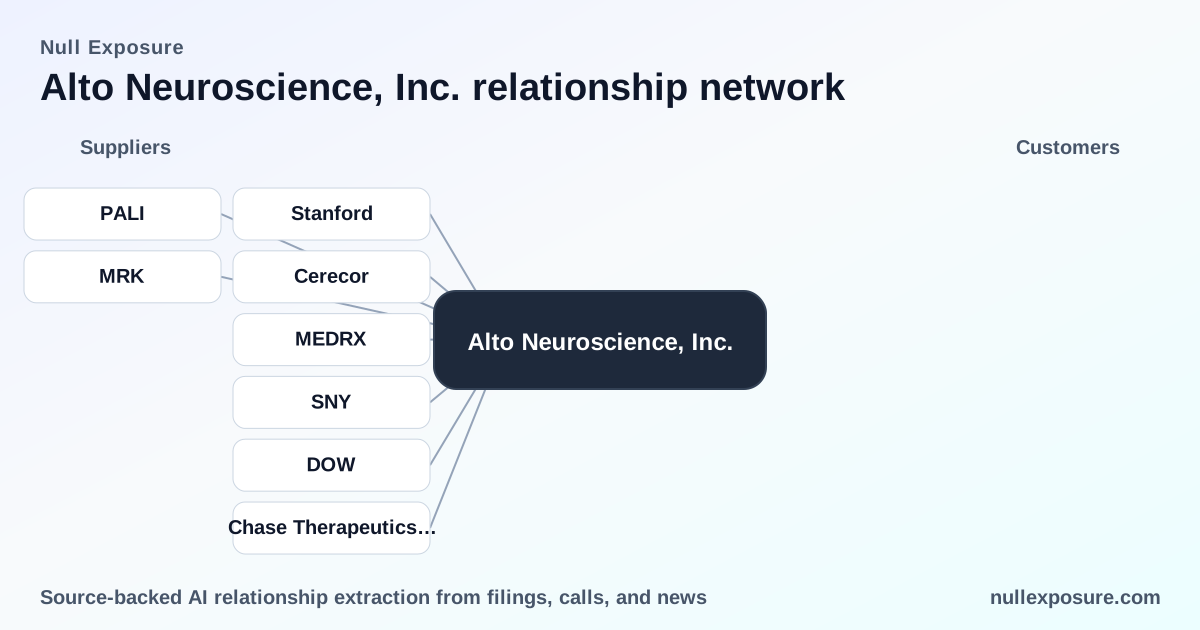
The complete list of supplier and partner relationships you need on your radar
Below I summarize every relationship cited in the sourced results and point to the originating disclosure or news item.
Stanford — university IP license (FY2024 10‑K)
Alto has an exclusive license from Stanford covering five issued U.S. patents and one pending U.S. patent directed to machine‑learning techniques for identifying treatable patient populations, which supports Alto’s precision psychiatry approach; this is disclosed in the company’s FY2024 Form 10‑K. (Source: Alto FY2024 10‑K)
Cerecor — patent/license for ALTO‑202 (FY2024 10‑K)
Alto in‑licensed one issued U.S. patent from Cerecor (owned by Merck and licensed to Cerecor) with claims directed to the composition of matter for the ALTO‑202 compound, reflecting a common in‑licensing route for lead molecules. (Source: Alto FY2024 10‑K)
MedRx / MEDRx — patent licenses and development collaboration (FY2024 10‑K)
The 10‑K states Alto exclusively in‑licensed one U.S. patent, one granted European patent, and two foreign patents in Japan and China from MedRx, underlining multi‑jurisdictional IP coverage for certain candidates. (Source: Alto FY2024 10‑K)
Sanofi — exclusive license for ALTO‑101 (FY2024 10‑K)
Alto obtained an exclusive, worldwide, royalty‑bearing license from Sanofi for a PDE4 inhibitor now known as ALTO‑101, including multiple foreign patents (Germany, France, U.K.), positioning Sanofi as a strategic IP source for Alto’s transdermal program. (Source: Alto FY2024 10‑K)
Dow — patent for intermediate manufacturing chemistry (FY2024 10‑K)
Alto in‑licensed a patent from Dow directed to certain intermediate compounds useful in manufacturing ALTO‑100, indicating reliance on third‑party chemical IP for process and scale‑up. (Source: Alto FY2024 10‑K)
Chase Therapeutics Corporation — asset purchase (Business Wire / Yahoo Finance, June 3, 2025)
Alto acquired a portfolio of dopamine agonist combinations, including ALTO‑207 (formerly CTC‑501), via an asset purchase agreement with Chase Therapeutics, extending Alto’s TRD (treatment‑resistant depression) pipeline through an outright asset acquisition. (Source: Business Wire press release via Yahoo Finance, June 3, 2025)
MEDRx — transdermal delivery collaboration (BioSpace press release, March 2026)
Alto’s ALTO‑101 uses a proprietary transdermal delivery system developed in collaboration with MEDRx, according to a Biospace press release announcing completion of a Phase 2 cohort; this ties device and formulation know‑how to third‑party capabilities. (Source: BioSpace press release, March 2026)
Palisade Bio — asset acquisition (MedCityNews, October 2024)
Alto’s ALTO‑100 was acquired from Palisade Bio under an asset transfer; the October 2024 coverage notes the ALTO‑100 Phase 2b trial referenced the molecule Alto obtained from Palisade. (Source: MedCityNews, October 2024)
Merck — underlying patent owner for ALTO‑202 (FY2024 10‑K)
The filing notes that the patent in‑licensed via Cerecor for ALTO‑202 is owned by Merck and licensed to Cerecor, establishing Merck as an indirect IP stakeholder in ALTO‑202’s chain of title. (Source: Alto FY2024 10‑K)
What investors should infer from these relationships
Alto’s supplier and partner map is dominated by licenses and small asset purchases rather than heavy vertical integration. That structure creates several investment‑relevant dynamics:
- Value drivers are IP and clinical proof‑points, not manufacturing scale. Alto extracts upside from selective in‑licensing and de‑risking through early trials; successful trials or partnerships will drive the primary valuation inflection points.
- Execution risk is concentrated on a small set of third‑party manufacturers and CROs. Although contracts are often short‑term and labelled immaterial contractually, the company explicitly warns that losing a manufacturer would be materially adverse—this is the principal operational vulnerability.
- Geographic sourcing is non‑trivial. API and drug product manufacturing in China for ALTO‑101 and ALTO‑203 introduces geopolitical and quality‑control vectors investors must monitor, particularly for regulatory filings and commercialization planning.
- Spend is program‑level and lumpy. The filing breaks out direct external program expenses (line items such as ALTO‑100, ALTO‑300, ALTO‑203, ALTO‑101), indicating capital deployment is concentrated around discrete candidate milestones.
Bottom line and next actions for investors
Alto’s model delivers capital efficiency and optionality through licensing and targeted acquisitions, but the company’s upside is tightly coupled to clinical success and the continuity of third‑party manufacturing partners. Monitor three things closely: trial readouts, license milestone schedules, and any vendor notices or CMO changes that could affect supply continuity.
If you want an actionable supplier risk brief or to benchmark Alto’s partner concentration versus peers, start at https://nullexposure.com/ for tailored reports. For ongoing monitoring of Alto’s supply and licensing posture, subscribe or request a bespoke supplier diligence package at https://nullexposure.com/.
Key takeaway: Alto is a licensing‑centric, outsourced developer—value is in IP and trial outcomes, while supply‑chain and single‑source manufacturer risks are the principal operational hazards investors must underwrite.