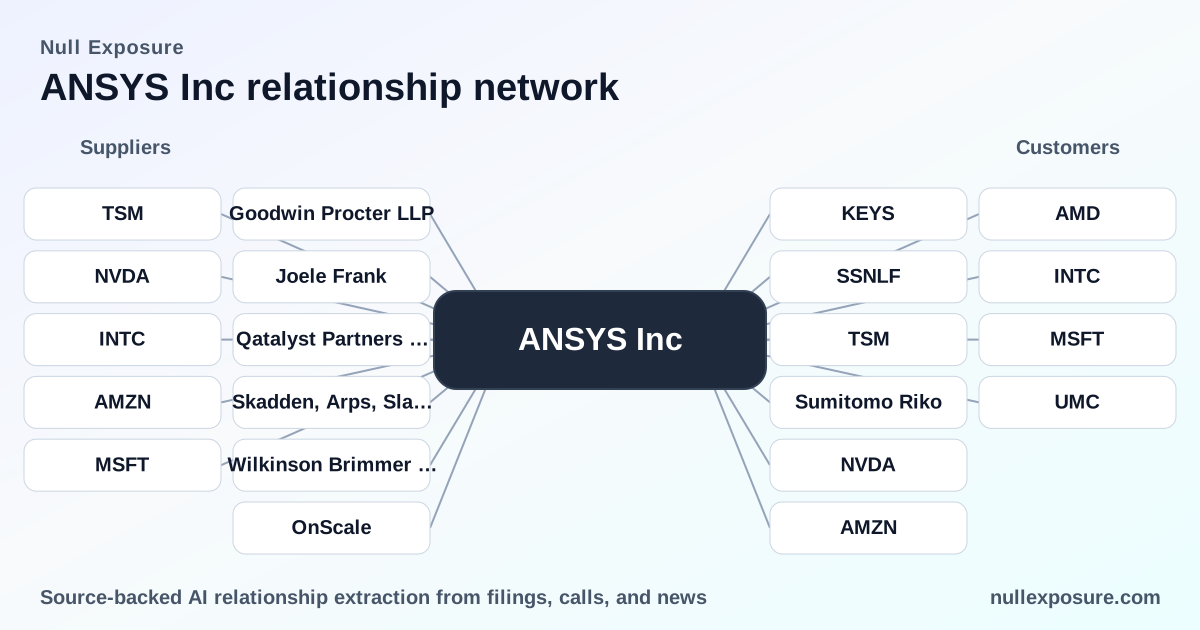
ANSYS Inc (ANSS) — Supplier relationships that shape a simulation leader
Ansys is a high-margin enterprise software firm that sells multiphysics engineering simulation platforms to product designers, manufacturers and semiconductor customers. The company monetizes through a mix of perpetual and subscription licensing, enterprise maintenance, and cloud-delivered simulation services, and generates significant recurring revenue—reflected in $2.58B trailing revenue and a roughly $33B market capitalization. Recent strategic transactions and partnerships have reshaped its supplier and advisor network into a combination of legal and financial advisers, cloud providers, and technology integrators that directly support product delivery and distribution.
Explore how these relationships affect risk and commercial optionality at https://nullexposure.com/.
Why supplier relationships matter for investors
Ansys’ supplier map is not a roster of commodity vendors; it is a set of relationships that influence go-to-market, cloud delivery, M&A execution and strategic interoperability with semiconductor foundries and GPU/cloud platforms. Advisors determine deal execution and regulatory readiness; cloud partners control the scalability of on-demand simulation; and technology partners determine the platform’s ability to stay embedded in customer workflows.
Below I walk through each named relationship found in public filings and press coverage, with a concise take on why it matters for investors and operators.
Who’s on the list — advisors, partners and customers
Legal and financial advisers used in major corporate activity
- Goodwin Procter LLP — Listed as a legal advisor tied to the Synopsys acquisition announcement; their involvement signals professional legal resources supporting transaction execution. According to Synopsys’ acquisition announcement (2026), Goodwin Procter served as a legal advisor to Ansys.
- Skadden, Arps, Slate, Meagher & Flom LLP — Also named as a legal advisor on the same Synopsys announcement, indicating top-tier transactional counsel was retained for the deal. See the Synopsys press release (2026).
- Qatalyst Partners LP — Identified as Ansys’ financial advisor in the Synopsys announcement; Qatalyst’s engagement signals a high-touch sell-side process for valuation and deal structuring. See the Synopsys press release (2026).
- Joele Frank — Named as an external communications/IR advisor (for Ansys) in the Synopsys release, showing a structured investor and media relations strategy during the transaction period. See the Synopsys press release (2026).
- Wilkinson Brimmer Katcher — Listed alongside Joele Frank for media relations in the Synopsys announcement, reinforcing the company’s engagement of specialist PR firms during high-profile corporate events. See the Synopsys press release (2026).
Each advisor citation comes from the Synopsys investor announcement covering the acquisition of Ansys (publicized in early 2026).
Cloud and technology partners that affect product delivery
- OnScale — Acquired technology from OnScale to augment Ansys’ cloud portfolio, adding a cloud-native, web-based interface and simulation framework; this improves Ansys’ scalable, browser-based delivery. PR Newswire covered the OnScale deal and its role in expanding Ansys’ cloud offerings in 2022.
- AWS (Amazon Web Services) — Ansys Gateway is powered by AWS marketplace infrastructure, which gives customers scalable access to Ansys simulation through AWS channels; PR Newswire described Ansys’ marketplace offering and its relationship to AWS (2022).
- Azure (Microsoft) — Ansys Cloud runs on Azure as a managed cloud offering, indicating a multi-cloud delivery posture that supports enterprise customers who standardize on Microsoft’s cloud (PR Newswire, 2022).
- Nvidia Corp. (NVDA) — Ansys entered a licensing and distribution agreement to embed Nvidia’s Omniverse technology into its simulation products, which increases graphical and collaborative capabilities for users; this partnership was reported in FY2025 press coverage. See market reports discussing the Ansys–Nvidia integration (FY2025).
These partnerships are operational levers that determine scalability, performance and the user experience of Ansys’ cloud and on-premise simulation products.
Strategic customers and ecosystem exposure
- Taiwan Semiconductor Manufacturing Company (TSMC) — Coverage of the Synopsys/Ansys combination emphasizes the importance of serving foundries like TSMC; the combined entity’s success will be measured by its ability to help foundries achieve high-yield mass production (financial markets reporting, FY2026).
- Intel (INTC) — Financial commentary around the Synopsys acquisition frames Intel alongside TSMC as a critical customer for semiconductor-focused simulation solutions, underscoring exposure to leading-edge node adoption cycles (financial markets reporting, FY2026).
The market commentary (FY2026) that discusses TSMC and Intel characterizes Ansys’ software as strategically critical to semiconductor customers’ ramp cycles and yield engineering.
What these relationships imply about Ansys’ operating model
- Contracting posture: Engagements with top-tier legal and financial advisers during the Synopsys transaction indicate a corporate posture accustomed to high-stakes, negotiated outcomes and sophisticated contract terms. This is consistent with Ansys’ scale and institutional investor base.
- Concentration: Institutional ownership is high (about 95% reported), and the company’s revenue base is concentrated around enterprise accounts in aerospace, automotive and semiconductors; that concentration amplifies the importance of strategic partners who support those verticals.
- Criticality: Partnerships with TSMC, Intel and Nvidia reflect a product that is mission-critical for engineering and manufacturing workflows—simulation is embedded into customers’ design-to-production pipelines.
- Maturity: Ansys’ dual approach—maintained on-premise licensing plus cloud marketplace and managed cloud offerings on AWS and Azure—signals a mature commercial model transitioning further into cloud delivery while retaining legacy enterprise revenue streams.
These are company-level signals derived from public financials and relationship disclosures; they shape vendor risk, procurement negotiation leverage and integration complexity.
If you want a deeper, transaction-level view of Ansys’ supplier exposures and contract implications, start an analysis at https://nullexposure.com/.
Investment implications and next steps
- Operational leverage from cloud partnerships accelerates recurring, usage-based revenue but creates dependency on third-party cloud infrastructure and GPU/visualization partners for performance-sensitive workflows.
- M&A and advisor-driven activity signals strategic repositioning that can unlock value but also introduces integration and execution risk; legal and financial advisers on the record are consistent with a controlled, professional sell-side process.
- Customer concentration in semiconductor and industrial verticals enhances margin potential during capital-cycle upturns but amplifies cyclical exposure.
For analysts and procurement officers, the most actionable step is to monitor contract terms with cloud providers and the commercial scope of the Nvidia licensing/distribution arrangement; these are the levers that determine both margin expansion and operational risk going forward.
Further supplier intelligence and curated relationship maps are available at https://nullexposure.com/.
Conclusion — what investors should watch next
Ansys operates as a highly profitable, enterprise-focused software supplier with a cloud-forward distribution strategy and deep ties to semiconductor customers. The company’s supplier and adviser footprint confirms a business positioned for scale but sensitive to execution on cloud integration and M&A. Monitor ongoing disclosures about the Synopsys transaction, cloud contract renewals with AWS/Azure, and the operational integration of technology from OnScale and Nvidia as the next indicators of durable value creation.