ANTE as a Supplier: Hosting relationships, concentration risks, and what investors need to know
ANTE operates as a Bitcoin mining operator that acquires mining hardware and outsources physical hosting and operations to third‑party data center operators. The company monetizes by producing mined Bitcoin and by structuring hosting arrangements (fixed hosting fees, revenue share, or managed‑service contracts) that enable scale without owning large real estate or utility contracts. For investors, the operational leverage sits in hashing capacity deployed off‑balance‑sheet at host sites; counterparty stability and contract terms therefore drive execution risk more than raw hardware inventory.
Explore full supplier mapping at NullExposure: https://nullexposure.com/
Why a single hosting tie matters for a miner’s risk profile
A Bitcoin miner’s economics are straightforward—revenue equals Bitcoin produced times realized price, less power, hosting and maintenance costs—but the delivery model varies. ANTE’s decision to rely on third‑party data centers means counterparty operational continuity and contract enforceability are first‑order risk factors. When a supplier relationship concentrates a material share of deployed hashing, a host‑level outage, regulatory action, or price repricing can rapidly change unit economics.
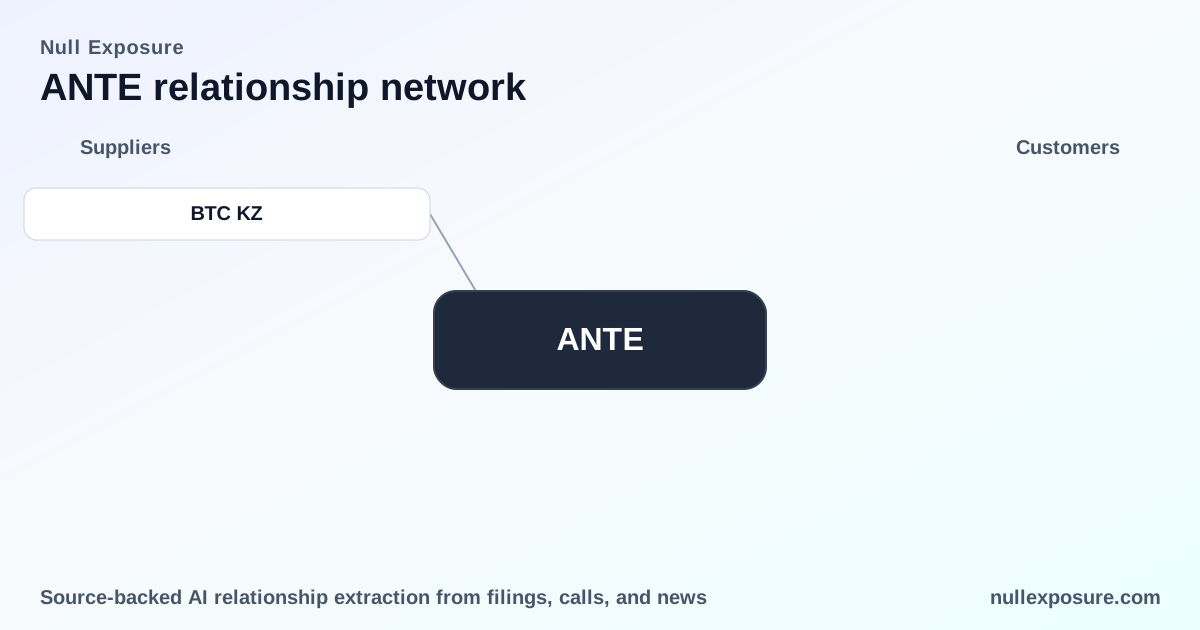
This supplier profile shows exactly that pattern: public reporting ties ANTE to a data‑center host in Kazakhstan, which introduces geographic and single‑site concentration issues that investors must quantify against the company’s broader deployment plan and hedging. Learn more about supplier-level signals at NullExposure: https://nullexposure.com/
Counterparty snapshot: BTC KZ — what the public record shows
- BTC KZ: ANTE entered an agreement to host mining servers at BTC KZ’s Almaty data center; the public reporting indicates ANTE had acquired mining hardware by May 2024 and arranged hosting at this facility. This places physical operations in Kazakhstan and ties a portion of ANTE’s hashing to BTC KZ’s site and operational continuity. A DatacenterDynamics article first reported the hosting arrangement, referencing the May 2024 equipment acquisition and was first seen in NullExposure records on March 9, 2026 (DatacenterDynamics, article on Airnet and Kazakhstan data center, referenced May 2024 / first seen Mar 9, 2026). Source: https://www.datacenterdynamics.com/en/news/airnet-announces-130mw-kazakhstan-data-center-for-bitcoin-mining-re-entry/
Reading the relationship: what investors should annotate on the model
-
Concentration risk is visible and material. With the only public supplier tie pointing to BTC KZ’s Almaty facility, a nontrivial portion of deployed hashing could be exposed to a single operator and jurisdiction. That exposure amplifies operational and regulatory risk, and it should be stressed in sensitivity analysis rather than treated as a marginal counterparty.
-
Operational criticality is high. Hosting is not a peripheral procurement; it is the core infrastructure that converts capital (hardware) into revenue (mined Bitcoin). A host outage, power curtailment, or contract renegotiation directly reduces production, making counterparty performance a revenue driver.
-
Contracting posture is likely private and bilateral. There are no public constraints or detailed filings describing standardized third‑party agreements in the record. The absence of publicly filed contract excerpts signals that ANTE’s deals are negotiated privately, which is common in mining but increases negotiation opacity for outside investors.
-
Geographic and regulatory concentration elevates event risk. Kazakhstan has been a frequent locus of policy shifts affecting mining and power access; placing capacity there requires explicit scenario planning for regulatory actions, grid constraints, or cross‑border payments friction.
These are company‑level signals based on the available supplier reporting, not isolated contractual excerpts.
Operational constraints and what’s missing from the public record
The supplier constraints dataset returned no explicit contract clauses or unique limitations for ANTE—no published force‑majeure, exclusivity, or minimum‑term excerpts were retrieved. The absence of disclosed constraints is itself a signal: contracts are likely private, not subject to routine SEC‑style disclosure, and therefore require active diligence to uncover counterparty termination rights, power pass‑throughs, and indemnities that can materially affect net margins.
Investors should demand or validate:
- Minimum term and termination triggers for hosted racks.
- Power provisioning guarantees and penalty regimes for outages.
- Billing mechanics (fixed hosting vs. revenue share; passthrough of energy price shocks).
- Cross‑border currency, tax, and repatriation mechanics for Kazakhstan operations.
How to prioritize further diligence
- Obtain copies of hosting agreements or at minimum contract summaries that disclose termination rights and energy pass‑throughs; these clauses determine cash‑flow volatility.
- Map deployed hashing to hosts and jurisdictions to quantify concentration at the site and country level.
- Stress test production under forced curtailment or price shocks in Kazakhstan; run scenarios whether ANTE can rapidly redeploy hardware and at what cost.
- Interview the host operator (BTC KZ) or review public filings from counterparties where available to validate uptime, power contracts, and co‑tenant exposure.
Continue supplier due diligence at NullExposure for structured supplier visibility: https://nullexposure.com/
Bottom line: placement of mining rigs is the business, and counterparties are the leverage
ANTE’s public supplier footprint, as recorded, ties hardware ownership to third‑party hosting via BTC KZ’s Almaty data center. That relationship transforms counterparty credit and operational execution into the company’s primary exposure, not hardware ownership alone. For investors, the analytic priority is to move beyond headline deployment statistics and to stress the counterparty agreements that control uptime, power costs, and redeployment flexibility.
If you are evaluating ANTE as an investment or an operator partner, the decisive questions are contractual enforceability, geographic concentration, and contingency plans for host disruptions—answers to which will materially change valuation and risk appetite. Explore supplier intelligence and comparative benchmarks at NullExposure: https://nullexposure.com/
Acknowledgment of sources: the BTC KZ hosting arrangement is reported in a DatacenterDynamics article referencing equipment acquisition by May 2024 and was captured in NullExposure records on March 9, 2026 (DatacenterDynamics, May 2024 / first seen Mar 9, 2026). Source: https://www.datacenterdynamics.com/en/news/airnet-announces-130mw-kazakhstan-data-center-for-bitcoin-mining-re-entry/