Annovis Bio (ANVS): Supplier Relationships and Operational Constraints Investors Should Track
Annovis Bio operates as a clinical-stage drug developer focused on neurodegenerative disorders; the company outsources manufacturing and trial execution to third parties and currently monetizes through equity financing and the prospective value of its pipeline (not product revenue). Management funds development via registered offerings and distribution agreements while advancing buntanetap through late-stage trials — the commercial model will only monetize if regulatory approval and successful manufacturing scale are achieved.
Explore the supplier relationships and operational signals that drive ANVS’s risk/reward profile on NullExposure: https://nullexposure.com/
How suppliers are woven into Annovis’s business model
Annovis is structurally a research-driven biotechnology company that does not own manufacturing capacity. As a result, third-party contract manufacturing organizations (CMOs) and contract research organizations (CROs) are core to execution — they supply cGMP active pharmaceutical ingredient (API), produce drug product and run clinical operations. This is not an incidental outsourcing strategy; it defines the company’s contracting posture, regulatory exposure, and capital needs.
Key operating-model characteristics:
- Contracting posture: a mix of long-term engagements for key CMOs and short-term or limited agreements for other suppliers; the company documents both approaches in its filings.
- Concentration and geography: manufacturing is concentrated with a primary U.S. API supplier and a backup API manufacturer with primary operations in China; clinical trials cover North America and Europe.
- Criticality and materiality: third-party suppliers are critical to both trial continuity and any future commercialization; supplier failures would materially harm Annovis’s prospects.
- Maturity and stage: a clinical-stage supplier footprint — active engagement with CMOs/CROs for trials rather than commercial-scale manufacturing today.
These company-level signals are drawn from recent corporate disclosures and form the backdrop for evaluating counterparty risk and financing strategy.
Supplier and partner mentions in the public record
The collected news and filings reference a small set of counterparties and distribution channels; each is summarized below with the source context investors will use for verification.
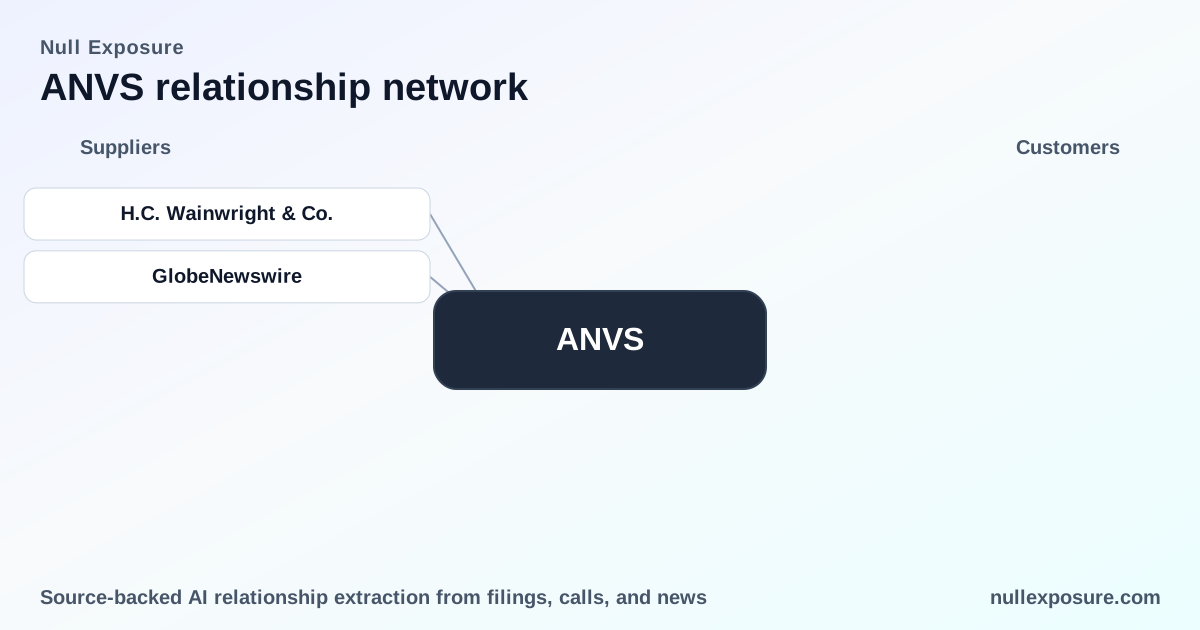
H.C. Wainwright & Co.
- H.C. Wainwright acted as the exclusive placement agent for a $6.0 million registered direct offering that Annovis closed to advance its development programs, signaling ongoing reliance on investment-banking-led equity raises to fund operations. This is described in the company’s press release distributed in mid‑October 2025 and covered by market outlets. (See GlobeNewswire press release, October 15, 2025; CityBuzz coverage October 16, 2025; StockTitan summary March 9, 2026.)
GlobeNewswire (press distribution of company announcements)
- Annovis used GlobeNewswire to distribute multiple corporate announcements — including a DSMB positive safety recommendation for buntanetap in a Phase 3 Alzheimer’s trial and the launch of a long-term open‑label study for buntanetap in Parkinson’s disease slated to begin January 2026 — which were republished by market aggregators in March 2026. These press distributions relay regulatory and trial-readout milestones that materially affect the company’s development timeline. (See GlobeNewswire distribution as republished by QuiverQuant/market outlets, March 2026; related GlobeNewswire release, October 2025.)
Why these relationships matter to investors
The two relationship types above — capital markets intermediaries and press/distribution channels — are operationally different but jointly informative for investors:
- The use of placement agents like H.C. Wainwright is a practical signal of continuing equity funding needs and an execution path for raising working capital without a committed corporate partner or product revenue. The $6 million registered direct offering is concrete evidence of that path.
- The reliance on press distribution via GlobeNewswire is standard for small-cap biotech, but the content distributed matters: DSMB and open-label study announcements change the risk timeline for trial success and hence cash-burn and funding cadence.
Operational constraints that shape counterparty risk
Company disclosures provide explicit constraints that investors must weigh as part of supplier diligence. Presenting these as company-level signals:
- Long-term vs short-term contracting: Annovis documents both long-term relationships with CMOs for cGMP supply and limited, non‑committed supply agreements for other materials, indicating a hybrid contracting strategy that blends secured capacity with flexible, shorter-term arrangements.
- Geographic exposure: The company operates manufacturing relationships in North America (primary API supplier) and maintains a backup manufacturer with primary operations in China, while trials run across NA and EMEA; this multi‑region footprint introduces regulatory and logistical complexity.
- Critical dependency: Management explicitly states third‑party manufacturing and CRO services are critical to clinical programs and potential commercialization; supplier performance is therefore a principal business risk.
- Active stage relationship profile: Most supplier relationships are active and geared to support ongoing clinical trials rather than winding down to commercialization in the near term.
These constraints translate into three investor imperatives: verify contract terms and exclusivity, confirm quality and regulatory history of the named manufacturers, and align runway expectations with likely financing cadence.
Diligence checklist for operators and investors
Use this short checklist to prioritize supplier due diligence and scenario planning:
- Confirm whether cGMP suppliers have multi‑year capacity commitments or are on short-term purchase orders.
- Validate the regulatory inspection history and product release performance of the U.S. API supplier and the China backup.
- Assess the timing and implications of DSMB recommendations and open‑label study starts on near-term enrollment, cash burn and milestone inflection points.
- Model financing outcomes assuming recurring equity placements (placement agent activity) and the Oppenheimer distribution avenue cited in filings.
Explore a mapped view of these supplier signals and related documents on NullExposure: https://nullexposure.com/
Bottom line — what a supplier lens reveals about ANVS
Annovis is a small-cap, clinical-stage biotech whose operating model depends on externally provided manufacturing and clinical services and whose funding profile relies on placement agents and distribution agreements. The primary investment risks are supplier execution and financing cadence: successful trial conduct and scale-up hinge on third-party CMOs/CROs, and ongoing development requires recurring capital raises. Investors evaluating ANVS should prioritize contract terms, supplier quality records, and the timing of clinical readouts announced through the company’s press channels.
For a deeper supplier analysis and record-level sourcing for Annovis, visit NullExposure: https://nullexposure.com/