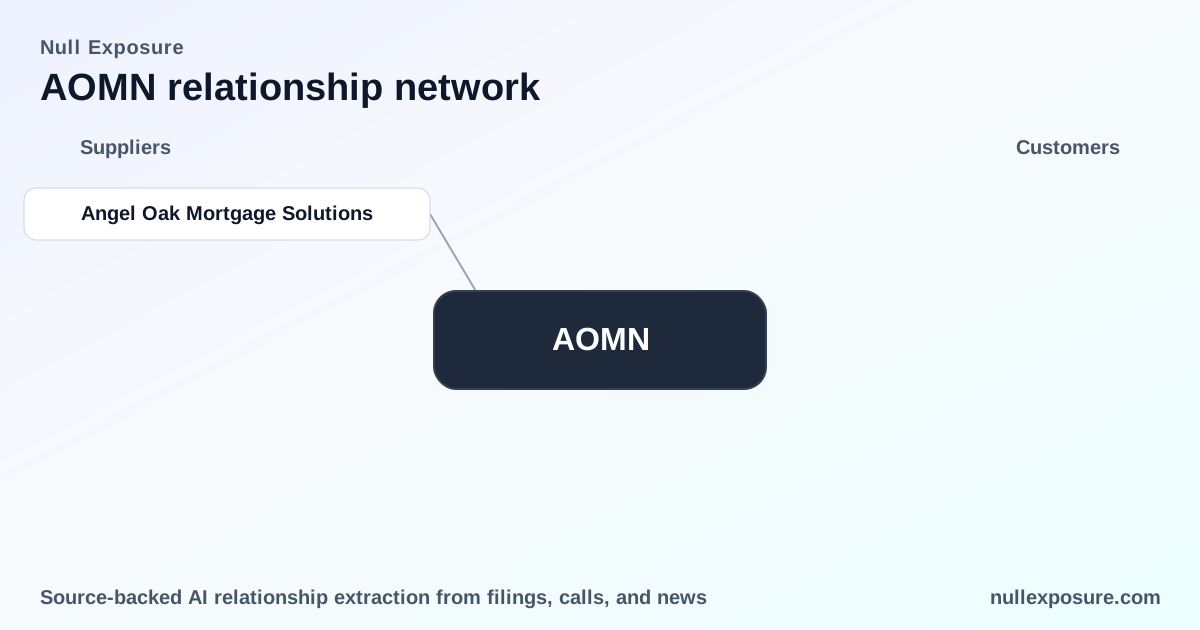
Angel Oak Mortgage REIT (AOMN): Supplier relationships and what they mean for investors
Angel Oak Mortgage REIT (AOMN) buys and manages first‑lien, non‑qualified mortgage (non‑QM) loans and monetizes that position through interest income, securitizations and financing spread — supplemented by leverage from repurchase facilities and unsecured notes. The company’s economics hinge on sourcing stable flow of non‑QM originations, locking funding costs through securitizations and repo lines, and extracting net interest spread while returning cash via dividends (current yield ~7.28%). For a quick gateway to more supplier‑level intelligence, visit Null Exposure.
Market context and investor thesis
- AOMN’s operating model is asset‑driven and counterparty‑sensitive: loan origination channels and financing counterparties determine both earnings volatility and balance‑sheet flexibility. The firm generates revenue primarily from mortgage interest and servicing economics and reduces funding volatility through term securitizations and occasional long‑dated unsecured debt.
- Key investment lever: ability to maintain origination access (supply of non‑QM loans) and stable financing at scale; loss of either supplier flows or borrowing capacity would compress distributable earnings materially.
If you want deeper supplier mapping and counterparty risk scoring, see Null Exposure.
How the company contracts and why that matters AOMN operates with a mixed contracting posture that blends long‑term and short‑term arrangements. That mix drives both liquidity risk and earnings stability.
- Long‑term anchors: the company has issued 9.50% senior unsecured notes due 2029 and relies on fixed‑rate term securitizations to lock funding costs over multi‑year horizons, which stabilizes net interest margins against rising short‑term rates. This is a structural hedge that supports dividend planning.
- Short‑term dependence: AOMN also uses uncommitted loan financing lines and short‑term repurchase facilities, with master repurchase agreements that are renewable at short intervals. These facilities create sensitivity to market liquidity and counterparty appetite during stress episodes.
- Frameworks and master agreements: A formal Master Repurchase Agreement with institutional lenders and a named master agreement filed in 2022 establish repeatable mechanics for repo financing, but they do not eliminate roll risk.
Collectively, those constraints imply operational complexity: securitizations reduce repricing risk, while repo and uncommitted lines deliver funding agility but increase rollover exposure.
Company‑level signals investors should weigh
- Counterparty profile is large‑enterprise‑heavy. Lenders are described as global money center and regional banks; AOMN’s financing mix is concentrated among institutional counterparties — a positive for depth but a concentration risk if a small number of banks pull back (company filings as of December 31, 2024).
- Spend and balance‑sheet scale are material. The company carried roughly $230.1 million of debt at par and has settlement exposures (a broker payable of about $202.0 million) that indicate high transactional scale with few large counterparties.
- Geographic focus is North America / US mortgage market. All core sourcing and assets are U.S. non‑QM loans.
- Materiality of loan repurchase/indemnity risk: the company warns that inability to obtain indemnity or repurchase for a significant number of loans would have a material adverse effect — an explicit call‑out of counterparty and credit‑control risk.
- Active relationship posture: AOMN remains active in securitizations (five transactions in 2024 contributing $855 million of principal), indicating ongoing execution and reliance on capital markets to warehouse and distribute risk.
These signals describe a company that balances longer‑dated funding (for stability) with short‑dated, scalable facilities (for growth and execution) — a hybrid that generates yield but requires constant counterparty engagement.
Relationship breakdown: Angel Oak Mortgage Solutions Angel Oak Mortgage Solutions is the primary sourcing channel for a significant portion of AOMN’s non‑QM production, supplying newly‑originated loans that feed the REIT’s portfolio and securitizations. According to National Mortgage Professional’s March 2026 coverage, the firm’s strong interest‑income outperformance in Q4 reflects ongoing demand and financing capacity for non‑QM production largely sourced through Angel Oak Mortgage Solutions (National Mortgage Professional, March 2026: https://nationalmortgageprofessional.com/news/angel-oak-mortgage-reit-reports-q4-revenue-surge-distributable-earnings-slightly-under).
Other named counterparties and what they imply
- Angel Oak Mortgage Lending (seller originator): Angel Oak Mortgage Lending is the proprietary lending platform that feeds AOMN’s pipeline, but it has no contractual obligation to sell loans to the REIT; AOMN therefore supplements originations from third parties and the secondary market as needed (Company Form 10‑K, as of December 31, 2024). This creates sourcing optionality with embedded dependency on proprietary flow.
- Falcons I, LLC (external manager / service provider): AOMN is externally managed and advised by Falcons I, LLC (an affiliate of Angel Oak Capital), which handles portfolio management and capital markets execution under a management agreement (Company filings, Management Agreement). External management concentrates execution risk in a third party but allows AOMN to leverage specialized origination and capital‑markets capabilities.
- Multinational and global money‑center banks (lenders): AOMN’s uncommitted loan financing lines and a named master repurchase agreement with a multinational bank establish short‑term liquidity lines that permit aggregate borrowings up to $1.1 billion as of year‑end 2024; these banks provide depth but introduce rollover and counterparty concentration risk (Company 2024 disclosures).
- Broker counterparties: The REIT purchased whole‑pool RMBS from a broker to whom it owed approximately $202.0 million payable on settlement — a bilateral trading exposure that highlights trade‑settlement concentration risk (Company reporting, Dec 31, 2024).
Investment implications and risk checklist
- Strength: Active securitization program and long‑dated notes provide a base of stable funding and help lock in spreads.
- Risk: Heavy reliance on short‑term repo and uncommitted lines combined with significant payables to a broker create roll and settlement concentration risks that could amplify stress.
- Operational dependency: External management and a proprietary originator supply chain mean investors should track contract terms, transfer pricing and any change in origination economics.
For a supplier‑level risk map and counterparty scoring, start with a subscription at Null Exposure.
Bottom line AOMN is a yield‑oriented mortgage REIT built on a hybrid funding model: securitizations and notes for term stability, plus repo and bank lines for execution and growth. Supplier strength — especially originators and large bank lenders — is a primary determinant of distributable earnings and balance‑sheet resilience. Investors evaluating AOMN should focus on counterparty concentration, the company’s ability to replace flow if Angel Oak Mortgage Lending reduces sales, and the health of short‑term financing markets.
If you want a detailed, actionable supplier map and counterparty risk scoring for AOMN and peer REITs, visit Null Exposure.