Aon PLC: supplier exposure and what investors should price for
Aon is a global professional services and insurance-brokerage franchise that monetizes through advisory fees, brokerage commissions, risk-transfer placement spreads and recurring administration services across employee benefits, reinsurance and data/analytics platforms. The company’s supplier relationships are operationally critical—outsourced technology, data providers, and facilities underpin revenue delivery—and therefore represent both operational leverage and a concentration-risk vector for investors. For an investor evaluating Aon as a supplier counterparty or assessing its vendor dependencies, focus on the company’s contracting posture, continuity risks, and the documented third-party relationships disclosed in filings. Learn more at https://nullexposure.com/.
How Aon’s business model converts supplier inputs into cash flow
Aon collects recurring client fees for benefits administration and long-tail advisory mandates, and earns transaction- and commission-based income when placing insurance and reinsurance. Revenue depends on uninterrupted access to data, execution platforms and market counterparties; the vendor base therefore functions as an operating asset rather than a simple cost center. Financially, Aon is a large-cap, margin-rich broker: market capitalization around $70.2 billion and trailing revenue near $17.2 billion, with operating margin above 30% and return on equity near 47% (latest quarter through 2025-12-31). Those metrics create scope for supplier investments but also raise the stakes for supplier continuity.
What the company disclosures signal about supplier contracting and risk
Aon’s public disclosures and filing excerpts point to several company-level operating characteristics that investors should internalize:
- Long-term contractual commitments: Aon reports an operating lease for its corporate headquarters that expires in 2044 and weighted-average remaining operating-lease terms in the multi-year range. That signals a contracting posture that includes long-duration real-estate commitments and predictable facility costs, which anchors part of its fixed-cost base (source: company filings).
- Criticality and potential for material disruption: The company explicitly states that failure to recover from a disaster or business-continuity failure could cause material financial loss, regulatory action and reputational harm—language that elevates supplier continuity from convenience to strategic risk (source: Aon filings, FY2025/FY2026 disclosures).
- Service-provider reliance and active outsourcing: Aon discloses reliance on third parties for core functions—technology platforms, data processing, benefits administration, and other outsourced services—establishing these vendors as functional extensions of the firm’s delivery model (source: company filings).
- Technology and software footprint: Filings list software and system vendors among third parties, indicating the supplier base includes licensed/hosted software and managed-services relationships rather than only commodity services (source: vendor enumeration in filings).
- Maturity of relationships: The language in filings describes ongoing and active third-party engagements, suggesting established, operationally mature supplier relationships rather than temporary pilots (source: Aon filings).
Together these signals portray a supplier ecosystem that is long-dated in parts, materially important to operations, concentrated around service providers and software vendors, and governed under long-term commercial terms.
Financial context that changes vendor negotiation dynamics
Aon’s profitability and scale give it bargaining leverage: strong operating margins and significant institutional ownership allow the company to secure long-term vendor commitments and invest in redundancy where commercially justified. At the same time, the materiality of continuity risk means suppliers with niche capabilities or market access can command premium pricing or contractual protections. Investors should treat supplier risk as an extension of Aon’s operating leverage—good for margins in stable conditions, costly in disruptions.
For deeper third-party intelligence and counterparty ranking, visit https://nullexposure.com/ for comparative supplier risk analysis.
Supplier relationships documented in the public record
Below I cover every supplier/relationship instance present in the observed results.
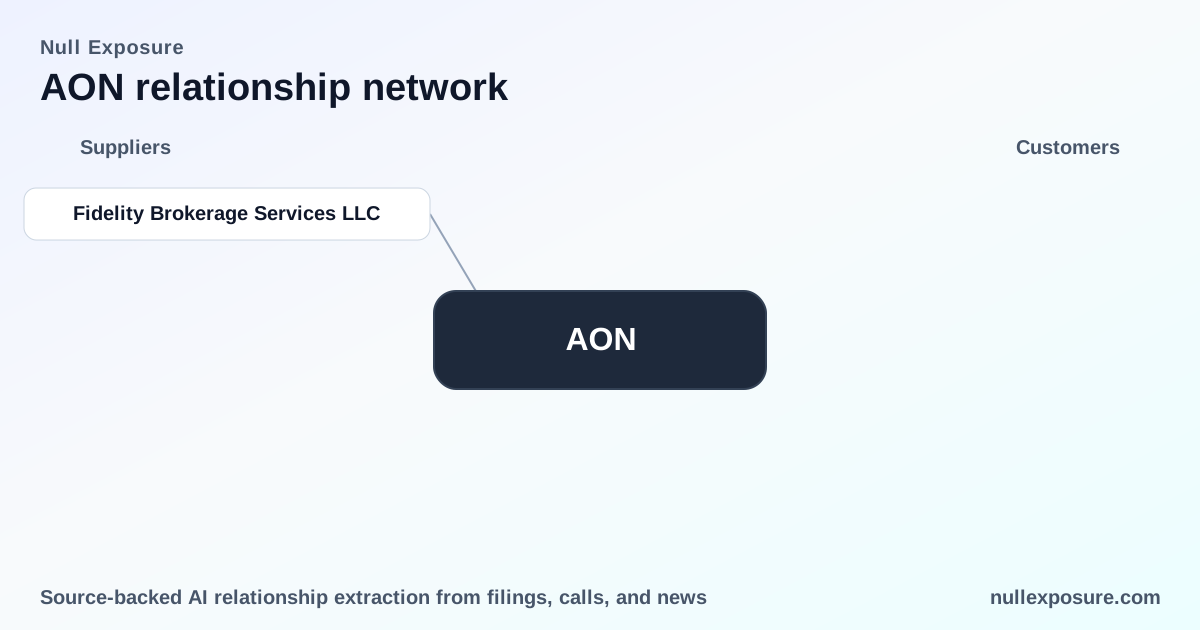
Fidelity Brokerage Services LLC — transactional ownership activity recorded in FY2026
Fidelity Brokerage Services LLC is recorded in an FY2026 SEC filing as the broker handling a sale of 4,300 Aon shares on 02/26/2026 with an aggregate market value reported near $1,417,783.50; this reflects a transactional brokerage role rather than an operational-service supplier. The filing indicates the trade was processed on the NYSE and is documented in the company’s FY2026 disclosure (source: SEC filing reported via StockTitan, March 2026).
Practical implications for investors and operators
- Concentration risk is operational: Aon’s disclosures about reliance on third parties and potential for material interruption elevate supplier concentration into a valuation-relevant input—investors should stress-test scenarios where a critical vendor experiences outage or regulatory limitations.
- Contracting posture favors stability: Long-term leases and active outsourced relationships indicate Aon negotiates enduring commitments for core infrastructure; this reduces short-term volatility in supplier costs but creates longer-term fixed obligations.
- Vendors can be value accelerants or liabilities: Because software and managed services play a central role, vendor performance directly influences client retention and revenue continuity—monitor vendor-change events, data-breach disclosures, and disaster-recovery test results.
- Financial strength cushions but does not eliminate contagion: Aon’s cash flows and margins allow for redundancy spending, but the public admissions of material continuity risk mean a severe vendor failure would likely have measurable earnings and reputational impact.
Midway action item: if you are modeling operational risk into valuation or stress testing counterparty exposure, incorporate Aon’s long-term lease commitments and third-party reliance into scenario inputs and mitigation assumptions. For comparative supplier risk dashboards, see https://nullexposure.com/.
Key takeaways for buyers, investors and vendor managers
- Aon runs a vendor-dependent delivery model where software and service providers are operationally critical.
- Contractual posture includes long-lived commitments (e.g., headquarter lease to 2044) that shape fixed-cost exposure.
- Disclosures classify third-party failures as material risks—this is a governance signal for investors and procurement teams to prioritize resilience.
If you oversee vendor risk or are evaluating Aon as a counterparty, incorporate continuity provisions, recovery-time requirements and audit/visibility rights into agreements; and if you are an investor, incorporate supply-side stress tests into upside/downside scenarios. For a structured supplier-risk assessment tailored to financial services firms, visit https://nullexposure.com/ for actionable tools and benchmarks.
Closing: Aon’s scale and profitability make it resilient, but the company’s explicit dependence on third-party technology and services converts vendor events into enterprise-level risks—price that into both credit and equity views.