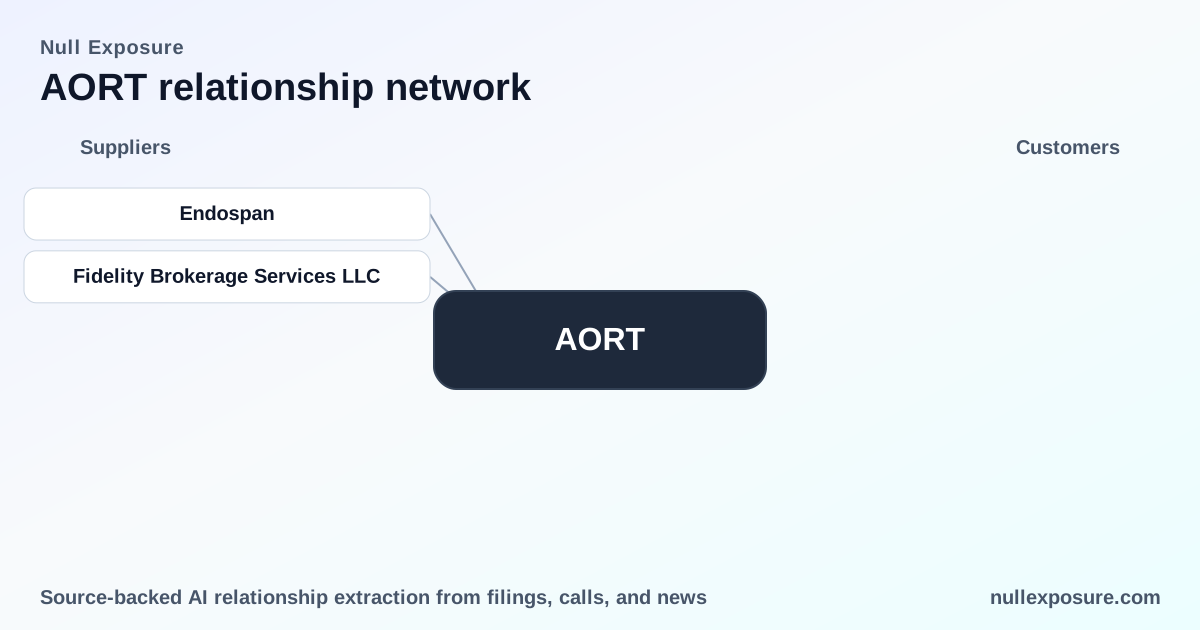
AORT supplier map and what it means for investors
AORT operates as a medical-products company that generates revenue by selling implanted cardiovascular devices and processed biologic materials, supported by a mix of proprietary products and outsourced manufacturing and service relationships. The company monetizes through product sales, licensing of device families, and the distribution of preserved human-tissue products, while relying on a geopolitically distributed supply base and third-party manufacturing and service providers to deliver finished goods. Investors should evaluate AORT on two axes: concentration of critical manufacturing for key product families, and the operational resilience of third-party tissue and cybersecurity providers.
For a broader supplier-risk view and continuous monitoring, visit https://nullexposure.com/.
The single-sentence supplier facts investors need
- Endospan: The company discloses that the NEXUS family of products are solely manufactured by Endospan in Herzliya, Israel, establishing a clear single-source production point for that product family. According to the AORT FY2024 10‑K, the NEXUS products are manufactured exclusively by Endospan in Herzliya, Israel (FY2024 10‑K).
- Fidelity Brokerage Services LLC: A public SEC filing referenced on StockTitan in March 2026 lists Fidelity Brokerage Services LLC at 900 Salem Street, Smithfield, RI as the broker and the trading venue as the NYSE, indicating the broker/dealer and market referenced in an AORT filing (StockTitan report, March 2026).
(Each of the relationships above is summarized in plain English and tied to the cited filing or report.)
Why Endospan’s sole-manufacturer status matters
Endospan’s exclusive role for the NEXUS family creates an acute concentration risk for AORT’s device revenue tied to that product line. Sole-source manufacturing elevates the importance of supplier continuity, regulatory compliance at the Endospan facility, and geopolitical or logistical disruptions originating in Israel. Investors pricing AORT should treat NEXUS supply continuity as binary from an operational standpoint: either the single manufacturer continues to run or AORT faces rapid remediation costs and potential product shortages.
Source: AORT FY2024 10‑K disclosure identifying Endospan as sole manufacturer.
The broker detail has corporate disclosure implications
The listing of Fidelity Brokerage Services LLC and the NYSE in a March 2026 filing clarifies the corporate capital-markets plumbing named in an AORT filing and helps investors verify trade and shareholder recordkeeping arrangements. This information is housekeeping in nature but useful for governance and share-registration traceability.
Source: StockTitan-hosted SEC filing referenced in March 2026.
Company-level sourcing and service signals that shape the operating model
AORT’s public disclosures surface three firm-level supplier characteristics that influence contract posture and risk tolerance:
- Global sourcing base: The company states, “We obtain a number of our raw materials and supplies from a global supply base,” signaling a geographically distributed procurement model that spreads vendor exposure but increases logistics, tariff, and regional disruption vectors.
- Reliance on contract manufacturers: Management notes reliance on contract manufacturers for some production needs; this creates a hybrid operating model where AORT leverages external capacity rather than owning all manufacturing, which improves scalability but reduces direct control.
- Third‑party service providers for critical functions: The company procures donated human tissue through OPOs and tissue banks and incorporates cybersecurity risk controls for third parties, indicating that tissue procurement and digital third-party services are material to operations.
Treat these as company-level signals that define AORT’s contracting posture: a mix of strategic single-source dependencies for select products and broad outsourcing for other elements. This configuration delivers flexible cost structure benefits while concentrating risk where sole-sourcing exists.
Operational implications: concentration, criticality, and maturity
- Concentration: High for any product family with a single listed manufacturer (e.g., NEXUS/Endospan); this elevates downside if that link breaks.
- Criticality: Very high for tissue procurement and for device manufacturing—both are directly tied to revenue and regulatory compliance.
- Contracting maturity: The coexistence of contract manufacturers and explicit third-party cybersecurity due diligence indicates a moderately mature outsourcing model; AORT enforces vendor standards but retains exposure when a vendor is sole-source.
These characteristics translate into focused monitoring priorities: supplier inspection reports, regulatory correspondence, cross-border logistics indicators, and cybersecurity audit results for vendors with system access.
Practical steps for investors and operators
- Prioritize due diligence on Endospan’s operational continuity, including inspection history, capacity, and contingency plans for NEXUS production.
- Monitor filings and vendor communications for changes in supplier status or new contract-manufacturing arrangements that reduce concentration.
- Track tissue-procurement chain governance and regulatory updates affecting OPOs and tissue banks, since those inputs are essential to product availability.
- Keep an eye on third‑party cybersecurity posture and contractual audit clauses that protect AORT’s data and manufacturing continuity.
For an ongoing, plain-English supplier risk feed and actionable signals, see https://nullexposure.com/.
How to monitor these relationships going forward
Focus reporting and event-tracking on four signals: supplier-specific 10‑K/8‑K disclosures, regulatory agency communications or recalls tied to manufacturers, logistics and customs delays for Israel-based shipments, and changes to third‑party service-provider contracts (including tissue banks and OPO relationships). A quarterly review that ties supplier event flow to product revenue exposure will surface whether mitigation steps—dual sourcing, insourcing, or inventory buffers—are being implemented.
Bottom line: concentrated risk plus diversified sourcing equals a trade-off
AORT presents a classic trade-off: outsourced flexibility and geographic sourcing to control costs, paired with high concentration for at least one strategic device family that creates outsized operational risk. Investors should value AORT with a premium on supplier transparency and remediation capability—companies that can demonstrably show supply redundancy or rapid substitution capability deserve higher multiples. Operators should prioritize supplier audits, documented contingency plans, and contractual remedies that reduce single-point failure risk.
For the clearest supplier risk dashboards and to subscribe to updates on AORT’s partner movements, visit https://nullexposure.com/.