Alpha & Omega Semiconductor (AOSL): Supply relationships that underwrite a power‑semiconductor franchise
Alpha & Omega Semiconductor designs, develops and sells power semiconductors for computing, consumer electronics, networking and industrial customers, monetizing through chip sales and integrated packaging/testing services across mature, high‑volume product lines. AOSL combines in‑house manufacturing, a material joint‑venture fab stake and third‑party foundry and OSAT relationships to secure capacity and control cost — a mix that drives margins on high-volume parts while concentrating supplier risk. For a deeper look at supplier exposures and contract posture visit https://nullexposure.com/.
Why the supplier map matters for investors
AOSL’s commercial performance is a function of both design strength and supply-chain access. The company’s ability to secure wafer capacity, outsource assembly/test, and manage receivables directly affects revenue continuity and gross margin volatility. Investors should read supplier signals as operational levers — not peripheral disclosures.
Who AOSL works with (what the record shows)
Below I cover every counterparty mentioned in the available source material and summarize their role in plain English.
-
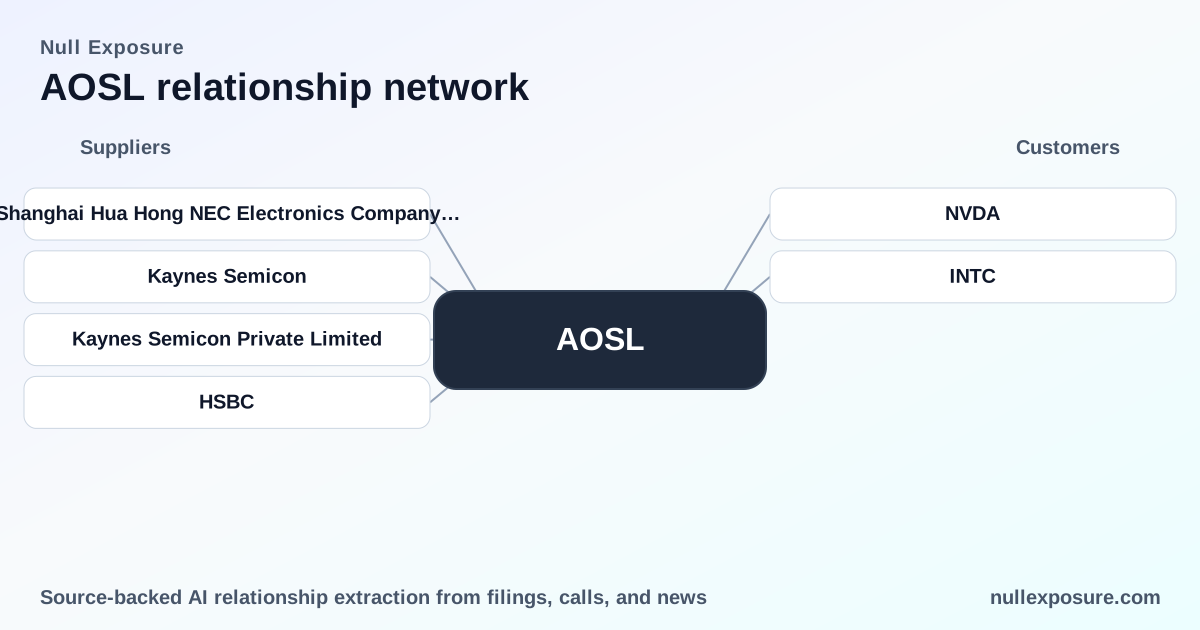
Shanghai Hua Hong NEC Electronics Company, Limited
AOSL discloses a longstanding Foundry Agreement dated January 10, 2002 with Shanghai Hua Hong NEC, reflecting a formal wafer supply relationship that supports AOSL’s fabrication needs. This comes directly from AOSL’s FY2025 10‑K filing (period ended June 30, 2025). -
Kaynes Semicon / Kaynes Semicon Private Limited
Multiple media reports in 2025 document Kaynes’ role as an outsourced‑semiconductor‑assembly-and‑test (OSAT) partner for AOSL: Kaynes secured a multi‑year packaging and testing agreement covering roughly 11–12 package types and used about 60% of its first‑phase OSAT capacity to service AOSL; Kaynes reported shipping 900 Intelligent Power Modules (MCM/IPM5) to AOSL from its Sanand facility in October 2025 and delivered India’s first paid chip prototype to AOSL in July 2025. Sources: Sify (July 2025); Economic Times and BusinessUpturn reporting (2025). -
HSBC (factoring partner)
AOSL has a receivables factoring agreement with HSBC to manage accounts receivable; the company reported no outstanding balance under that facility as of June 30, 2025. Reporting on this arrangement appears in commentary drawn from AOSL’s SEC 10‑K (FY2025) and financial news summaries in 2026.
Contracting posture, concentration and other operating constraints
AOSL’s supplier disclosures and constraint excerpts reveal a coherent operating model. These are company‑level signals (unless an excerpt names a party directly):
-
Framework contracting for capacity: AOSL relies on contractual capacity guarantees from JV partners — the company references agreements that provide monthly wafer production capacity guarantees with provisions for future increases as fab output scales. That indicates a framework relationship rather than one‑off purchases and signals a medium‑to‑long horizon commitment to suppliers (confidence 0.80).
-
Materiality of JV capacity: AOSL describes JV capacity as material to its manufacturing and R&D plans, and as a significant source of foundry capacity that supports product development and distribution. This elevates supplier risk into the core operating model rather than a peripheral sourcing choice.
-
Manufacturing role and vertical mix: About 39.2% equity ownership in a JV operating a Chongqing fab and packaging/testing facility positions AOSL as both an owner and buyer — the company also sources roughly 30% of wafers from third parties and uses subcontractors for standard packages. This hybrid model balances control with outsourcing flexibility.
-
Active purchase commitments and spend band: Outstanding purchase commitments were approximately $85.9 million as of June 30, 2025, placing supplier spend in a meaningful $10m–$100m band that is large enough to influence bargaining dynamics and capital planning.
-
Service provider posture: AOSL uses third‑party service providers for assembly/test and other functions while maintaining significant in‑house capabilities in China, indicating selective outsourcing for industry‑standard packages.
-
Relationship maturity and stage: The company reports active, ongoing purchase commitments and long‑running contracts (a foundry agreement that traces to 2002 and multi‑year OSAT deals), pointing to mature, operational relationships rather than ad hoc spot arrangements.
What this implies for investors: opportunities and risks
AOSL’s supply configuration delivers both defensive and leverageable advantages:
-
Upside: capacity control and margin leverage. Ownership in a JV fab plus framework guarantees give AOSL predictable wafer throughput for mature high‑volume products, supporting stable gross margins on those lines. The company’s strategy to mix owned fab capacity with third‑party foundries and OSATs gives operational flexibility to scale production without sole dependence on a single external vendor.
-
Risk: concentration and geographic complexity. The reliance on a China‑based JV fab and third‑party foundries, together with significant purchase commitments, creates concentration risk and exposure to regional operational disruption, export controls or policy shifts. The multi‑year OSAT contract with Kaynes also creates a dependency on a single external packaging partner for several packages and an inaugural production program in India for specific modules.
-
Working‑capital and receivables optionality. The HSBC factoring facility reduces balance‑sheet friction by providing a receivables management tool; although no balance was outstanding at June 30, 2025, the presence of the facility is a liquidity optionality that supports receivables turnover in stress scenarios.
-
Operational predictability versus market cyclicality. Framework agreements and JV capacity guarantees smooth supply for existing product portfolios, but demand cyclicality in semiconductors means that excess capacity or sudden order declines would transmit to AOSL’s working capital and utilization metrics quickly.
If you are modeling AOSL’s next 12–24 months, prioritize scenario work on wafer utilization rates, OSAT throughput for the Kaynes programs, and the cadence of purchase commitments captured in the company’s public filings.
For a concise supplier‑risk scorecard and further supplier mapping, visit https://nullexposure.com/.
Key takeaways and recommended next steps
- AOSL’s supply model is hybrid and deliberate: equity in a JV fab plus third‑party foundries and OSAT partners secures capacity while keeping capital intensity manageable.
- Supplier commitments are material: outstanding purchase commitments (~$85.9m) and framework guarantees elevate supplier relationships from transactional to strategic.
- Watch concentration points: the Chongqing JV and multi‑package agreement with Kaynes are concentration vectors that determine continuity of supply and cost structure.
For investors and operators evaluating counterparty exposures, prioritize validating JV output plans, Kaynes’ capacity ramp milestones, and the company’s utilization assumptions in earnings models. Explore practical supply‑risk monitoring and scenario analytics at https://nullexposure.com/.
Sources: AOSL FY2025 Form 10‑K (filed for year ended June 30, 2025); Sify Technology reporting (July 2025); Economic Times and BusinessUpturn coverage of Kaynes (2025); news summaries referencing AOSL’s 10‑K and HSBC factoring agreement (reported in 2026).