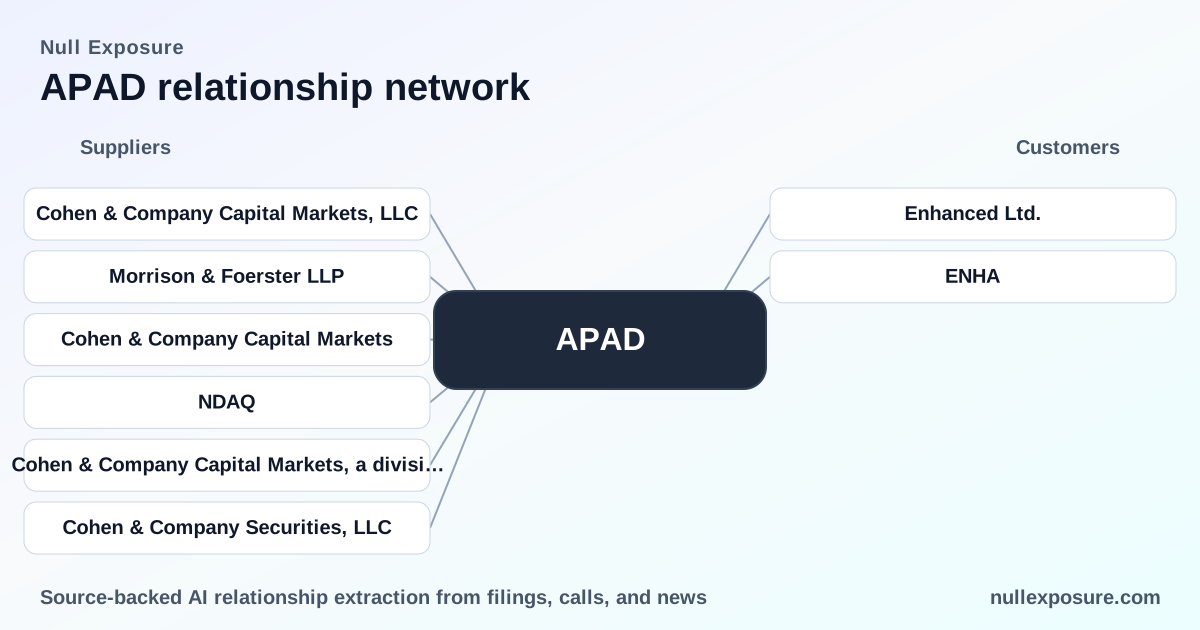
A Paradise Acquisition Corp. (APAD) — supplier relationships and what they mean for investors
A Paradise Acquisition Corp. is a Nasdaq-listed SPAC that monetizes by raising capital through a public offering of units, collecting underwriting and sponsor economics, and executing a business combination that converts trust proceeds into equity in a target company. Revenue and value realization are driven not by operating cash flow today but by the ability to complete a high-value merger, the terms of underwriting and sponsor arrangements, and retainment of capital in the trust after redemptions. For a focused supplier-risk read on APAD, this note maps the key professional relationships, the contractual and spend signals embedded in filing language, and the practical implications for investors and deal counterparties. Visit https://nullexposure.com/ for the broader supplier intelligence platform that supports this analysis.
Quick commercial summary: how APAD operates and what to watch
APAD’s operating model follows the standard SPAC playbook. The company raises IPO proceeds through units sold on Nasdaq, compensates underwriters and advisors via cash discounts and deferred fees, and positions its sponsor and management to finance transaction costs and potentially convert working capital loans into post-combination units. The economic lever for investors is the post-combination valuation of the acquired business; for counterparties it is the contractual mechanics that determine who ultimately shoulders transaction costs, underwriting fees, and redemption risk.
Key company-level signals drawn from public language:
- Contracting posture: APAD uses external service providers for capital markets execution, legal counsel, and potentially operational services (including cybersecurity), indicating a vendor-heavy, outsourced operating model.
- Spend profile: Underwriting and advisor payments are in the $1m–$10m band, with headline cash underwriting discounts totaling roughly $4.0 million and deferred fees up to $8.0 million tied to a completed business combination — a mid-market spend posture consistent with a single-deal SPAC.
- Maturity and stage: The SPAC is in an early, deal-formation phase; internal working capital loans are referenced but not drawn as of year-end 2025, signaling a prospect-stage posture with reliance on sponsor or affiliate financing optionality.
- Criticality and concentration: Execution of the IPO and future business combination is highly dependent on underwriters, counsel, and the Nasdaq listing mechanics; those relationships are critical to APAD’s strategy.
Supplier map: the professional relationships that underwrite APAD’s strategy
Below I cover every relationship in the provided source results. Each entry is a concise description of role and provenance.
-
Cohen & Company Capital Markets, LLC — MarketScreener reported on March 9, 2026, that Cohen & Company Capital Markets, LLC acted as financial advisor for A Paradise Acquisition Corp., reflecting an advisory role in transaction planning and capital markets positioning. (MarketScreener, first seen 2026-03-09)
-
Morrison & Foerster LLP — MarketScreener noted on March 9, 2026, that Morrison & Foerster LLP served as legal advisor to APAD, indicating retained counsel for securities documentation and transaction structuring. (MarketScreener, first seen 2026-03-09)
-
Cohen & Company Capital Markets — A StockTitan release (first seen March 9, 2026) stated Cohen & Company Capital Markets functioned as the sole book-runner and was granted a 45-day option to purchase up to 3 million additional units to cover over‑allotments, establishing primary distribution responsibility for the offering. (StockTitan / press release, first seen 2026-03-09)
-
Nasdaq — StockTitan reported the units began trading on the Nasdaq Capital Market under the ticker "APADU" on July 30, 2025, confirming the listing venue and effective public trading date for the units. (StockTitan, first seen 2026-03-09)
-
Cohen & Company Capital Markets, a division of Cohen & Company Securities, LLC — A Yahoo Finance release (reported March 9, 2026) identified Cohen & Company Capital Markets (as a division of Cohen & Company Securities, LLC) as the sole book-running manager for the offering, reinforcing the same underwriting and distribution assignment documented elsewhere. (Yahoo Finance, first seen 2026-03-09)
-
Cohen & Company Securities, LLC — StockTitan additionally referenced Cohen & Company Securities, LLC in the underwriting context on March 9, 2026, confirming the legal entity and corporate structure that supported the capital raise. (StockTitan, first seen 2026-03-09)
What the supplier roster implies for commercial and execution risk
The roster shows a concentrated set of external providers focused on capital markets execution and legal counsel. Concentration around a single book-running manager simplifies distribution and coordination but concentrates execution risk and economic leverage to that counterparty. The underwriting economics stated in filings — a 2% cash underwriting discount (about $4.0 million) and a deferred fee of up to $0.40 per unit (up to $8.0 million) payable only upon completion of a business combination — create asymmetric payouts: advisory and underwriting teams are paid out only if the SPAC reaches a successful deal closure and net trust balances survive redemptions.
Operational and governance constraints that affect supplier relationships:
- The underwriters’ cash and deferred fees create aligned incentives for deal closing, but they also introduce counterparty bargaining power if the SPAC faces redemption pressure.
- Sponsor financing optionality (working capital loans convertible up to $1.5 million into units at $10.00) signals internal backstop capacity for transaction costs, which reduces short-term liquidity risk but concentrates future dilution risk in sponsor-affiliated entities.
- APAD’s reliance on third-party technologies and personnel for cybersecurity and operations is an operational dependency that raises service-criticality for specialty vendors.
If you want a comprehensive supplier risk profile built from these relationship details, explore further at https://nullexposure.com/ — our platform aggregates contractual signals and market disclosures to quantify supplier leverage.
Practical investor takeaways
- Underwriting economics are material to eventual sponsor and investor outcomes. The combination of cash underwriting discounts and deferred fees shifts meaningful compensation to underwriters upon deal completion, so redemption rates and trust account retention are direct drivers of net proceeds available to target companies and post-combination shareholders.
- Counsel and exchange relationships are standard but essential. Morrison & Foerster as legal counsel and Nasdaq as the listing venue are consistent with a transaction that requires sophisticated securities work and standard exchange compliance.
- Concentrated supplier set reduces coordination friction but increases dependency risk. A single lead book-runner simplifies distribution but creates a single point of negotiation power for deal pricing and overallotment mechanics.
For operational teams evaluating counterparty risk or for investors sizing deal economics, these are the practical levers to model. For deeper supplier transparency and a structured vendor-risk scorecard, visit https://nullexposure.com/.
Closing: decisive signals for deal-era monitoring
APAD’s supplier profile is characteristic of an active SPAC executing a mid-market capital raise: a single, identifiable book-runner and related securities entities, top-tier legal counsel, and the Nasdaq listing anchor the public-financing leg of the strategy. Investors should monitor redemption behavior, deferred fee crystallization, and any draw on working capital loans as immediate metrics that determine deal feasibility and dilution outcomes. Operators and counterparties should treat the underwriter and counsel relationships as high-leverage negotiation points in term sheets and engagement letters.
Bottom line: APAD’s external supplier footprint is compact and concentrated, with clear cost structures that materially affect eventual transaction economics — track underwriting fee realization, sponsor financing activity, and trust-account retention as primary predictors of value creation. For a full supplier-risk profile and scenario modeling, begin with the NullExposure platform at https://nullexposure.com/.