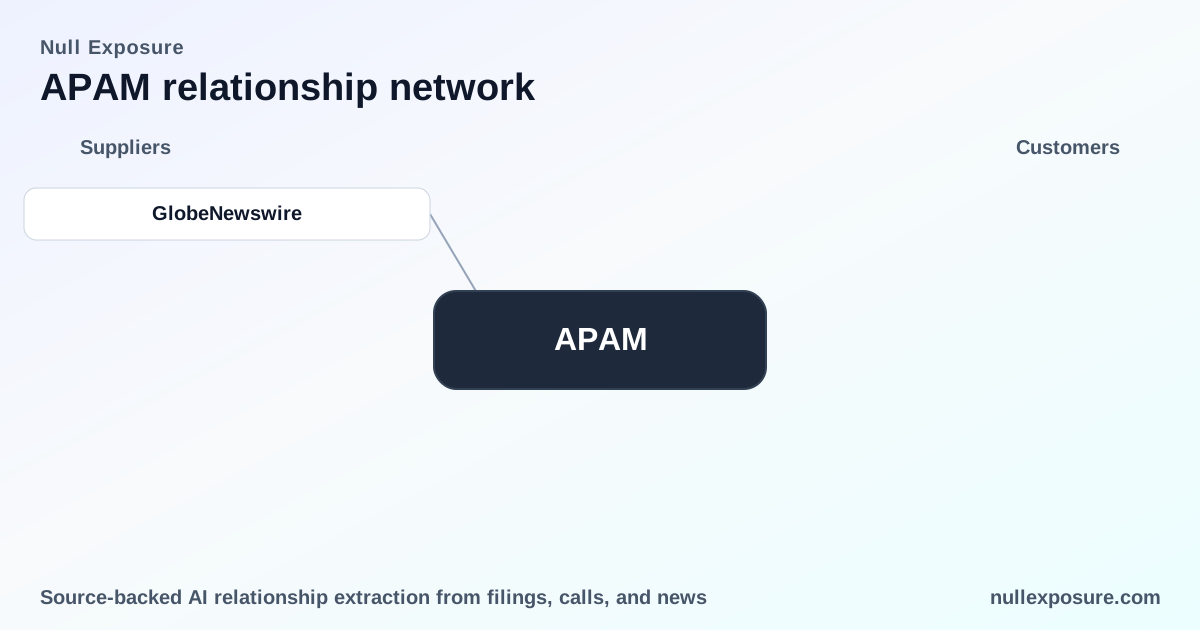
APAM Supplier Relationships: How Artisan Partners Sources and Secures Critical Services
Artisan Partners (APAM) operates as a publicly traded investment manager that monetizes primarily through management and performance fees tied to assets under management (AUM), with distribution and servicing arrangements that drive client access and retention. The firm's operating model relies on outsourced trading, middle- and back-office, custody and fund administration partners while simultaneously paying intermediaries to distribute Artisan Funds; that dual dependency creates a mix of recurring fee economics and concentrated operational exposures that investors must evaluate alongside traditional financial metrics. For primary research on supplier risk and relationship mapping, see https://nullexposure.com/.
A concise financial framing for supplier analysis
Artisan’s public metrics show a profitable, cash-generative business: market capitalization roughly $2.5 billion, trailing revenue near $1.20 billion TTM, and strong operating margins that reflect fee-driven economics. Those economics scale with AUM, making AUM a first-order driver of revenue volatility and supplier bargaining power. The relationships we examine are not peripheral: company disclosures and vendor descriptions identify certain suppliers as critical to trading, custody, fund administration and security operations, which elevates operational risk relative to a pure in-house model.
For deeper supplier-level signals and a structured diligence workflow, visit https://nullexposure.com/.
What the reported relationships say about operational posture
Artisan’s own disclosures define three practical characteristics of its supplier posture:
- Criticality: The company explicitly categorizes some service providers as critical to operations, meaning vendor failures would materially impair trading, NAV calculation or fund servicing. This increases the importance of contractual protections, redundancy and insurance coverage. (Company filing language in operational disclosures.)
- Distributor relationships: Artisan Funds authorizes intermediary distributors—broker-dealers, banks and other financial services firms—to accept purchase, exchange and redemption orders, and Artisan pays compensatory fees for distribution and servicing. This externalized distribution model increases go-to-market scale but also creates recurring distribution expense and revenue dependence on intermediary reach. (Fund documentation describing authorized intermediaries.)
- Service-provider outsourcing: The firm outsources trading, middle/back-office functions, custody, transfer agency and certain security operations to third parties and managed security service providers, while maintaining an internal security engineering team as first line. Outsourcing accelerates time-to-scale and variable-cost flexibility but concentrates risk in vendor selection and oversight. (Operational disclosures and security program descriptions.)
These are company-level signals drawn from regulatory and operational disclosures—not attributes of any single named vendor.
The single relationship surfaced in the supplier sweep
GlobeNewswire press release (via QuiverQuant), FY2025 — Artisan reported preliminary AUM of $180.8 billion as of November 30, 2025, a headline that underscores the scale underpinning its fee revenue and why vendor performance is consequential for fund operations and investor servicing. (Source: GlobeNewswire press release distributed via QuiverQuant, reported FY2025.)
How those signals translate into contracting, concentration and maturity questions
Artisan’s disclosures imply a mix of contracting behaviors that matter to counterparties and investors:
- Contracting posture — structured, fee-based vendor agreements with explicit operating responsibilities: expect standard SLA language for custody and fund administration and fee schedules for distribution intermediaries. The existence of operating leases and long-term commitments signals predictable fixed-cost lines that vendors and lessors can enforce. (Company filings reference operating leases and vendor engagement.)
- Concentration and criticality — select vendors are critical: the firm admits that while many providers play minor roles, some perform services that are critical to operations; that elevates counterparties whose failure would cause outsized operational disruption. Investors should prioritize mapping vendor concentration and contingency plans.
- Maturity and oversight — internal control plus outsourced specialists: Artisan maintains an in-house security engineering function supplemented by consultants and two managed security service providers, indicating a hybrid model of internal governance with outsourced execution. This points to a relatively mature vendor oversight posture but also dependence on external capability.
Investment implications — what to watch in due diligence
Operational counterparty exposure is a second-order but measurable source of investment risk for asset managers. For APAM, the critical items to target in diligence are:
- AUM sensitivity to distribution channels — quantify revenue tied to intermediary flows and how distribution fees affect net margins.
- Vendor concentration metrics — identify single points of failure among trading, custody and fund admin providers and verify documented contingency plans.
- Contract terms and SLAs — confirm termination rights, service credits, and indemnities for critical vendors.
- Security operations resilience — review managed security provider contracts, escalation paths and incident-response coordination with the internal security team.
- Fixed commitments — understand the cadence and size of lease and other long-term obligations that constrain flexibility in downturns.
These checks convert the company-level signals into actionable risk items for investors and procurement teams.
For vendor benchmarking and supplier risk tools tailored to asset managers, go to https://nullexposure.com/.
Closing: pragmatic next steps for investors and operators
Artisan Partners combines scalable fee economics with a vendor-dependent operating model. The business benefits materially from elevated AUM and broadened intermediary distribution but simultaneously inherits operational concentration and contractual dependencies that are economically meaningful. Investors evaluating APAM should prioritize AUM sustainability, contractual protections with critical providers, and governance evidence that vendor failure scenarios are tested and insurable.
If you want a structured approach to map these supplier relationships and translate them into investment risk factors, start your review at https://nullexposure.com/.