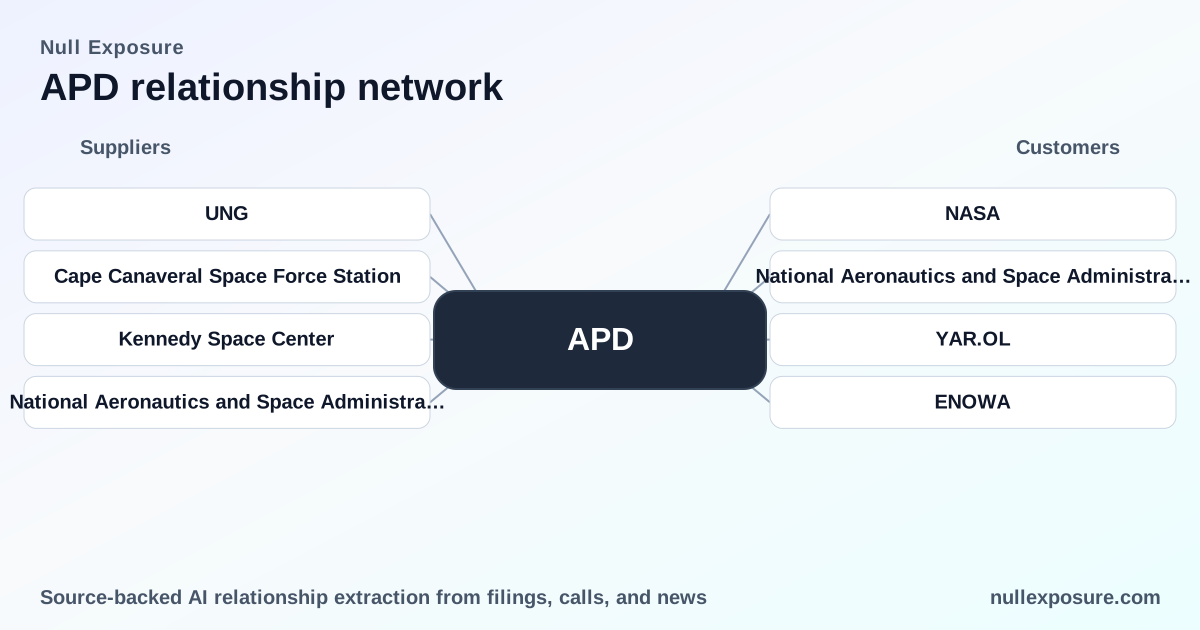
Air Products (APD) — Supplier relationships that drive long-term gas and hydrogen cash flow
Air Products and Chemicals monetizes industrial gases and chemicals by owning and operating production assets and selling on-site and bulk offtake contracts to industrial and government customers. The company captures value through long-duration on-site contracts, plant ownership and operation, and expanding hydrogen supply into strategic markets such as space launch and government programs. For investors and operators, the combination of asset control and multi-year contracts produces predictable revenue streams and operational leverage, while exposure to critical customers and rigorous supplier governance creates both opportunity and concentrated operational risk.
Visit https://nullexposure.com/ to see more supplier-mapping intelligence for APD and peers.
Why these supplier relationships matter to investors
Air Products’ operating model centers on owning and operating production assets that feed long-term offtake agreements. That model converts capital investment into contracted cash flow rather than spot commodity exposure. The FY2025 10‑K confirms this posture: APD owns and operates on-site facilities and locks in customers under multi-year contracts that can span a decade and beyond, creating durable revenue visibility. Financially, the company generates substantial top-line scale (Revenue TTM ~$12.2B) with a healthy operating margin (~24%), which underscores how contract structure and asset control support profitability even as EPS and net margins fluctuate.
- Contract duration matters: a disclosed 15‑year on-site contract structure is emblematic of APD’s contracting posture—capital-intensive assets paired with long-term offtake.
- Asset control reduces execution risk: owning and operating facilities gives APD operational control and margin capture versus pure tolling or merchant models.
- Strategic customers drive growth: government and aerospace hydrogen demand adds volume and prestige, supporting broader hydrogen platform expansion.
Explore APD supplier maps and relationship analytics at https://nullexposure.com/ for deeper diligence.
How Air Products governs supplier risk (a company-level signal)
Air Products discloses that its suppliers and third‑party service providers are subject to cybersecurity obligations and that the company assesses security posture prior to engagement. This governance disclosure signals maturity in third‑party risk management and a contracting posture that includes explicit service-level and security requirements. For investors, this translates into two operational characteristics:
- Higher contracting discipline: pre-engagement assessments and contractual obligations reduce vendor-related operational shocks.
- Increased sourcing friction: elevated governance standards can lengthen onboarding and concentrate work with providers that meet APD’s controls.
These constraints are presented as company-level signals and are not assigned to any single relationship unless the disclosure explicitly names that counterpart.
Relationship map: the specific counterparties disclosed
Below are every counterparty mentioned in the provided results, each with a concise plain-English summary and source reference.
UNG
Air Products owns and operates the acquired facility and supplies all offtake products to UNG under a 15‑year on‑site contract, while UNG supplies the feedstock natural gas and utilities. This arrangement places APD in control of production and product delivery, with the counterparty providing upstream feedstock. According to Air Products’ FY2025 10‑K filing, the 15‑year on‑site contract formalizes this operating split (APD FY2025 10‑K).
Cape Canaveral Space Force Station
Air Products is contracted to supply liquid hydrogen deliveries to Cape Canaveral as part of a broader set of hydrogen agreements that serve launch and testing hubs. A March 2026 Energies Media report noted the contracts require roughly 36.5 million pounds of liquid hydrogen allocated across NASA launch centers, including Cape Canaveral (Energies Media, March 2026).
Kennedy Space Center
Air Products will supply liquid hydrogen to Kennedy Space Center under the same set of strategic launch agreements tied to NASA’s operations, supporting fuel needs for launches and test operations. The Energies Media article outlined Kennedy as a primary beneficiary of the new hydrogen supply agreements (Energies Media, March 2026).
National Aeronautics and Space Administration (NASA)
Air Products secured hydrogen supply agreements with NASA to support functions at Kennedy Space Center and Cape Canaveral Space Force Station; the contracts position APD as a key hydrogen supplier for national space operations. A March 2026 press report detailed these NASA agreements and the aggregate supply commitment (Energies Media, March 2026).
Strategic implications for investors and operators
The disclosed relationships reveal a consistent operating theme: APD prefers asset ownership and long-term offtake rather than short-term merchant exposure. That strategy produces several investment-relevant implications:
- Predictable, contract-linked cash flows: Long-duration on-site contracts (e.g., 15 years) create stable revenue profiles supportive of capital deployment and dividend policy, and help explain the company’s high institutional ownership (~94%).
- Concentration and criticality risk: Large strategic contracts with government entities like NASA are lucrative but create exposure to a handful of high-impact counterparties and program timing. Operational execution and contract renewals are high-impact events for margin continuity.
- Growth vector in hydrogen: Securing NASA and space-center contracts for liquid hydrogen demonstrates APD’s ability to scale supply into specialty high-purity hydrogen markets — a premium segment that supports higher per-unit economics than commodity gases.
- Supplier governance reduces operational tail risk: The company’s supplier cybersecurity obligations are a signal of governance maturity, which lowers third‑party operational risk but can reduce supplier pool breadth and increase counterparty dependency.
Operational risks to monitor
- Contract concentration: Large on-site deals are bilateral and long-term; the loss or non-renewal of a major contract would have outsized revenue impact.
- Execution risk on owned assets: Plant operations and feedstock supply arrangements (as with UNG) require seamless coordination; operational disruptions can compress margins quickly.
- Program timing and demand volatility: Hydrogen demand driven by government programs is subject to budgetary and schedule shifts that can change volume forecasts.
If you’re evaluating APD supplier exposure for a portfolio or operational partnership, review contractual terms, renewal mechanics, and feedstock symmetry in the on-site arrangements. For quick access to APD relationship intelligence and supplier governance signals, visit https://nullexposure.com/.
Bottom line and next steps for diligence
Air Products’ supplier footprint is defined by asset-backed, long-dated contracts and increasing exposure to strategic hydrogen markets, including government space programs. That operating posture generates highly visible cash flow and a pathway to premium hydrogen pricing, while concentrating execution risk in a small set of critical relationships. Investors should prioritize contract terms, counterparty credit, and operational oversight when assessing APD exposure.
For a deeper supplier-level analysis and comparative supplier maps across peers, see https://nullexposure.com/.