American Public Education (APEI): Supplier relationships that matter to investors
American Public Education (APEI) operates postsecondary education businesses—primarily online and campus-based institutions—including APUS and RU—and monetizes through tuition and related student services, content licensing, and institutional contracts. Revenue is driven by enrollment and program expansion, while margins depend on scaled digital delivery and third‑party service arrangements that handle IT, learning platforms, curriculum and testing. For an active view of counterparties and supplier posture, review the relationship map below and the operating constraints that govern vendor risk and spend. Visit https://nullexposure.com/ for more supplier intelligence and investor-grade briefs.
How APEI runs the business and where suppliers sit in the value chain
APEI’s business model is straightforward: tuition and program fees generate the top line while outsourced services supply the tech, content and administrative functions necessary to serve roughly six-figure student enrollment levels. The company discloses material reliance on third‑party cloud and SaaS providers, a managed service provider for IT and student support, and external vendors for curriculum, testing and financial aid processing. These arrangements convert fixed campus costs into variable, vendor-driven operating costs and create concentration and execution risks that investors must monitor.
- Revenue scale and efficiency: Trailing revenue is approximately $649 million with operating margin around 12% (company financials through FY2025).
- Supplier exposure: APEI runs a hybrid model—owning campuses and outsourcing critical digital infrastructure—so vendors function as both operational levers and potential single-point failures.
Explore the full supplier picture at https://nullexposure.com/ for context and counterparty profiles.
What the public record lists as APEI relationships
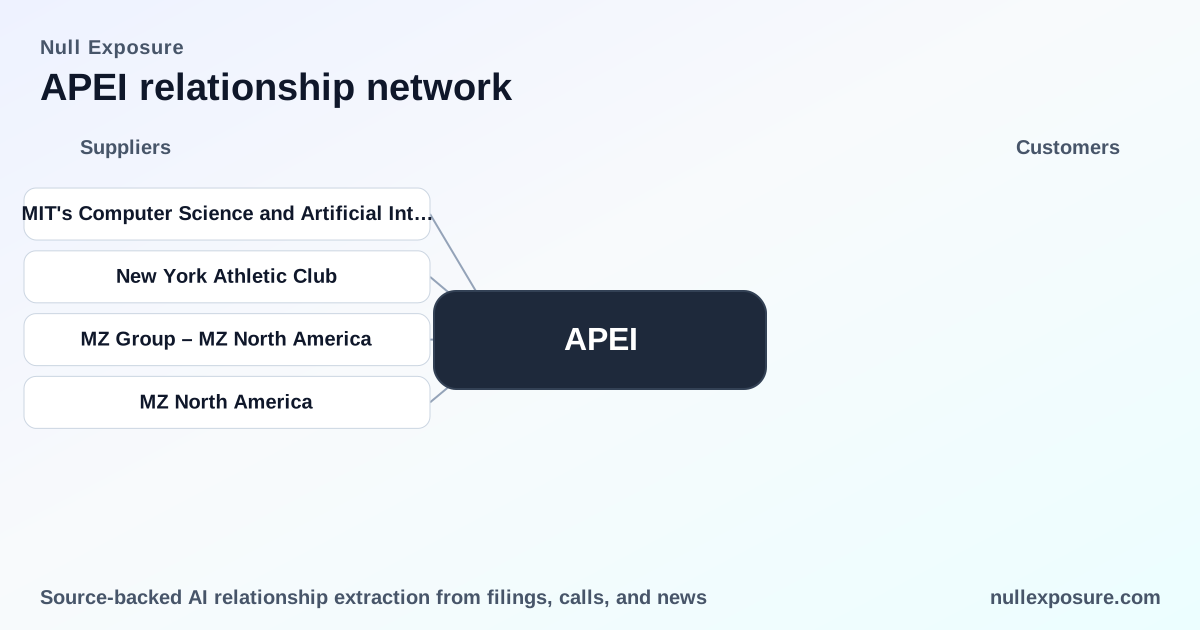
MIT CSAIL — academic licensing for digital skills and AI (FY2026)
APUS announced an expansion of course content through a licensing agreement with MIT’s Computer Science and Artificial Intelligence Laboratory (CSAIL) to bolster digital skills and AI offerings, signaling a strategic push into higher‑value, technical curricula. According to a Finviz news item dated March 9, 2026, APUS is leveraging the CSAIL relationship to expand academic content for students (Finviz, March 2026).
New York Athletic Club — venue for investor communications (FY2025)
APEI held its 2025 Investor Day at the New York Athletic Club on November 20, 2025, an event venue choice that underscores the company’s active investor outreach and corporate visibility. Eastern Progress reported the November 2025 Investor Day, noting the company’s student population and institutional footprint (Eastern Progress, November 2025).
MZ Group / MZ North America — investor relations partner (FY2025)
Multiple investor notices and presentation materials list MZ North America (MZ Group) and Brian M. Prenoveau, CFA, as APEI’s investor relations contact, indicating engagement with a retained IR firm for communications and shareholder outreach. StockTitan and SahmCapital postings (and related press listings) from early 2026 point to MZ’s role in distributing investor day materials and managing IR inquiries tied to the November 2025 Investor Day (StockTitan; SahmCapital; postings March 2026).
Contracting posture, concentration and maturity: what the constraints reveal
Company disclosures and filings provide a clear signal of supplier posture and spend discipline:
- Long‑term commitments exist and are material: A July 2024 contract (RU) for nursing curriculum upgrades, course materials and testing services carries an estimated annual expense of $6–7 million through December 31, 2027, replacing a prior provider and indicating a multi‑year procurement that locks in service and cost structure (company filings, 2024). Additionally, APEI leases administrative and campus real estate with expirations stretching to 2034 across approximately 569,000 square feet, embedding long‑dated real estate obligations into operating leverage.
- Subscription-style sourcing for core infrastructure: Filings explicitly state use of cloud computing and software‑as‑a‑service and reliance on a managed service provider for IT, service desk and student support—an operational posture that favors subscription contracts with predictable recurring fees rather than ad hoc purchases.
- Buyer and service‑provider duality: APEI is both a buyer (outsourcing key tech and support functions) and a consumer of educational content licensing (e.g., MIT CSAIL) while also contracting third parties to deliver student-facing services; this duality concentrates execution risk around vendor performance.
- Active, mature relationships with mid‑range spend: Relationship stage is described as active, with typical supplier spend bands in the $1–10 million per year range for significant contracts—sufficient to matter to operations but not typically large enough to qualify as enterprise-scale single‑vendor exposure.
These constraints combine to create a supplier profile where vendors are operationally critical, contractually stable for multi‑year periods, and moderately concentrated. Investors should treat vendor performance and transition costs as recurring governance items.
Operational risks and investment implications
- Execution risk from vendor transitions: APEI recorded roughly $3.8 million of information technology transition costs for 2024, underscoring the real cash impact when changing providers or moving services in‑house (company 2024 disclosure). Transitions generate near‑term P&L pressure and testing risk for student services.
- Content partnerships as revenue levers: The MIT CSAIL licensing is a high‑impact strategic move—content licensing diversifies program offerings and supports tuition pricing power if student uptake follows.
- Lease and campus exposure: Long lease terms through 2034 create fixed-cost drag if enrollment softness emerges; the RU contract through 2027 confirms multi‑year vendor commitments tied to program delivery.
- Investor communications are centralized: Use of MZ North America for investor relations and repeated investor day materials indicates active market engagement, which reduces information asymmetry and improves governance signalling.
Where investors should focus next
- Monitor operational KPIs tied to vendor performance: student satisfaction and completion rates after the RU curriculum transition, and delivery metrics for new CSAIL‑licensed courses.
- Track cash flow volatility from IT transitions and lease obligations as enrollment trends evolve.
- Evaluate management’s vendor governance: contract terms, exit options, and contingency provisions for mission‑critical services.
For a consolidated view of APEI’s counterparties, contracts and risk indicators, see the supplier intelligence hub at https://nullexposure.com/. If you need a tailored supplier risk brief or counterparty scorecard for portfolio due diligence, contact the research team through https://nullexposure.com/ and request the APEI supplier dossier.
Bottom line
APEI is a tuition‑driven education operator that leverages third‑party providers to scale digital delivery and expand curriculum via licensing. That model supports margin expansion through scale but creates vendor dependency that investors must monitor—especially around multi‑year contracts, IT transitions and campus lease obligations. The MIT CSAIL content deal is a strategic growth vector; the RU contract and recurring IT/SaaS relationships are the operational levers and risk points. Use targeted supplier intelligence to quantify counterparty concentration and contract terms before sizing exposure.