APG (APi Group): Supplier relationships, contracting posture, and what investors should price in
APi Group Corporation operates as an acquirer and operator of security, specialty and industrial services across North America, monetizing through recurring service contracts, project execution and complementary equipment/lease arrangements that support field operations. Revenue derives from service delivery and project work rather than product margins, while corporate leasing and vendor arrangements provide operational leverage and footprint scale. This profile creates a cash-flow mix that combines stable, recurring maintenance-like revenue with episodic project receipts; investors should evaluate supplier exposure through the lens of contract duration, counterparty quality, and the cost of leased assets.
Explore more supplier intelligence at https://nullexposure.com/.
Why supplier relationships matter for APi’s valuation
APi is a services-led industrial platform with substantial revenue (about $7.9 billion trailing twelve months) and material operating lease expense. Supplier and lease arrangements are an operational lever that affect capital intensity, flexibility to deploy crews, and margin stability. The disclosures reviewed show a blend of long-term and short-term contractual commitments: facility leases extend up to ten years while equipment and vehicle leases commonly run from one to seven years. Those time horizons create a predictable base of fixed operating cost that investors should treat as quasi-capital commitments rather than purely variable supplier spend. According to APi Group’s financial statement notes for the year ended December 31, 2024, facility leases carry initial terms up to ten years while equipment and vehicle leases generally run one to seven years.
The single supplier relationship surfaced — what it is and why it’s relevant
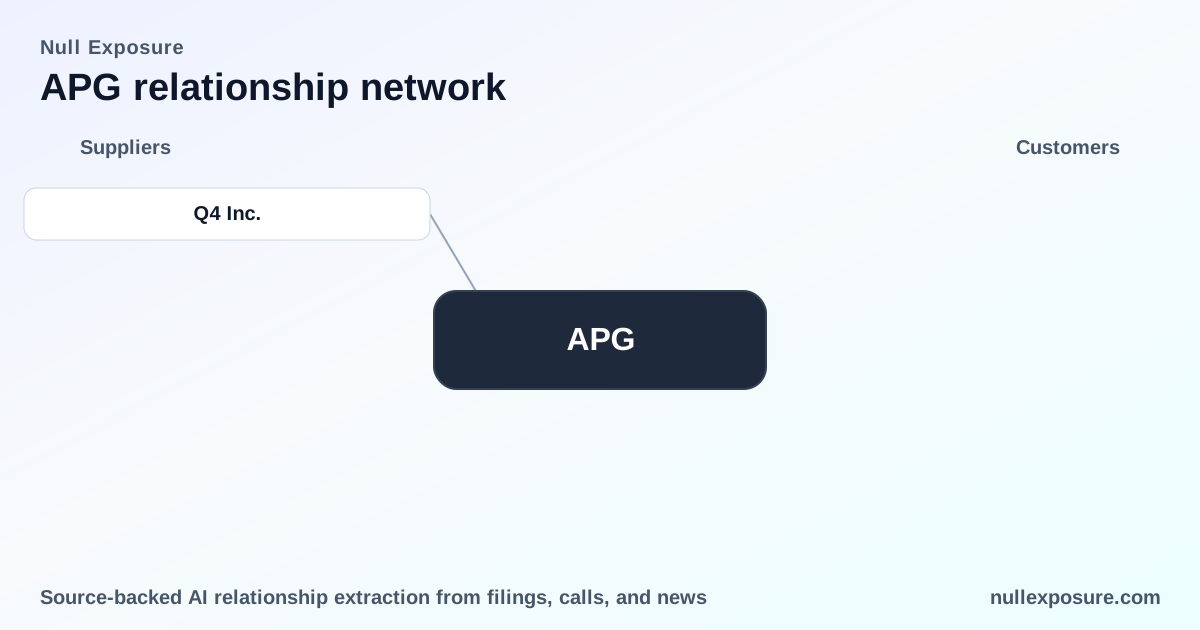
Q4 Inc.: investor relations/web platform vendor
APi’s investor relations pages are delivered using Q4 Inc.’s platform, which is a vendor relationship for web hosting and capital markets communications. The relationship is visible on APi’s Q4 2025 earnings conference call event page, which is branded “Powered by Q4 Inc.” and was posted in March 2026. This is a non-core but visible vendor that supports disclosure distribution and investor engagement rather than field operations. (Source: APi Group investor relations event page for the Q4 2025 earnings call, March 9, 2026.)
What the contract and spend constraints tell investors
-
Contracting posture: APi maintains a mixed-duration contracting posture that balances long-term occupancy commitments with shorter term equipment and vehicle leases. The facility leases’ up-to-ten-year initial terms signal geographic and office commitment, while 1–7 year equipment and vehicle leases preserve operational flexibility.
- Evidence: lease disclosures in the company’s filings indicate facility leases up to ten years and equipment/vehicle lease terms of one to seven years.
-
Spend scale and concentration: Lease-related operating costs are meaningful but not core revenue drivers. For the year ended December 31, 2024, operating lease cost was recorded at about $99 million and total lease cost about $168 million, which is material at the expense-line level but small compared with roughly $7.9 billion in revenue. Treat lease expense as a recurring fixed operating obligation that impacts leverage and free cash flow volatility during downturns.
- Evidence: operating lease and total lease cost figures reported in the year-end notes (2024).
-
Counterparty quality and financial risk: The company executes hedging and swap contracts with major global banks and financial institutions, indicating counterparty selection is large-enterprise focused and credit risk is managed through credit approvals/limits. This reduces the probability of severe counterparty failure disrupting treasury operations.
- Evidence: the filing notes that the company selects major global banks and financial institutions as counterparties for foreign currency forwards, cross-currency swaps and interest rate swaps.
-
Supplier roles and criticality: Disclosures identify APi as a buyer of leased facilities/equipment, a purchaser of prefabricated goods from third-party manufacturers, and a consumer of third-party service providers for non-core functions. Third-party manufacturing supplies system components for project execution, and services vendors support operations and risk management; none of these are shown as single-source, system-critical suppliers in the excerpts reviewed.
- Evidence: filing language on reliance on multiple third‑party manufacturers and the company’s third‑party service provider risk assessments.
-
Materiality of pre-contract costs: The company reports that incremental costs incurred to obtain or fulfill contracts are generally immaterial; mobilization or initial design costs are capitalized only when they directly relate to a contract and are amortized over the project life. This suggests limited capitalized acquisition costs and predictable margin recognition on new contracts.
- Evidence: notes indicating fulfillment costs were not material for any period presented.
What investors should do with this information
- Prioritize monitoring lease expense and covenant sensitivity: lease obligations are a steady fixed cost and should be trended against free cash flow and leverage ratios, particularly in slower project cycles.
- Treat IR/web vendors (like Q4 Inc.) as operational-service suppliers with low operational disruption risk but high visibility—issues here affect disclosure delivery, not field capacity.
- Validate counterparty selection for hedging and supplier credit processes in diligence: the use of major global banks reduces counterparty concentration risk for treasury activities, which is a positive signal for credit-focused investors.
Want a focused supplier risk brief or counterparty heat map for APG? Visit https://nullexposure.com/ for tailored analysis.
Relationship-by-relationship breakdown (concise)
- Q4 Inc. — APi uses Q4 Inc.’s investor relations platform to host and distribute earnings event content; this is a communications vendor relationship rather than an operational supplier. The IR event page for APi’s Q4 2025 earnings call is labeled “Powered by Q4 Inc.” (Source: APi Group investor relations event page for the Q4 2025 Earnings Conference Call, posted March 9, 2026.)
Final takeaways for investors
- APi’s supplier landscape is dominated by lease commitments and a dispersed manufacturing/service supplier base, not single critical vendors; this reduces single‑counterparty supply shock risk but creates fixed-cost exposure through leases.
- Lease expense is non-trivial—operating lease costs were about $99 million and total lease cost about $168 million for FY2024—so investors should price in the leverage effect of those commitments against revenue cyclicality.
- Treasury and hedging counterparties are large global banks, which is a credit-positive sign for financial operations.
If you want a concise supplier risk memo or a verification of APi’s contract horizons for diligence, start here: https://nullexposure.com/.