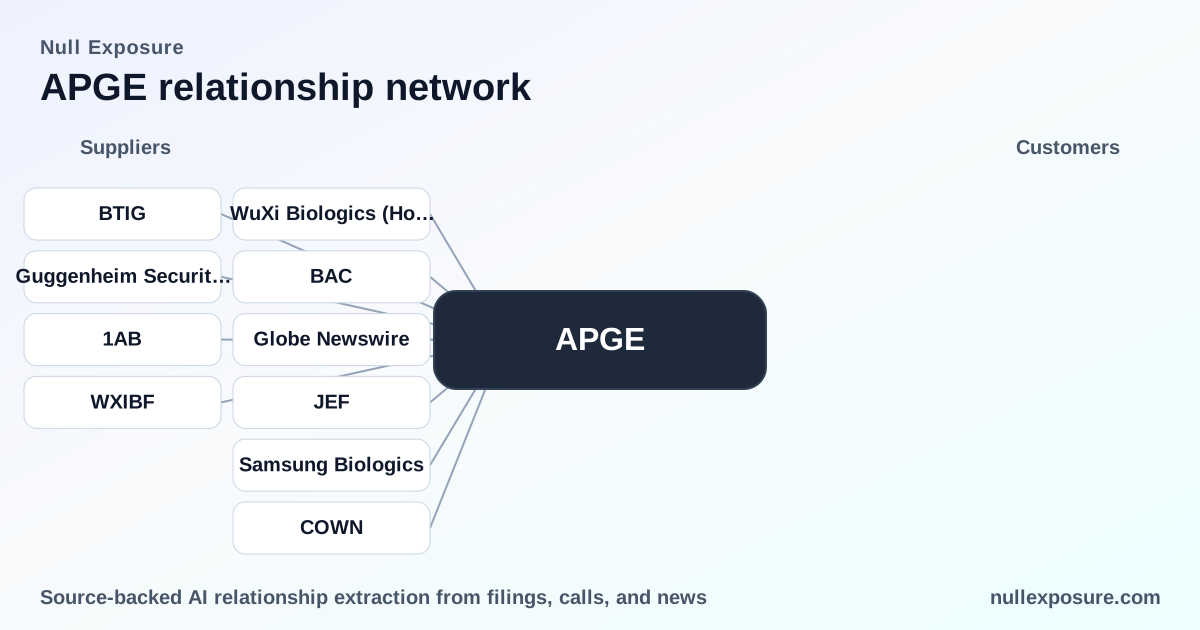
Apogee Therapeutics (APGE): who supplies the science and who sells the story
Apogee Therapeutics develops biologic candidates for atopic dermatitis, COPD and related inflammatory indications and currently monetizes through R&D partnerships, licensing of cell‑line and manufacturing technologies, and capital raises tied to clinical milestones. The company is clinical‑stage and revenue‑absent; its enterprise value rests on successful development of its antibody programs and on reliable third‑party manufacturing and capital markets execution to fund trials and a potential commercial launch. For supplier and partner diligence, the relationships below identify the operational and capital plumbing that supports Apogee’s programs.
Learn more about supplier risk and exposure mapping at https://nullexposure.com/.
The manufacturing and cell‑line axis that runs the programs
Apogee’s drug substance and product supply chain is outsourced and concentrated; its commercial trajectory depends on a small set of CMOs and licensors.
WuXi Biologics (Hong Kong) Limited
Apogee novated a biologics master services agreement originally executed by Paragon, under which WuXi provides development activities, GMP manufacturing and testing on a work‑order basis; the novation is documented in Apogee’s FY2024 Form 10‑K (Novation Agreement dated April 1, 2023). According to Apogee’s FY2024 10‑K, the WuXi MSA is a framework agreement that governs APG777, APG990, APG333 and APG808 and includes non‑cancellable work‑order obligations. (Source: Apogee FY2024 Form 10‑K.)
WuXi Biologics (parent reference)
Apogee recorded material R&D expense tied to the WuXi MSA — roughly $31.8 million in 2024 — underscoring significant spend concentration and criticality of this supplier to ongoing program execution. (Source: Apogee FY2024 Form 10‑K.)
Samsung Biologics
Apogee executed a letter of intent with Samsung Biologics for drug substance supply and recognized $9.9 million of related R&D expense in Q4 2024, establishing second‑source manufacturing capacity for potential clinical and commercial scale. (Source: Apogee FY2024 Form 10‑K and related press reporting.)
Paragon Therapeutics (related‑party research)
Paragon (formerly the originator of certain option and license agreements) continues to provide R&D services; Apogee reported $19.2 million of R&D expense in 2024 tied to services provided under Paragon agreements, reflecting outsourced discovery and early development work. (Source: Apogee FY2024 Form 10‑K.)
Who underwrites the balance sheet and funds the runway
Apogee is actively tapping investment bank syndicates to raise capital and support liquidity events.
Jefferies
Jefferies is named as a joint book‑running manager on the proposed underwritten public offering announced in October 2025, positioning it as a primary capital markets partner for Apogee’s equity raises. (Source: GlobeNewswire press release, Oct 8, 2025.)
BofA Securities
BofA Securities is listed among the joint book‑running managers on the October 2025 proposed offering, reflecting a syndicate role in equity issuance and distribution. (Source: GlobeNewswire press release, Oct 8, 2025.)
Guggenheim Securities
Guggenheim Securities was named as part of the book‑running syndicate for the proposed offering, signaling participation from middle‑market investment banking channels. (Source: GlobeNewswire press release, Oct 8, 2025.)
TD Cowen
TD Cowen joined the group of underwriters for the October 2025 offering, expanding the syndicate footprint across specialty healthcare banks. (Source: GlobeNewswire press release, Oct 8, 2025.)
BTIG
BTIG is included in the underwriting syndicate for the proposed October 2025 offering, contributing distribution capacity for the equity deal. (Source: GlobeNewswire press release, Oct 8, 2025.)
Messaging, milestones and investor relations channels
Apogee uses standard biotech PR and investor outreach channels to communicate clinical progress and corporate events.
Globe Newswire
GlobeNewswire distributed Apogee press releases announcing clinical milestones (for example, a first‑patient announcement in February 2025) and the October 2025 proposed offering, serving as the company’s principal press distribution channel. (Source: GlobeNewswire releases, Feb 3, 2025 and Oct 8, 2025.)
1AB (media contact)
Apogee lists 1AB (Dan Budwick) as a recurring media contact on multiple press releases in 2025–2026, indicating the outsourced PR engagement for media and investor communications. (Source: GlobeNewswire and Yahoo Finance aggregation, 2025–2026.)
StockTitan / TradingView citations (secondary reporters)
Market news aggregators such as StockTitan and TradingView republished filings and press releases—reporting the same underwriting syndicate and referencing manufacturing agreements with WuXi and Samsung—amplifying transactional disclosures to investor audiences in FY2025–FY2026. (Source: StockTitan and TradingView articles reporting on Apogee filings and press releases, 2025–2026.)
What the constraints tell investors about Apogee’s operating model
The public evidence defines a clear operating posture and risk profile for supplier relationships.
-
Contracting posture: framework and long‑term. The WuXi relationship is governed by a biologics master services agreement and work orders; the MSA has termination tied to completion of services (evidence in the FY2024 10‑K), which establishes a multi‑year framework and a long‑term contracting posture for core programs. (Company‑level signal tied to WuXi per the MSA excerpts.)
-
Concentration and criticality. Apogee relies on a small number of CMOs and third‑party providers for all preclinical and clinical supply; the company’s filings explicitly state that a supply interruption would materially affect R&D programs, making these suppliers critical single points of operational risk. (Company‑level signal from FY2024 10‑K.)
-
Role clarity: service provider, manufacturer, licensor. WuXi functions as both a service provider and licensor (cell line license and royalty‑bearing arrangements are documented), Samsung is positioned as a manufacturer and second‑source drug substance provider, and Paragon supplies discovery and development services. These roles create operational dependency across development, manufacturing and intellectual property rights. (Relationship‑level signals where the constraint excerpts explicitly name the counterparties.)
-
Spend scale and maturity. R&D spend tied to individual relationships is material: WuXi‑related costs were in the tens of millions in 2024 and Paragon‑related costs were similarly significant; Samsung’s LOI generated near‑double‑digit million recognition in Q4 2024, consistent with mid‑to‑high single supplier spend bands and a maturing outsourcing program. (Spend evidence from FY2024 disclosures.)
If you are modeling supplier disruption or constructing counterparty exposure scenarios, use direct filings to map the MSA work‑order schedule and the Samsung LOI timing; our platform centralizes that mapping at https://nullexposure.com/.
Investment implications and risk checklist
- Positive: Framework MSAs plus a second‑source letter with Samsung indicate that Apogee is building manufacturing redundancy and licensing rights that support scalability.
- Negative: Heavy concentration of spend and the critical role of a few CMOs create execution risk if timelines slip or regulators reject manufacturing processes.
- Catalysts to watch: progress in the Phase 1b/2 readouts, the outcome of the proposed underwritten offering, and any amendments to the WuXi MSA or Samsung supply agreements that change exclusivity, pricing or non‑cancellable obligations.
For a complete supplier exposure profile and to monitor real‑time changes across Apogee’s counterparties, visit https://nullexposure.com/. If you need a tailored supplier risk brief—mapped to your investment horizon—we publish periodic updates and scenario analyses on the same platform: https://nullexposure.com/.
Bold takeaway: Apogee’s value realization depends on execution by a concentrated set of external manufacturers and on successful capital raises led by a syndicate of active bankers; operational disruption or funding shortfalls will directly delay clinical progress and de‑risking, with material implications for valuation.