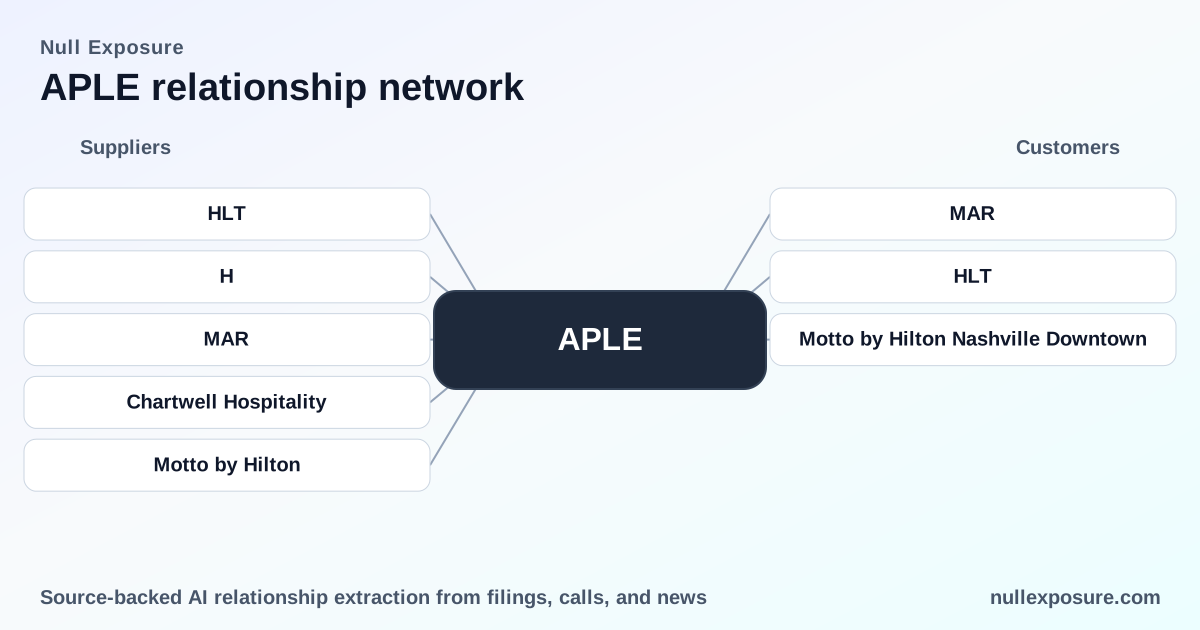
Apple Hospitality REIT (APLE): supplier map, contracting posture, and investor implications
Apple Hospitality REIT owns a portfolio of upscale, predominantly franchise-branded hotels across the United States and monetizes by capturing property-level cash flow through ownership while outsourcing day-to-day operations to third‑party managers and franchise networks; the company distributes cash to shareholders via a high-yield monthly payout and targets value through selective acquisitions and portfolio pruning. Investors should view APLE as a real‑estate owner that relies on branded reservation systems and outsourced hotel operators for revenues and guest distribution. For a concise supplier-risk snapshot and ongoing monitoring, visit https://nullexposure.com/.
How APLE operates as a counterparty to lodging brands and managers
Apple Hospitality's operating model is a two‑tier outsourcing construct: long‑dated franchise/licensing relationships deliver brand distribution and loyalty economics (initial franchise terms typically 10–30 years), while hotel operations are largely delegated under management agreements that skew short — 82% of hotels operate under variable management fee contracts with average initial terms of about one to two years, aligning manager incentives with performance. This mixed contracting posture produces a portfolio with brand stickiness at the franchisor level and operational flexibility at the manager level; concentration toward Marriott and Hilton increases revenue capture through global reservation ecosystems but elevates single‑industry dependency. For a deeper supplier-risk dashboard, see https://nullexposure.com/.
- Contracting posture: Predominantly variable short‑term management agreements for operational control, backed by long‑term franchise/license commitments for brand and distribution.
- Concentration & criticality: Substantial exposure to Marriott and Hilton brands; branded reservation and loyalty systems are mission‑critical to occupancy and yield.
- Maturity & spend: Franchise terms are long; management fees are recurring and material (Apple incurred ~$46.7m of management fees in 2024), and single acquisitions can be in the ~$100m range.
- Geography: Pure U.S. focus — 221 hotels across 37 states plus D.C. — which simplifies regulatory risk but concentrates macro sensitivity to the U.S. travel cycle.
Supplier relationships — source-by-source readout
Below are concise, source‑specific summaries that cover every relationship item surfaced in the results.
-
Hilton (MarketBeat instant alert, Feb 17, 2026): MarketBeat noted Apple Hospitality’s portfolio is primarily operated under premium franchise agreements with leading brands, explicitly listing Hilton as one of the principal franchisors supporting APLE’s distribution and loyalty advantage. (MarketBeat, 2026-02-17)
-
Hyatt (MarketBeat instant alert, Feb 17, 2026): The same MarketBeat piece lists Hyatt among the branded partners operating APLE properties, underscoring the role of major chains in the REIT’s operating footprint. (MarketBeat, 2026-02-17)
-
Marriott (MarketBeat instant alert, Feb 17, 2026): MarketBeat cites Marriott as a core franchise partner for Apple Hospitality, reinforcing the REIT’s strategic tilt to household lodging brands. (MarketBeat, 2026-02-17)
-
Hilton (MarketBeat filing report, Feb 26, 2026): A separate MarketBeat filing note reiterates that APLE’s hotels operate under franchise or management agreements with brands including Hilton; the item surfaced in the context of an investor filing about share transactions. (MarketBeat, 2026-02-26)
-
Hyatt (MarketBeat filing report, Feb 26, 2026): The Feb 26 MarketBeat filing again references Hyatt as a franchisor/brand partner in the company’s portfolio commentary. (MarketBeat, 2026-02-26)
-
Marriott (MarketBeat filing report, Feb 26, 2026): The Feb 26 MarketBeat notice repeats Marriott’s placement as a principal brand in APLE’s portfolio. (MarketBeat, 2026-02-26)
-
Marriott (SahmCapital analysis, Feb 25, 2026): SahmCapital reports that in 2025 APLE shifted 13 Marriott‑managed hotels to third‑party franchises and sold seven hotels, signaling active portfolio reshaping under new board direction. (SahmCapital, 2026-02-25)
-
Hilton Worldwide Holdings Inc. (8‑K reported on StockTitan, Mar 2026): An 8‑K posting summarized Apple Hospitality’s investment in Marriott, Hilton and Hyatt branded hotels and highlighted the benefits of their reservation systems and loyalty programs to APLE’s cash flow profile. (StockTitan / 8‑K filing, 2026)
-
Hyatt Hotels Corporation (8‑K reported on StockTitan, Mar 2026): The same 8‑K filing states APLE’s investment strategy includes Hyatt‑branded assets that leverage corporate reservation channels and loyalty economics. (StockTitan / 8‑K filing, 2026)
-
Marriott International, Inc. (8‑K reported on StockTitan, Mar 2026): StockTitan’s 8‑K copy emphasizes the strategic reliance on Marriott’s distribution and loyalty infrastructure across APLE’s portfolio. (StockTitan / 8‑K filing, 2026)
-
Motto by Hilton (TravelAgentCentral report, Mar 2026): TravelAgentCentral reported that Motto by Hilton Nashville Downtown opened as an APLE‑owned hotel managed by Chartwell Hospitality, illustrating APLE’s acquisition and repositioning activity within branded sub‑flags. (TravelAgentCentral, 2026)
-
Chartwell Hospitality (TravelAgentCentral report, Mar 2026): The same TravelAgentCentral article identifies Chartwell Hospitality as the manager running the new Motto by Hilton property owned by APLE. (TravelAgentCentral, 2026)
-
Marriott (TravelandTourWorld summary, Mar 2026): TravelandTourWorld highlighted APLE’s established presence with industry leaders including Marriott while reporting on the REIT’s monthly distribution. (TravelandTourWorld, 2026)
-
Hilton (TravelandTourWorld summary, Mar 2026): TravelandTourWorld likewise listed Hilton among the key brands that anchor APLE’s portfolio in the U.S. lodging market. (TravelandTourWorld, 2026)
-
Hyatt (TravelandTourWorld summary, Mar 2026): TravelandTourWorld reiterated Hyatt’s role as one of the leading franchisors associated with APLE properties. (TravelandTourWorld, 2026)
-
Motto by Hilton (The Globe and Mail press release, Mar 2026): A Globe and Mail press release announced APLE’s acquisition of Motto by Hilton Nashville for $98.2 million, showing the scale of single-asset transactions. (The Globe and Mail / PR, 2026)
-
Hilton (The Globe and Mail press release, Mar 2026): The same Globe and Mail notice framed the acquisition under the Hilton family of brands, reinforcing the franchise link to APLE’s purchase. (The Globe and Mail / PR, 2026)
What this supplier map means for investment risk and operational strategy
Apple Hospitality’s model is defensible in distribution but exposed in execution. The REIT benefits materially from Marriott and Hilton’s reservation platforms and loyalty economics, which sustain demand and pricing; at the same time, operational execution is outsourced via short‑term variable management contracts, creating toggles for performance that can accelerate upside or compress margins if managers underperform. The company’s spend profile is meaningful: management fees are a mid‑double‑digit million annual line item while single acquisitions like Motto by Hilton Nashville sit near the $100m mark, placing vendor selection and contract terms squarely in the center of value creation.
- Investor takeaway: Concentrated brand exposure is a double‑edged sword — it reduces marketing and distribution risk but increases dependency on franchisor economics and brand standards enforcement.
- Operator takeaway: Short initial management terms create flexibility to replace underperforming operators quickly, but successful execution requires disciplined asset oversight and franchise compliance.
For monitoring APLE’s supplier risk, track changes in management‑fee run rate, the number of hotels under variable fee agreements, and any shift in franchise mix between Marriott and Hilton.
If you want an ongoing supplier-risk tracker and tailored supplier relationship summaries, explore our coverage at https://nullexposure.com/.
Conclusion — actionable checks for investors
Apple Hospitality’s economics are driven by asset ownership plus branded distribution and outsourced hotel operations. Key risks are brand concentration and manager performance; key strengths are scale, predictable franchise economics, and an attractive dividend yield (over 8%) supported by property cash flows. For investors evaluating exposure to APLE, validate the company’s manager performance metrics, monitor franchise renewal timelines, and watch portfolio disposition/acquisition activity for signs of strategic de‑risking or value creation. Learn more about supplier concentration and contract posture in our APLE profile at https://nullexposure.com/.