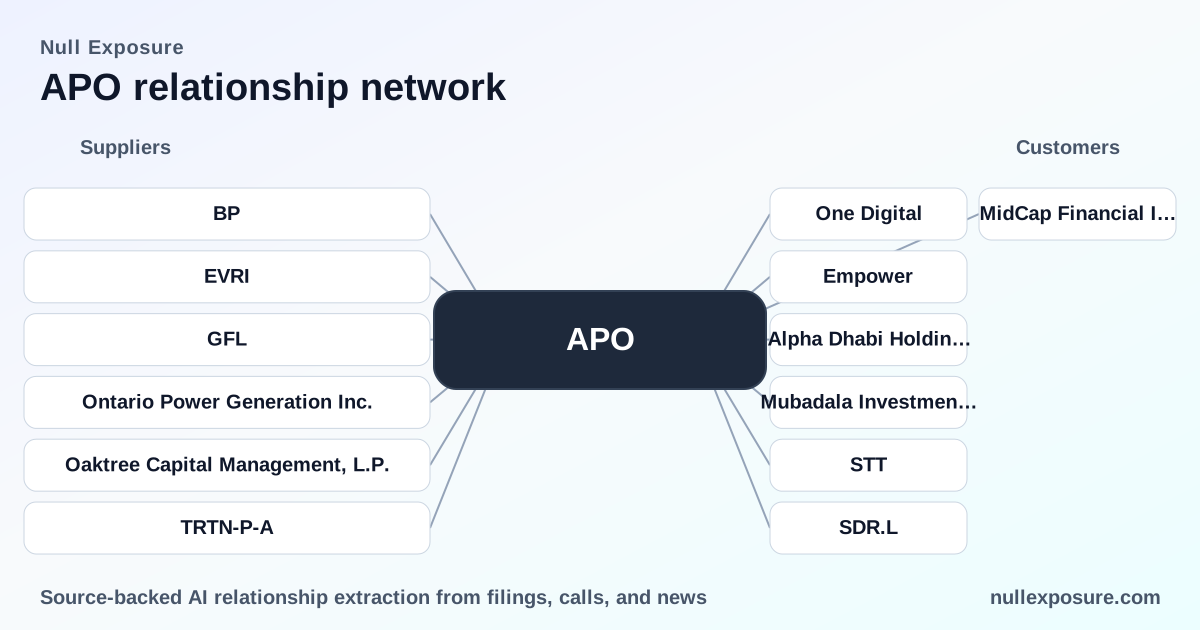
Apollo Global Management (APO): supplier relationships and what they mean for counterparties
Apollo Global Management operates as a global alternative asset manager that monetizes through management and performance fees, co-investment capital, and direct equity buys funded by its managed funds. The firm executes sponsor-led acquisitions and portfolio carve-outs across credit, private equity, and real assets, then extracts value through operational improvement, capital structure optimization, and strategic exits. For counterparties evaluating supplier or vendor exposure, Apollo behaves like an operationally active buyer—large-ticket, deal-driven, and capital-intensive.
For deeper counterparty intelligence and supplier risk signals, visit https://nullexposure.com/.
What to know up front: how Apollo contracts and spends
Apollo’s public disclosures and news coverage show a mix of contracting behaviors that matter to suppliers and operators. Apollo routinely executes multi-hundred-million dollar deals and also uses short-dated liquidity instruments in its consolidated vehicles. Its contracting posture combines long-tenor credit facilities for core entities with short-term subscription lines and liquidity facilities used by fund vehicles. That structure produces high notional exposure but mixed maturity profiles for counterparties.
Key company-level signals:
- High spend and deal scale: Borrowing capacities and facility sizes disclosed imply counterparty spend and credit demands in the $100M+ band, consistent with large-supplier contracts and material financing relationships.
- Mixed contract maturity: Evidence of five-year revolving facilities alongside subscription lines with sub-1-year remaining maturities indicates counterparties must manage both long-term credit exposure and rapid-turnover funding arrangements.
- Service-provider posture: Apollo engages third parties for audits, cybersecurity assessments, and operational services; vendors should expect standard enterprise oversight and risk-based vendor reviews.
- Netting and immaterial residuals: Disclosures note amounts not subject to master netting were immaterial, signaling disciplined collateral/netting practices that reduce unsecured counterparty credit exposure.
Deal map — recent relationships investors and operators should track
Below I cover every relationship listed in the available results, with a plain-English take and source note for each transaction.
BP p.l.c.
Apollo-managed funds agreed to acquire a 25% stake in BP Pipelines (Tanap) Limited from BP for $1 billion, representing a strategic energy infrastructure purchase that transfers a meaningful minority interest to Apollo’s balance of managed capital. According to Simply Wall St coverage dated March 9, 2026, the transaction was reported as a completed agreement in FY2026.
Everi Holdings Inc.
Funds managed by Apollo completed the acquisition of Everi Holdings Inc., a move that expands Apollo’s presence in payments and gaming services and demonstrates willingness to buy publicly listed operators outright. Simply Wall St reported the transaction on March 9, 2026, marking it as an FY2026 acquisition.
GFL Environmental Inc.
Apollo and BC Partners completed the purchase of a 56% stake in GFL’s Environmental Services Business, consolidating waste and remediation assets under private ownership and emphasizing Apollo’s appetite for infrastructure and service-sector platforms. This completion was reported in Simply Wall St on March 9, 2026.
Ontario Power Generation Inc. (Eagle Creek Renewable Energy)
Apollo agreed to acquire Eagle Creek Renewable Energy, LLC from Ontario Power Generation, increasing its renewable-energy footprint and aligning with the firm’s real-assets strategy in power generation. Simply Wall St captured this FY2026 agreement on March 9, 2026.
Oaktree Capital Management, L.P.
Undisclosed Apollo funds agreed to acquire a majority stake in OEG Offshore Limited from funds managed by Oaktree’s Power Opportunities strategy and others for an enterprise value of $1 billion, illustrating deal-level coordination among alternative managers and secondary-market movement of energy assets. Simply Wall St noted this FY2026 agreement on March 9, 2026.
Triton (Kelvion Holding GmbH)
Apollo-managed funds completed the acquisition of a majority stake in Kelvion Holding GmbH from Triton Fund IV, evidencing strategic buyouts of engineered-product platforms in Europe that can be scaled via operational improvements. This transaction was reported by Simply Wall St on March 9, 2026.
What these relationships mean for suppliers and counterparties
Collectively, the transactions show Apollo’s playbook: large, sponsor-led acquisitions across energy, environmental services, industrials and financial services. For suppliers this produces a predictable set of implications:
- Concentration and credit size: Expect counterparties to face large notional contract values; the data signals a spend band in the $100M+ territory at the company level, so supplier risk exposure can be material even for minority-contract positions.
- Contractual maturity mix: Counterparties must manage both long-term supplier contracts tied to portfolio companies and short-term liquidity relationships (subscription lines, revolving facilities) that can turn over quickly.
- Operational oversight and vendor discipline: Apollo’s use of third-party auditors and cybersecurity reviews implies rigorous vendor due diligence and performance monitoring for strategic suppliers.
- Netting and collateral practices reduce unsecured credit risk: Public filings describe amounts not subject to master netting as immaterial, suggesting counterparties will often operate within agreements that limit unsecured positions.
For more supplier-focused intelligence and to map these dynamics across counterparties, explore https://nullexposure.com/.
Risk and opportunity for investors evaluating APO supplier links
- Risk: Suppliers that become dependent on a single Apollo-owned platform can face concentration risk given Apollo’s willingness to consolidate or flip assets into new ownership structures. Long-term credit facilities paired with short-term subscription lines introduce timing-driven liquidity risk for some counterparties.
- Opportunity: Being a preferred supplier to an Apollo portfolio company can generate durable revenue streams and access to cross-portfolio scale when Apollo pursues roll-up strategies—particularly in services and industrials where the firm has shown repeat investments.
Bottom line and recommended next steps
Apollo operates as a heavyweight buyer and manager that transacts at scale, enforces vendor governance, and mixes long- and short-term financing structures. That combination makes it a strategically attractive customer for well-capitalized suppliers, but one that demands robust contract diligence and contingency planning.
If you are evaluating supplier risk or partnership strategy with Apollo or its portfolio companies, begin with a focused review of master netting, contract tenor, and service-level enforcement provisions—and monitor M&A announcements that can reconfigure counterparty exposure. For a structured view of Apollo’s counterparty signals and supplier risk maps, go to https://nullexposure.com/.
For bespoke supplier intelligence, vendor risk modeling, or a tailored counterparty report on APO relationships, visit https://nullexposure.com/ and request a deeper analysis.