Apogee Enterprises (APOG): How the company monetizes glass and metal fabrication and what its banking suppliers tell investors
Apogee Enterprises designs, fabricates and installs engineered glass and metal building systems and monetizes through project sales, aftermarket services and fabrication margin capture across commercial construction cycles. The company generated roughly $1.40 billion in trailing revenue with $162 million of EBITDA and a market capitalization near $711 million, reflecting a mature industrial operator with modest margins and cyclical end markets. For investors evaluating supplier and counterparty risk, the most consequential relationships disclosed in the FY2025 Form 10‑K are short-term liquidity providers — banks named on its revolving credit and line-of-credit — which underpin working capital and execution on project backlogs. Learn more about how we track these counterparty exposures at https://nullexposure.com/.
Operational and financial context Apogee operates as a vertically integrated supplier to the commercial construction ecosystem, which produces predictable fabrication cash flows when project schedules are stable and stretched working capital when projects concentrate or delays occur. The company’s operating margin (8.69%) and profit margin (2.86%) indicate fabrication margin capture with sensitivity to raw material and labor cost trends; the FY2025 metrics support a financing posture that relies on bank lines to smooth working capital across the project pipeline. Institutional ownership is high (about 96.7%), signaling disciplined shareholder oversight and limited insider concentration.
Bank counterparties and liquidity posture Apogee’s disclosures identify bank participants in its revolving credit and line-of-credit arrangements rather than long-term, exclusory strategic suppliers. That structure reflects a standard industrial working-capital financing model: diversified bank syndication for liquidity, not strategic vendor financing. Investors should treat these bank relationships as liquidity plumbing — critical for delivery continuity but replaceable in normal markets — and monitor covenant terms and rollover dates for signs of financing stress.
If you want a concise map of disclosed counterparties and their roles, we maintain an investor-friendly tracker at https://nullexposure.com/ that consolidates these supplier linkages.
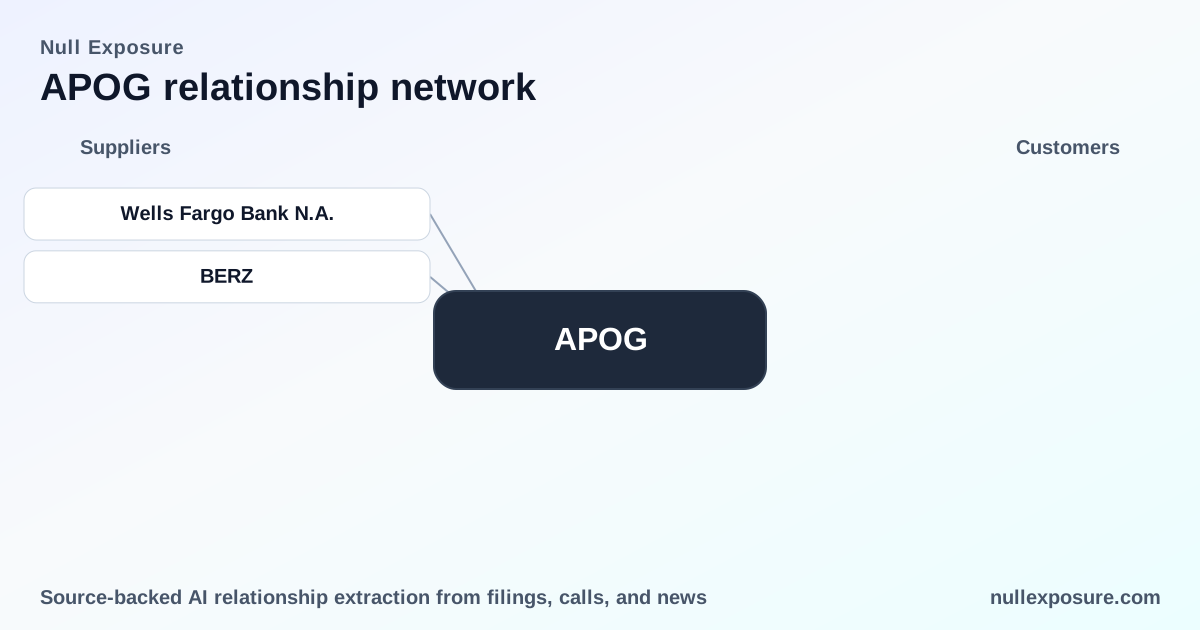
Detailed, line‑by‑line counterparties disclosed Below are the two bank counterparties named in Apogee’s FY2025 10‑K. Each entry is a plain‑English summary of the disclosed relationship and a short source citation.
Wells Fargo Bank N.A.
- The FY2025 Form 10‑K lists Wells Fargo Bank N.A. as a member of Apogee’s revolving credit facility and line-of-credit, indicating Wells Fargo participates in the company's short-term liquidity syndicate that supports working capital needs. According to the FY2025 10‑K filing, Wells Fargo is named explicitly among credit facility members (FY2025 Form 10‑K).
Bank of Montreal
- The FY2025 Form 10‑K names Bank of Montreal as a member of the same revolving credit facility and line-of-credit; this suggests a cross-border banking participation consistent with Apogee’s operations in the U.S., Canada and Brazil. The FY2025 Form 10‑K identifies Bank of Montreal among the credit facility participants (FY2025 Form 10‑K).
Operating-model constraints and what they imply for supplier risk Apogee’s public disclosure also provides a company-level signal on sourcing: raw materials are procured from a variety of domestic and international suppliers, establishing a global sourcing posture that reduces single-supplier concentration but increases exposure to international logistics, tariffs and currency swings. This excerpt is presented at the company level in the 10‑K and should be read as a corporate sourcing stance rather than a counterparty-specific commitment.
From that company-level signal we draw these operating-model characteristics:
- Contracting posture: Apogee relies on conventional commercial contracts and bank credit to fund project execution; supplier relationships are transactional rather than captive. This gives negotiating flexibility but also passes exposure for raw-material shortages to the company balance sheet.
- Concentration: Global sourcing reduces supplier concentration risk for raw inputs but increases systemic exposure to shipping, commodity and geopolitical volatility.
- Criticality: Bank facilities are critical for smoothing project-driven cash swings; bank participants are thus operationally important even if they are not strategic product suppliers.
- Maturity: Financial metrics and the presence of traditional credit facilities indicate a mature industrial financing model, not early-stage vendor financing or private credit arrangements.
Mid-article action — review exposure maps and facility terms If your thesis depends on counterparty strength or covenant flexibility, review the lenders’ roles and the credit agreement language directly; our platform provides searchable access to these disclosures for institutional workflows: https://nullexposure.com/.
Risk factors investors should monitor Apogee’s supplier and counterparty risk profile centers on three areas:
- Liquidity and covenant risk: Disclosed bank participation underscores dependence on revolving credit to fund working capital; covenant resets or adverse amendments would be first-order events for equity holders.
- Supply-chain volatility: Global sourcing reduces supplier concentration risk but increases sensitivity to freight, tariff and input-cost shocks that compress fabrication margins.
- Cyclical project timing: Project delays compress cash conversion cycles and escalate borrowing need; the combination of narrow profit margins and project timing variability elevates the importance of lender flexibility.
Bottom line — what this means for investors and operators Apogee is a capital‑intensive, project-driven fabricator that monetizes through product and service delivery and relies on bank syndication to manage working capital across construction cycles. The FY2025 10‑K names Wells Fargo Bank N.A. and Bank of Montreal as participating lenders to the company’s revolving credit and line-of-credit, which positions these banks as the operational liquidity backstop for project execution. Key monitoring triggers for investors: amendments to the credit agreements, changes in lender composition, margin erosion from raw materials or logistics, and meaningful shifts in project timing. For an at-a-glance map of these and other supplier relationships tailored for diligence teams, visit https://nullexposure.com/.
If you want a deeper counterparty assessment or continuous monitoring for covenant changes, our platform consolidates these issuer-to-supplier linkages and updates them each reporting cycle at https://nullexposure.com/.