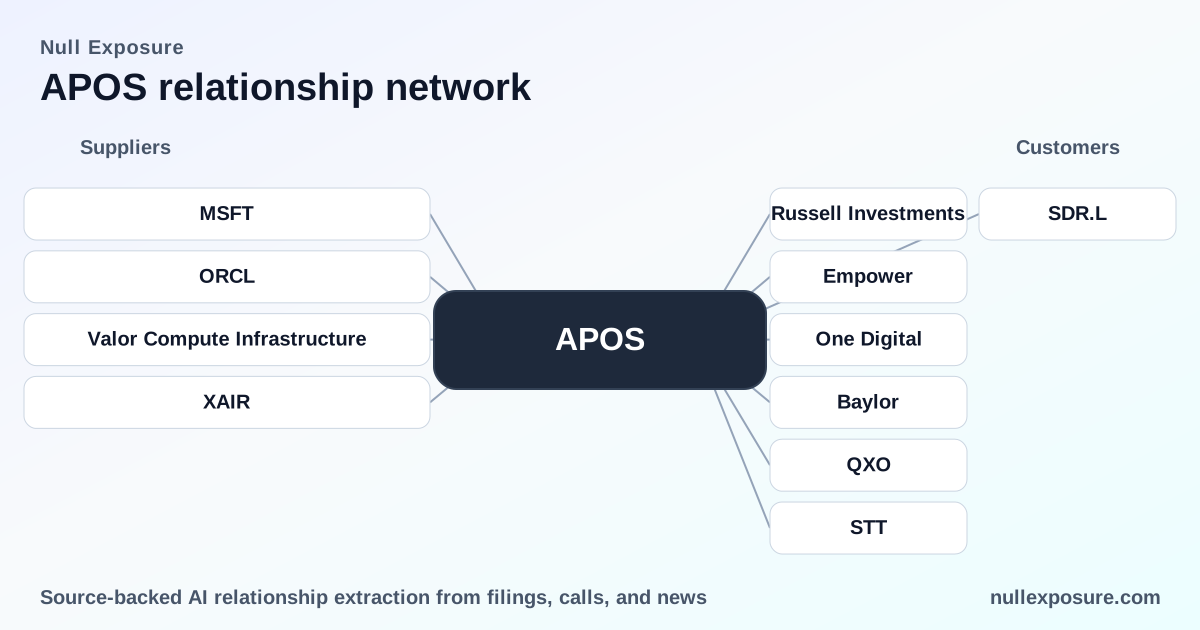
Apollo Global Management (APOS): Supplier relationships and what they reveal about credit posture and operational risk
Apollo Global Management operates as a global alternative asset manager that monetizes through management fees, performance fees (carry), and credit investing—including direct financing and structured asset-backed financing. The firm deploys capital across private equity, credit and real estate while also acting as a lender/arranger on large-scale financings; those financing relationships both generate returns and create counterparty exposures that are material to risk assessment. For investors and operators evaluating APOS supplier links, the current signal set highlights a preference for large, investment-grade counterparties, a blended mix of long- and short-term funding arrangements, and selective direct financing into technology infrastructure. Explore more about Apollo’s supplier footprint at https://nullexposure.com/.
Quick take: why supplier relationships matter for an alternative manager
Apollo’s balance-sheet and sponsored financing activities mean suppliers—banks, hyperscalers and project financing partners—are not peripheral vendors but financial counterparties and demand drivers. Relationships with large banks determine liquidity and refinancing flexibility; relationships with hyperscalers and specialized infrastructure firms determine credit risk concentration when Apollo underwrites or holds exposure to their projects.
- Funding posture is hybrid: the company relies on multi-year revolving facilities for institutional funding while keeping short-term liquidity lines available to manage near-term cash flows.
- Counterparty quality is prioritized: exposures that are described as investment-grade and with hyperscalers point to a conservative credit underwriting tilt for some allocations.
- Selective growth into tech infrastructure: Apollo has recently led large financings for compute-heavy data centers, signaling appetite for complex, capital-intensive credit deals tied to AI scale-out.
If you evaluate or manage third-party exposures for institutional portfolios, see how these supplier dynamics affect counterparties and financings at https://nullexposure.com/.
The constraints that define Apollo’s supplier posture
The public excerpts and filings give company-level signals on contracting and counterparty management that shape supplier risk:
- Contracting maturity is mixed but intentional. Evidence shows five-year revolving credit agreements and other facilities maturing out to 2029, alongside shorter-term liquidity facilities with one-year ladders and extension options; this reflects an operational model that balances long-term committed capacity with tactical short-term liquidity lines.
- Counterparty concentration skews to large enterprises. Apollo’s retirement services and repurchase activity reference major brokerage firms and commercial banks as primary counterparties, indicating reliance on major financial institutions for secured funding and liquidity.
- Service-provider relationships are formal and bank-centric. Multiple facility agreements list banks as administrative agents, signaling that traditional banks are core service providers rather than tertiary vendors.
- Operational criticality and maturity are elevated. Long-duration facilities and repeated reliance on syndicated bank credit indicate mature arrangements that materially influence cash and leverage management.
Collectively, these constraints present a company-level strategy of diversified tenure in funding, high-quality counterparties, and bank-anchored service relationships—useful context when pricing counterparty risk or negotiating commercial terms.
Microsoft and Oracle: hyperscalers showing up on the balance sheet
Apollo disclosed that Athene’s balance sheet includes de minimis exposure (0.5%) that is almost entirely investment-grade and concentrated with hyperscalers such as Microsoft and Oracle, reflecting a conservative credit position for that slice of assets. This snippet came from Apollo’s 2025 Q4 earnings call commentary in March 2026 and indicates that where Apollo (via Athene) has technology-related credit exposure, it is to top-tier enterprise counterparties. According to Apollo’s 2025 Q4 earnings call (reported March 8, 2026), the hyperscaler exposure is investment-grade and immaterial in size for Athene.
Valor Compute Infrastructure: a major project finance role
Apollo recently led a US$3.50 billion financing package for Valor Compute Infrastructure to fund the build-out of xAI’s large-scale data centers and Nvidia GB200 GPU deployments, signaling active direct lending into hyperscale compute infrastructure. A Simply Wall St article in March 2026 notes Apollo’s leadership role in structuring and providing this sizeable financing, which demonstrates the firm’s willingness to underwrite concentrated, capital-intensive technology projects as part of its credit strategy.
xAI: beneficiary and demand driver
xAI is the named beneficiary of the Valor financing; Apollo’s capital is underwriting the AI compute capacity build that will drive near-term demand for high-end GPUs and data-center capacity. A Simply Wall St piece (March 2026) reported that the financing backs xAI’s large-scale data-center and GPU build-out, making xAI a commercial partner on the demand side of Apollo’s infrastructure financing.
What each relationship implies for investors and operators
- Hyperscaler exposures are small but strategically significant. The 0.5% exposure to Microsoft and Oracle is investment-grade and minimal in scale, which reduces immediate credit risk while giving Apollo access to high-quality counterparties.
- Project financing increases concentration and sector-specific risk. The Valor/xAI financing is large and sector-specific—exposure to AI infrastructure introduces technology-cycle risk, supply chain dependencies (GPUs), and project execution risk that differs from traditional corporate credit.
- Bank facilities are core operational levers. Evidence of multi-year revolving facilities and short-term liquidity lines indicates Apollo relies on bank syndicates for flexibility and leverage management; those relationships are operationally critical to funding and arbitrage activities.
Investor checklist: monitor these signals
- Track roll dates and covenants on the long-term revolving facilities maturing through 2029—covenant reset or repricing will affect liquidity and funding cost.
- Watch the performance and cashflow of Valor/xAI assets—project delays or GPU supply shifts could change credit metrics for the financed entity.
- Maintain counterparty exposure limits against large banks and hyperscalers given their central role in Apollo’s operating model.
For a structured view of Apollo’s supplier and counterparty landscape—useful for due diligence or risk modeling—visit https://nullexposure.com/ and review the supplier profiles.
Bottom line: conservative credit posture with targeted concentration
Apollo’s supplier footprint blends conservative credit placements with strategic, high-concentration project finance bets. The firm’s use of long-dated revolvers and short-term liquidity lines, reliance on large banking counterparties, and recent large-scale financing into AI compute infrastructure create a profile of mature funding arrangements plus selective exposure to technology execution risk. Investors should treat hyperscaler exposures as high-quality but monitor the Valor/xAI financing as a material, concentrated credit commitment that will drive performance variability in the near term.
If you want a deeper breakdown of Apollo’s counterparties and facility maturities for modeling counterparty default or liquidity stress, explore the supplier reports at https://nullexposure.com/.