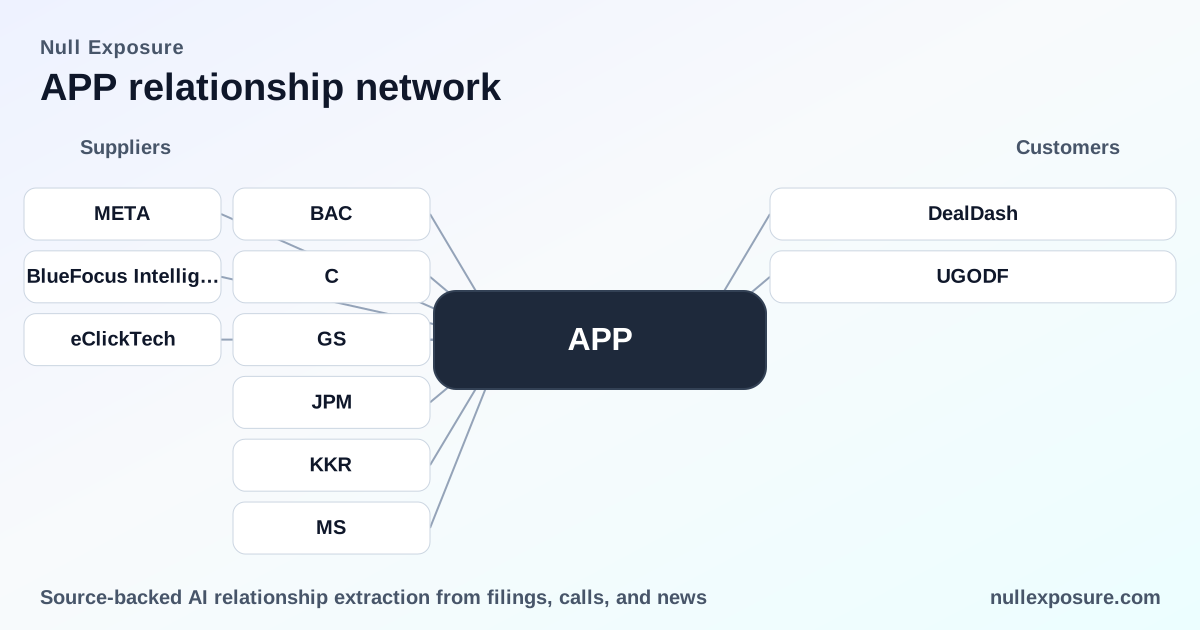
AppLovin (APP): Supplier map and what it signals for investors
AppLovin operates a software platform that helps mobile developers market and monetize apps globally. It generates revenue from advertising, in-app purchase (IAP) flows through app stores, and services tied to game studios and cloud infrastructure; the company reported roughly $5.48 billion in trailing revenue and carries a market capitalization around $153.2 billion. For investors and operators, the supplier footprint combines large capital-market counterparties, material platform dependencies (app stores and cloud), and a mosaic of third‑party service providers that together shape operating leverage and execution risk. Learn more at the Null Exposure homepage: https://nullexposure.com/.
Why suppliers matter for AppLovin: a short primer
AppLovin’s operating model is built on three interlocking supplier dynamics. First, distribution concentration is high: a significant portion of IAP and ad monetization flows through a limited set of app stores and social platforms. Second, infrastructure spend is large and long‑dated—the company has committed to over a billion dollars in non‑cancelable cloud spend tied to third‑party providers. Third, the business depends on a range of service providers (security consultants, payment processors, development studios) that impact uptime, compliance and attribution. These are not abstract statistics; they translate into negotiating leverage, single‑point failure risk, and predictable cash outflows that influence margins and capital allocation.
Who AppLovin is working with — counterparties and what each relationship means
Below I list each relationship found in public coverage and a plain‑English takeaway for investors.
-
Morgan Stanley — Morgan Stanley is listed as one of the lead firms managing AppLovin’s offering, reflecting institutional capital‑markets support for the company’s financing and public‑markets strategy. A PE Insights report naming the lead banks appeared on March 9, 2026: https://pe-insights.com/kkr-backed-applovin-files-for-ipo/.
-
JPMorgan Chase & Co. — JPMorgan is also a lead underwriter on the offering, providing distribution and syndicate capabilities for AppLovin’s capital transactions and signaling top‑tier banking access: https://pe-insights.com/kkr-backed-applovin-files-for-ipo/.
-
KKR — KKR is identified as an investor and lead participant in the offering, highlighting private‑equity capital involvement in AppLovin’s corporate structure and strategic financing: https://pe-insights.com/kkr-backed-applovin-files-for-ipo/.
-
Bank of America — Bank of America is named among the lead firms on the offering, indicating broad institutional underwriting and sale capability across retail and institutional channels: https://pe-insights.com/kkr-backed-applovin-files-for-ipo/.
-
Citigroup Inc. — Citigroup is listed as a co‑lead on the offering, adding another global bank to the capital markets consortium supporting AppLovin’s market activity: https://pe-insights.com/kkr-backed-applovin-files-for-ipo/.
-
Goldman Sachs Group Inc. — Goldman Sachs appears as a lead bank on the transaction, consistent with AppLovin’s access to elite investment‑bank distribution and advisory services: https://pe-insights.com/kkr-backed-applovin-files-for-ipo/.
-
Meta Platforms — Plaintiff filings and investor‑advisory notices allege that AppLovin exploited advertising data from Meta and used a “backdoor installation scheme” that inflated installation counts and related profit figures; these allegations are reflected in shareholder‑investigation press releases in mid‑ and late‑2025: Globenewswire, July 3, 2025 and October 16, 2025 (investigation notices posted by Bragar Eagel Squire P.C.): https://www.globenewswire.com/news-release/2025/07/03/3109611/0/en/APPLOVIN-ALERT-Bragar-Eagel-Squire-P-C-is-Investigating-AppLovin-Corporation-on-Behalf-of-Long-Term-Stockholders-and-Encourages-Investors-to-Contact-the-Firm.html and https://www.globenewswire.com/news-release/2025/10/16/3168358/0/en/applovin-reminder-bragar-eagel-squire-p-c-reminds-applovin-long-term-stockholders-to-contact-the-firm-regarding-ongoing-investigation.html.
-
BlueFocus Intelligence — A short‑seller report alleges AppLovin entered agency agreements with Chinese ad‑tech firm BlueFocus Intelligence as part of cross‑border e‑commerce expansion, a relationship cited in investigative coverage: Sahm Capital, June 12, 2025: https://www.sahmcapital.com/news/content/short-seller-says-applovin-is-desperate-and-doomed-shares-slide-2025-06-12.
-
eClickTech — The same short‑seller reporting claims AppLovin worked with eClickTech under agency agreements to expand operations in China, a relationship flagged in the June 12, 2025 short‑report coverage: https://www.sahmcapital.com/news/content/short-seller-says-applovin-is-desperate-and-doomed-shares-slide-2025-06-12.
What the supplier map implies for Investors and Operators
-
Concentration and criticality are primary risk vectors. AppLovin’s revenue is materially dependent on a handful of distribution platforms (Apple App Store, Google Play, Facebook per company statements). This creates high bargaining exposure to policy changes, commission resets, or de‑platforming events that can move top line quickly.
-
Contracting posture is defensive but committed. The company disclosed non‑cancelable cloud commitments of roughly $1.2–$1.3 billion, including an August 2024 amendment that set a $1.3 billion three‑year minimum, which signals long‑dated infrastructure costs and limited short‑term flexibility in that line item.
-
Service relationships are diverse and operationally material. AppLovin uses third‑party studios under service and development agreements, relies on consultants for cybersecurity and threat monitoring, and pays processing fees tied to IAP flows — together these create operational dependencies that affect uptime, compliance and monetization quality.
-
Counterparty maturity is mixed. On one hand AppLovin has top‑tier bank relationships for capital markets activity (Morgan Stanley, JPMorgan, Goldman Sachs, Bank of America, Citi); on the other, allegations from short‑seller coverage and shareholder investigations introduce reputational and legal volatility tied to partners like Meta and China‑facing ad‑tech firms.
-
Cost structure is predictable but sizeable. The disclosed spend band (100m_plus) for cloud services is a company‑level signal that meaningful cash is already committed to third‑party infrastructure, affecting free cash flow planning and negotiating leverage.
If you want a deeper supplier risk scorecard or a monitoring setup for these counterparties, explore Null Exposure’s supplier intelligence tools at https://nullexposure.com/.
Quick checklist for analysts before underwriting credit or modeling upside
- Validate the timing and amortization of the cloud spending commitment and its impact on EBITDA conversion.
- Stress test distribution concentration scenarios (Apple/Google policy changes, Meta ad platform restrictions).
- Include legal/reputational scenarios tied to the Meta allegation and short‑seller claims when forecasting downside.
- Review service‑provider SLAs and security attestations for third‑party risk that affects product integrity and user acquisition.
Final takeaways and next steps
AppLovin’s supplier map is a mix of high‑quality capital markets partners, material platform concentration, and significant long‑term infrastructure commitments. For investors this means upside is supported by strong monetization but exposed to platform policy shifts and lingering legal scrutiny. Operators should prioritize cloud‑contract flexibility and attribution integrity with distribution partners.
For a structured supplier risk report or to track these counterparties in real time, visit Null Exposure: https://nullexposure.com/. If you want a custom supplier due‑diligence brief for AppLovin, start here: https://nullexposure.com/.