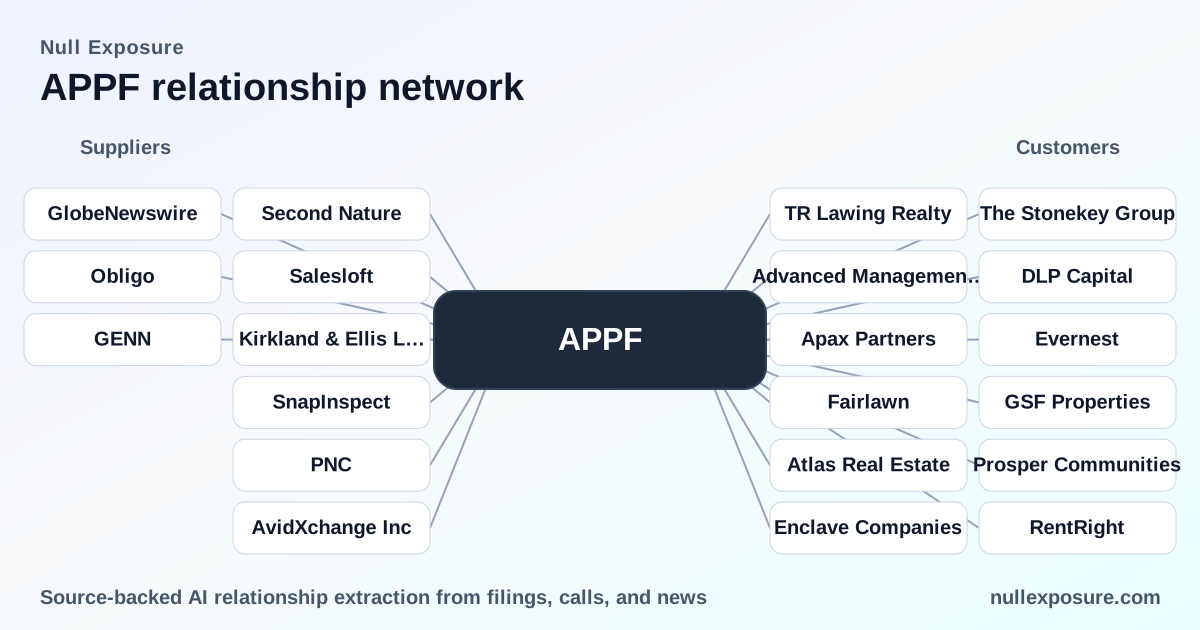
AppFolio (APPF): the supplier map investors need to underwrite recurring SaaS plus marketplace economics
AppFolio operates an industry-specific, cloud-native software platform that sells subscription access to property managers and layers transactional and value‑added services—payments, tenant screening, deposit alternatives and a partner marketplace—on top of its core SaaS. The business monetizes through a mix of recurring subscription revenue and higher‑margin platform services (payment processing, add‑on integrations and marketplace fees); AppFolio reported roughly $995M revenue TTM and a market cap near $6.14B, underscoring that supplier relationships are a direct lever on both margin and growth.
How AppFolio’s supplier posture shapes the investment case
AppFolio’s product strategy is explicitly integrative: the company stitches third‑party services into its resident onboarding, payments and operations workflows so customers rarely need to leave the AppFolio interface. That approach delivers distribution for partners and sticky bundled value for AppFolio, but it also creates operational dependencies.
- Contracting posture: AppFolio discloses it generally does not hold long‑term contracts with many service providers, indicating a short‑term, flexible procurement stance that prioritizes integration speed and marketplace breadth over long vendor lock‑ins.
- Role of suppliers: AppFolio treats many partners as service providers that power payment rails, credit reports, screening, communications and other value‑added services; those relationships are core to the platform experience and cost base.
- Business model implications: Short‑term contracts keep cost structure variable and reduce stranded vendor risk, but they increase execution risk around continuity, security vetting and negotiation leverage—factors investors should price into scenario models.
- Maturity and concentration: AppFolio integrates both established financial partners (large banks and payment processors) and specialized modern vendors (connectivity, inspection software), implying a hybrid maturity profile that spreads counterparty risk but elevates operational coordination needs.
For a deeper look at supplier exposures and documented partner activity, visit https://nullexposure.com/.
Supplier relationships you should track (each entry from public mentions)
Below I list every supplier relationship found in the public results and give a plain‑English takeaway with the original source context.
Second Nature
AppFolio co‑created a Resident Onboarding Lift with Second Nature to deliver a seamless move‑in experience that activates resident services and generates new revenue opportunities. This was disclosed in AppFolio’s Q4 2025 earnings call (reported March 2026).
Source: AppFolio Q4 2025 earnings call transcript, Mar 2026.
Salesloft (GlobeNewswire, Oct 8, 2025)
AppFolio disclosed a security incident on or around August 22, 2025 that affected Salesloft, identified as one of AppFolio’s vendors—calling attention to vendor security as a material operational risk vector.
Source: GlobeNewswire news release, Oct 8, 2025.
Salesloft (ClassActionLawyers blog)
A legal‑industry report reiterates that Salesloft operates AppFolio’s CRM portal and that the August 22, 2025 incident impacted that vendor connection, which has litigation and notification implications for customers.
Source: ClassActionLawyers blog post summarizing the incident, FY2025.
Salesloft (GlobeNewswire repeat notice)
Multiple public notices from October 2025 reinforce that the Salesloft breach was a vendor incident affecting AppFolio’s customer data flows and prompted investigative and legal responses.
Source: GlobeNewswire advisory, Oct 2025.
Grouprate Internet
AppFolio added Grouprate Internet to its Resident Onboarding Lift to offer residents immediate, affordable connectivity at move‑in—a direct product extension of onboarding monetization. This was mentioned in the Q1 2026 earnings call summary.
Source: Q1 2026 earnings call transcript coverage (Sahm Capital), Apr 2026.
Kirkland & Ellis LLP
Kirkland & Ellis served as legal counsel to AppFolio in the sale of MyCase to funds advised by Apax Partners (FY2020), evidencing that AppFolio uses top‑tier law firms for strategic transactions.
Source: GlobeNewswire press release, Sept 8, 2020.
SnapInspect (integration announcement, Nov 16, 2025)
SnapInspect integrated into the AppFolio Stack™ Marketplace to provide property inspection and maintenance workflows with real‑time updates and automated work orders, expanding operational automation for customers.
Source: Sahm Capital article covering the SnapInspect integration, Nov 16, 2025.
SnapInspect (valuation coverage, Nov 28, 2025)
Independent coverage repeated that SnapInspect’s live integration improves automation and efficiency for property managers using AppFolio, reinforcing the strategic value of marketplace integrations.
Source: Sahm Capital valuation commentary, Nov 28, 2025.
PNC Bank / PNC (credit facility, Feb 2026)
AppFolio entered a US$150M senior secured revolving credit facility with PNC Bank that includes stringent covenants restricting additional borrowing, major investments and certain capital returns—this changes capital allocation optionality.
Source: Sahm Capital coverage of the PNC facility, Feb 27, 2026.
PNC (duplicate mention)
Separately reported coverage reiterated the same PNC credit facility details and covenant profile, underscoring the financing constraint on strategic flexibility.
Source: Sahm Capital, Feb 2026.
AvidXchange Inc (embedded payments announcement)
AvidXchange announced an embedded supplier payment automation solution for AppFolio’s performance platform, signaling deeper automation of accounts‑payable and supplier payments inside the AppFolio workflow.
Source: MarketScreener news item, Mar 3, 2026.
Avid (AVGDD) (earnings call mention)
AppFolio’s Q1 2026 commentary describes a partnership with Avid that enables customers to manage the entire AP lifecycle—bill payment, reconciliation and fraud protection—directly within AppFolio.
Source: Q1 2026 earnings call transcript coverage (Sahm Capital), Apr 2026.
GlobeNewswire (press distribution reference)
A press distribution channel (GlobeNewswire) carried AppFolio announcements; a QuiverQuant posting noted an AI‑generated summary of an AppFolio release, highlighting how company news is propagated.
Source: QuiverQuant posting referencing GlobeNewswire distribution, FY2026.
SimpleVoIP
AppFolio added cloud communications through SimpleVoIP, extending voice and messaging capabilities as part of its integrated resident and operations stack.
Source: Q1 2026 earnings call transcript coverage (Sahm Capital), Apr 2026.
Obligo
AppFolio partnered with Obligo to introduce flexible deposit options for renters, broadening the company’s consumer‑facing financial services and increasing wallet share of resident transactions.
Source: Sahm Capital coverage of the Obligo partnership, Jul 2025 / FY2025 reporting.
Genesys (GENN) — earnings call example
AppFolio showcased partner orchestration using Genesys integrations as part of a “single pane of glass” approach; the company highlighted a customer case where consolidating nine systems into AppFolio produced meaningful operational gains.
Source: AppFolio Q4 2025 earnings call transcript, Mar 2026.
GENN (duplicate Genesys entry)
A second entry reiterates the Genesys integration example from the same earnings call, underscoring the strategic emphasis on integrated contact and workflow orchestration.
Source: AppFolio Q4 2025 earnings call transcript, Mar 2026.
What these relationships mean for investors
- Security is a live, quantifiable risk: the Salesloft vendor breach demonstrates that third‑party incidents can generate regulatory, legal and remediation costs that flow to AppFolio’s P&L and reputation.
- Platform stickiness runs through partners: integrations like SnapInspect, Grouprate, SimpleVoIP and AvidXchange deepen customer reliance on the AppFolio interface and create cross‑sell channels for services.
- Financing constraints change optionality: the PNC revolver covenants materially limit aggressive M&A or sizable capital returns until the facility is refinanced or covenants reset.
- Contract terms favor flexibility over lock‑in: short‑term supplier contracts are a deliberate operating choice that reduces long‑term fixed costs but increases negotiation and continuity risk.
Bottom line: AppFolio’s supplier ecosystem is a strategic asset that both accelerates monetization of the platform and introduces concentration and security vectors investors must underwrite. For a consolidated view of supplier exposures and how they affect scenario modeling, see our platform coverage at https://nullexposure.com/.
If you want a tailored briefing or a downloadable supplier map for APPF, reach out through the site and we’ll assemble the supporting documents and source links.