Appian (APPN) as a Supplier: Partner Exposure, Operational Constraints, and What Investors Should Price In
Appian sells a low-code automation platform and monetizes through cloud subscriptions and professional services, plus partner-driven delivery and implementation fees. The company operates a hybrid go-to-market model: it runs its own cloud offering (hosted on third-party infrastructure), sells enterprise subscriptions, and leverages systems integrators and regional partners to scale deployments. For investors, the key commercial drivers are subscription retention, large channel-led deals, and managed hosting economics; the key risks are concentrated infrastructure commitments and reliance on a handful of large partners for large-scale transformations. Learn more about supply-side signals at https://nullexposure.com/.
Quick take: the commercial model in one paragraph
Appian’s revenue mix is subscription-first, with professional services and partner delivery amplifying revenue and adoption. The platform can be delivered as a cloud subscription hosted in third‑party data centers, and Appian pays third‑party managed hosting providers as part of cost of subscriptions revenue. This creates a two-tier margin profile—recurring SaaS economics offset by fixed hosting commitments and service delivery costs—and drives the company’s capital allocation toward partner enablement and cloud capacity commitments.
What investors need to know about Appian’s supplier footprint
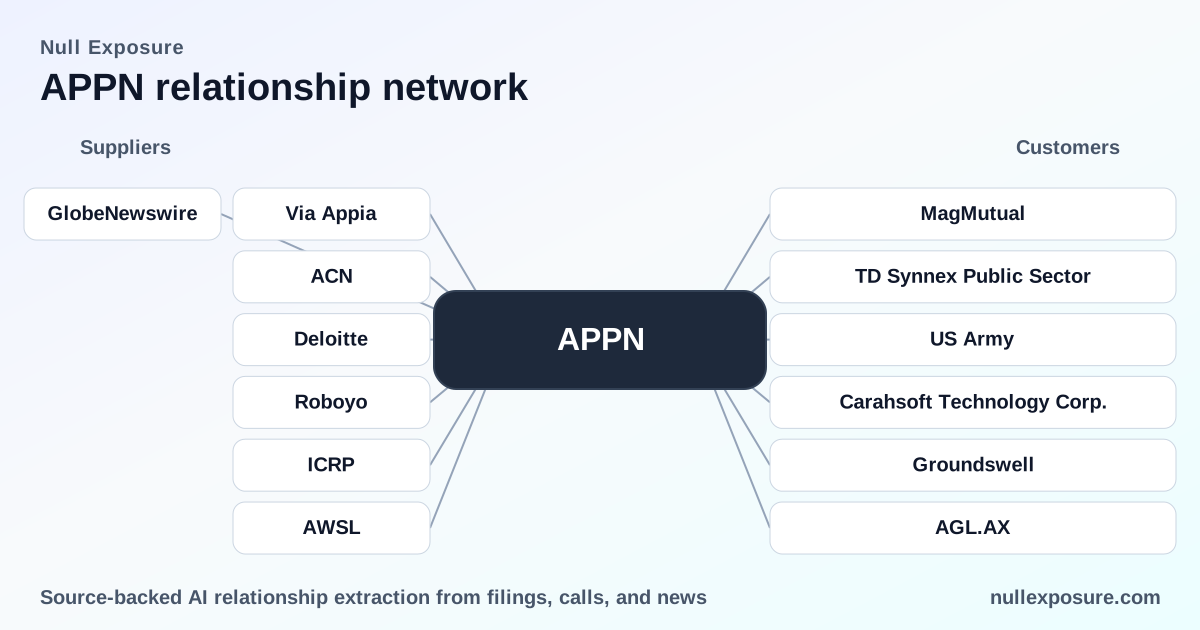
Appian’s supplier relationships are a mix of strategic infrastructure (cloud providers) and commercial partners (system integrators and RPA/automation specialists). The list of named partners in recent communications and filings gives a clear picture of the company’s route-to-market and operational dependencies.
Partner roster and press recognitions (FY2025)
- Via Appia — A PR Newswire release distributed via The Manila Times (Oct 14, 2025) recognized Via Appia for investing across innovation, Appian practice development, and delivery to expand Appian’s presence in the APJ region. This indicates regional reseller and delivery commitment tied to growth in Asia-Pacific. (Source: PR Newswire / The Manila Times, Oct 2025)
- Accenture (ACN) — The same PR Newswire noted Accenture as a leader in driving large-scale enterprise transformations using the Appian platform, underscoring strategic SI-led deal flow for enterprise customers. (Source: PR Newswire / The Manila Times, Oct 2025)
- Deloitte — Appian highlighted Deloitte’s multi‑year investment in the alliance, signaling sustained engagement with a global professional services firm to accelerate adoption. (Source: PR Newswire / The Manila Times, Oct 2025)
- Roboyo — Recognized for delivering Appian projects with quality and speed, Roboyo’s mention points to specialist delivery partners improving execution velocity on automation projects. (Source: PR Newswire / The Manila Times, Oct 2025)
Investor relations and communications suppliers
- ICR (ICRP) — Appian uses ICR as its investor relations/press contact for earnings releases (examples include third-quarter 2025 and full-year 2025 announcement schedules reported in Nov 2025 and Feb 2026). This is a standard IR relationship that supports market communications and earnings engagement. (Source: QuiverQuant press releases, Nov 2025 and Feb 2026)
Media distribution and release handling
- GlobeNewswire — One Appian press release was noted as being summarized by AI for distribution via GlobeNewswire; the presence of GlobeNewswire is an operational note about how Appian’s news reaches markets rather than a product or technology dependency. (Source: QuiverQuant / GlobeNewswire notice, FY2025)
Critical infrastructure partnership
- Amazon Web Services (AWS) — Appian’s 2024 Form 10‑K explicitly states that the company relies on AWS to operate its cloud offering and that a non‑cancellable cloud hosting arrangement contains minimum purchase commitments totaling $220 million over five years (with $44 million minimum annual spend from Nov 2024 to Oct 2029). This is the most material supplier exposure on the infrastructure side and creates both scale economics and fixed-cost risk. (Source: Appian 2024 Form 10‑K)
Contracting posture and company-level constraints investors should price
Appian’s public disclosures and constraint excerpts describe a supplier posture with these characteristics:
- Long-term, committed infrastructure spend. Appian maintains multi-year minimum purchase commitments with its cloud host (explicitly documented as $220 million over five years). This produces predictable hosting cost baseload but introduces downside when growth slows.
- Service-provider cost profile. Cost of subscriptions revenue is driven by fees paid to managed hosting and other third‑party service providers plus personnel for operations and support; this underscores gross‑margin sensitivity to hosting economics and delivery staffing.
- Infrastructure segment exposure. When delivered as cloud subscription, Appian manages operational needs in third‑party hosted data centers; infrastructure is a core operational dimension rather than an ancillary input.
- Large spend band. The disclosed commitments put Appian in a $100M+ spend band for critical hosting arrangements, which affects capital allocation and operating leverage.
These signals collectively define Appian’s supplier risk profile: high criticality and maturity on the infrastructure side (large, long-term commitments), and commercial distribution risk that is mitigated by established SI relationships.
Investment implications and risk checklist
- Positive: Partner network (Accenture, Deloitte, regional partners) amplifies enterprise reach and reduces direct sales CAC for large transformation deals. Specialist partners (Roboyo) shorten time-to-value, supporting subscription retention.
- Negative: Material fixed hosting commitments to AWS compress near-term margin flexibility if ARR growth decelerates. The dependence on third-party managed hosting creates an operational concentration risk that investors must price into multiples.
- Operational sensitivity: Cost of subscriptions revenue will track hosting rates and delivery staffing; any change in AWS pricing or delivery efficiency has outsized margin impact given disclosed minimum spend.
- Governance/market signals: High institutional ownership and a modest EBITDA base relative to market capitalization imply that investor expectations are forward-looking and sensitive to execution on partner-led growth and cloud economics (company overview metrics: Revenue TTM ~$727M, Market Cap ~$1.9B).
Explore supplier exposure and partner signals in more depth at https://nullexposure.com/ for investor-grade supplier intelligence.
Closing view and actionable next steps
Appian’s growth lever is clear: convert partner-driven deals into sticky subscription revenue while managing fixed hosting commitments. For investors and operators, the trade-off is between accelerated go-to-market via partners and the margin leverage (and risk) tied to large, long-term cloud commitments.
If you are evaluating Appian exposure for due diligence or portfolio positioning, review contract cadence and renewal terms for cloud commitments, and track partner-sourced ARR growth as the leading indicator of sustainable margin expansion. For a deeper supplier-risk assessment and ongoing monitoring, visit https://nullexposure.com/.
Bold takeaway: Appian’s partner ecosystem drives scale; AWS commitments create margin sensitivity — price the business as a subscription growth story constrained by infrastructure spend.