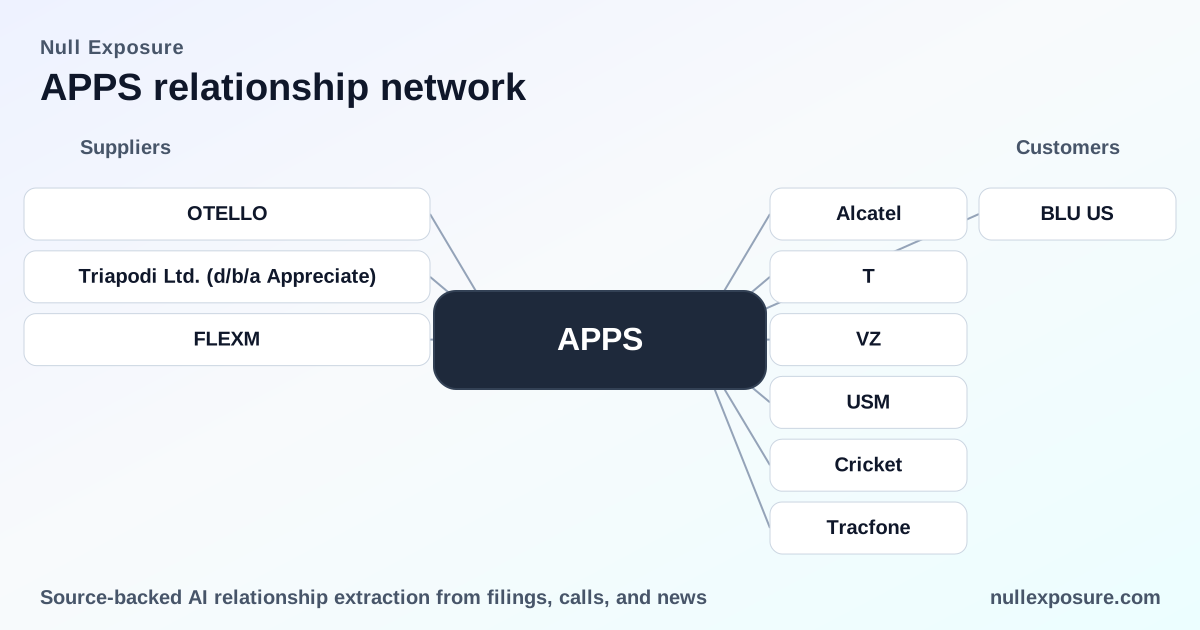
Digital Turbine (APPS): supplier relationships that shape growth and risk
Digital Turbine operates an on-device mobile distribution and advertising platform that stitches together carriers, OEMs, app publishers, advertisers, and demand-side technology to deliver app discovery and monetization on smartphones. The company monetizes through ad delivery, revenue-share agreements (CPM/CPI/CPA-style economics), licensing for on-device placement, and transactional ad campaigns, with a mix of multi-year channel deals and annual publisher contracts that drive recurring revenue and variable cost of goods sold.
For investors evaluating APPS supplier relationships, the key point is simple: growth depends on scale of carrier/OEM distribution and the economics of revenue sharing with publishers and advertisers, while operating leverage is constrained by minimum hosting commitments and a mix of contract tenors. Explore a concise review of material supplier ties below. For deeper supplier-risk analytics visit https://nullexposure.com/.
How the supplier model actually works — practical constraints that matter
Digital Turbine’s supplier posture shows deliberate hybrid contracting: long-term strategic arrangements with wireless carriers and OEMs sit alongside shorter, cancellable publisher agreements and usage-based revenue-sharing economics. The company discloses that carrier and OEM agreements are typically multi-year, sometimes exclusive, and can be terminated early by carriers; publisher deals are usually renewed annually and cancellable on short notice. Revenue share is the dominant cost line and is settled through CPM/CPI/CPA-style arrangements.
- Contracting posture: Mixed — multi-year carrier/OEM relationships provide distribution durability, while annual publisher deals preserve pricing flexibility but increase churn exposure. (Source: company disclosures covering ODS business and contract terms.)
- Concentration: The business-level signal is low single-partner concentration — no supply partner generated over 10% of net revenue in FY2023–FY2025 — which reduces counterparty single-point risk. (Source: company revenue disclosures for FY2023–FY2025.)
- Criticality: Supplier roles are chiefly distributor (carriers/OEMs) and service provider (hosting), meaning partners enable customer reach and platform operation rather than supplying raw inputs. (Source: company contract descriptions and hosting agreement language.)
- Maturity and financial commitments: Hosting arrangements include minimum purchase commitments totaling roughly $230k over the next five fiscal years — a modest but non-trivial fixed-cost floor that sits in the $100k–$1M spend band. (Source: disclosed hosting agreement commitments.)
This configuration produces scalable revenue when carrier placements and ad fill are strong, but variable margins because a significant share of cost is revenue-sharing tied to ad monetization.
The partnership landscape — deals and acquisitions that matter now
Below are the supplier and commercial relationships surfaced in public filings and news releases. Each is summarized in plain English with source context.
Otello Corp / AdColony (acquisition)
Digital Turbine completed a strategic acquisition of AdColony, the mobile in-app advertising network formerly owned by Otello Corp, for an estimated $400 million; the deal integrated a leading mobile game ad network and monetization stack into Digital Turbine’s on-device distribution platform. This acquisition was announced in February 2021 via a GlobeNewswire release tied to the Otello transaction and positioned APPS to own both distribution and an ad exchange/monetization channel. (Source: GlobeNewswire press release, Feb 2021.)
Triapodi Ltd. (d/b/a Appreciate) — DSP acquisition
Digital Turbine acquired Triapodi Ltd., operating as Appreciate, a demand-side platform that the company credited with helping scale its Single-Tap functionality; the press release framed Appreciate as a complementary demand and auction capability to enhance ad buying and yield. The company communicated the commercial and technical fit in a PR Newswire announcement describing the acquisition and operational integration. (Source: PR Newswire announcement, acquisition disclosure.)
Flexion — commercial growth partnership for games
Digital Turbine entered a strategic commercial relationship with Flexion to expand game developer audiences across large telecom platforms, designed to boost app discovery and revenue for game publishers via the carrier/OEM distribution channels that Digital Turbine controls. The relationship was announced on PR Newswire and positioned as a commercial partnership to accelerate user acquisition through carrier-based placements. (Source: PR Newswire partnership announcement, FY2023.)
What these relationships imply for value and risk
The relationships and disclosed contract characteristics drive a clear set of investment implications:
- Value capture is dual-sided — ownership of ad inventory and demand technology (AdColony / Appreciate) increases margin potential by internalizing margins that would otherwise be paid to third parties. The Acquisitions strengthen the vertical integration between distribution and ad demand.
- Revenue is variable and tied to ad economics. The use of revenue-share and cost-per metrics means top-line growth scales with ad demand but margins are sensitive to advertiser pricing and fill rates. This is explicit in the company’s revenue-share disclosures.
- Contract tenor is a mixed hedge. Long-term carrier/OEM agreements provide distribution defensibility; annual publisher contracts keep inventory flexible but increase exposure to publisher churn and pricing pressure. Importantly, carriers retain early-termination rights in some multi-year deals, which assigns termination risk to the carrier side. (Source: contractual language in company disclosure.)
- Operational fixed costs are modest but binding. Hosting minimums totaling ~ $230k across five years indicate some fixed-cost stickiness that limits near-term downside but is not large enough to materially alter cash flow under severe demand contractions. (Source: hosting agreement commitments statement.)
These points combine into a working investment thesis: Digital Turbine is building higher-margin, repeatable distribution by internalizing demand-side and monetization capabilities, but revenue-share economics and cancellable publisher contracts create earnings variability that investors must underwrite.
For a structured supplier-risk scorecard and ongoing monitoring of carrier and hosting commitments, see detailed coverage at https://nullexposure.com/.
Tactical considerations for investors and operators
- Track ad pricing and fill rates closely; small declines in CPM/CPI pass quickly through to net margins because of revenue-share payouts.
- Monitor carrier/OEM contract renewals and any public notices of termination, since these partners control critical distribution channels.
- Evaluate integration progress for Appreciate and AdColony into ad yield stacks; successful integration is the principal path to margin expansion.
If you are modeling APPS, stress test scenarios where publisher churn increases and advertising CPMs decline, and run upside scenarios where internal demand yields increase ad capture rates.
Learn how supplier exposure changes valuation in quarterly updates at https://nullexposure.com/.
Bottom line
Digital Turbine’s supplier relationships are a strategic mix of distribution scale and demand-side control: acquisitions and partnerships enhance monetization, but revenue-share economics and mixed contract tenors introduce earnings variability that requires active monitoring. Investors should weigh the upside from vertical integration against the operational realities of cancellable publisher contracts, carrier termination rights, and modest hosting commitments. For ongoing supplier intelligence and scenario-driven analysis, visit https://nullexposure.com/.