APUS: Supplier relationships that shape a clinical-stage commercialization path
Apimeds Pharmaceuticals US, Inc. is a clinical-stage biotech positioning itself to commercialize Apitox, a bee-venom therapeutic licensed for the U.S. market. The company monetizes by developing and commercializing that licensed product in the United States — generating product sales if approved and paying a perpetual 5% royalty to the original licensor — while it sources active material under an exclusive manufacturing supply arrangement for the U.S. market. For investors and operators, the value thesis is straightforward: clinical progress and supply exclusivity determine commercialization upside and downside. Learn more about supplier risk and counterparty analysis at https://nullexposure.com/.
What the supplier picture tells you about how Apimeds operates
Apimeds runs a classic small-cap biotech operating model: clinical development supported by strategic licensing and tightly controlled supply lines rather than large in‑house manufacturing. From the available documents, several company-level operating characteristics stand out:
- Contracting posture: The firm relies on licensing arrangements and letter agreements rather than integrated manufacturing, signaling a capital-light commercialization approach and dependence on external suppliers and licensors.
- Concentration and criticality: There is a single-source, exclusive supply commitment for the U.S. market for key raw material, which converts operational concentration into a critical dependency for commercialization.
- Maturity and compliance: Suppliers identified hold GMP certification and an FDA Drug Master File (DMF), indicating a mature regulatory posture for active-material supply even as the sponsor remains pre-revenue and clinical-stage.
- Financial posture: Promissory notes and convertible related‑party funding in the mid‑six‑figure range point to small but material cash infusions and related-party economics rather than large institutional capital.
- Geography and rights: Licensing splits commercial rights across APAC and North America — with Apimeds Korea retaining rights in Korea and Apimeds US holding U.S. commercialization rights — which shapes royalty streams and market exclusivity.
These signals combine to define a business that outsources manufacturing, monetizes through commercialization and royalty-sharing, and runs material counterparty concentration that is central to execution.
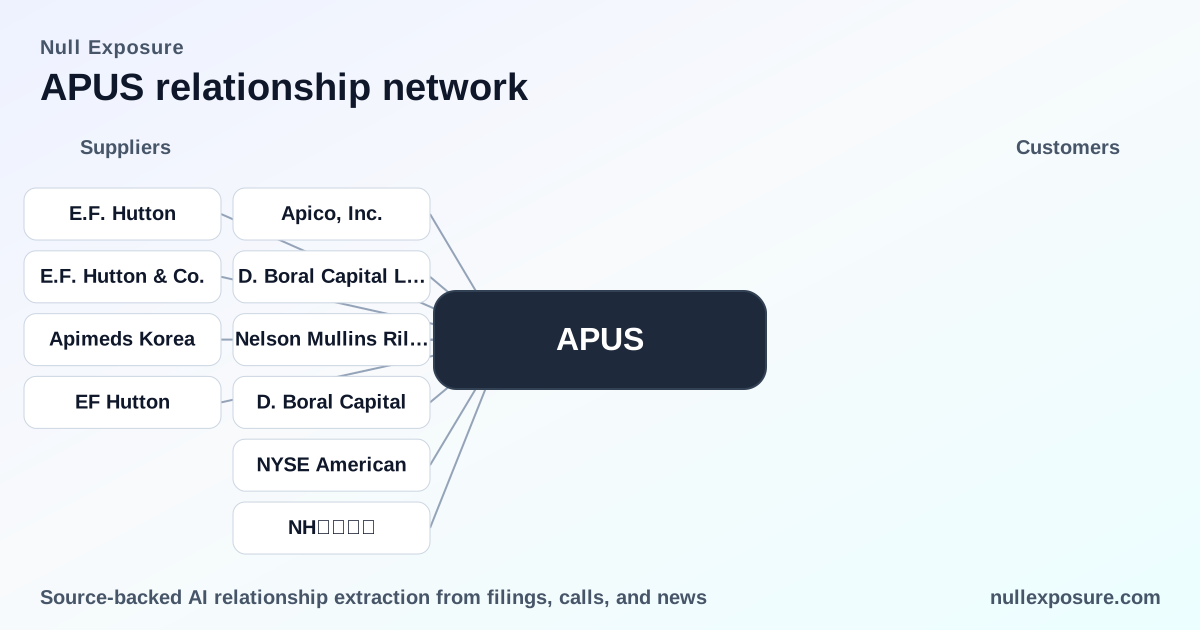
Supplier and advisor roll call (what each relationship means)
Below I cover every relationship found in sourced filings and news, each with a concise plain-English summary and its source.
-
Apico, Inc. — Apimeds purchases bee venom from Apico under a letter agreement; Apico agreed to exclusive supply for pharmaceutical use in the U.S. through November 3, 2031. According to the FY2024 Form 10‑K, Apico operates under FDA GMP and holds an active DMF for its harvesting method (FY2024 10‑K disclosure).
-
Apimeds Korea — Apimeds US holds a sublicensable, royalty-bearing license from Apimeds Korea to develop, manufacture and commercialize Apitox in the United States, and the company issued related convertible promissory notes to Apimeds Korea (royalty set at 5% of EBIT for Apitox). These terms are disclosed in the company’s business agreement language in FY2024 filings.
-
D. Boral Capital / D. Boral Capital LLC — Served as the sole bookrunner for Apimeds’ offering and IPO activity, including option arrangements for additional shares and warrants; coverage and deal terms are reported across Renaissance Capital and multiple press releases (news coverage, FY2024–FY2025).
-
Nelson Mullins Riley & Scarborough LLP — Acted as legal counsel for Apimeds in the offering process and was named in the press release describing deal representation (news release, FY2025).
-
NYSE American — The shares began trading on the NYSE American on May 9, 2025, under the symbol APUS, as noted in company press coverage around the offering (news release, FY2025).
-
E.F. Hutton / E.F. Hutton & Co. / EF Hutton — Served as an exclusive M&A advisor on the strategic merger between Apimeds Pharmaceuticals US and Mindwave Innovations Inc., a matter described in company and market press (CityBiz and GlobeNewswire coverage, FY2025).
-
NH투자증권 (NH Investment & Securities) — Reported in Korean financial press as being involved in allocation discussions with the underwriting group ahead of the Apimeds US listing, indicating international placement conversations (SeoulFN coverage, FY2025).
Each of the above relationships is documented in either the FY2024 company filing or contemporary press coverage around the FY2024–FY2025 offering and merger activity.
How the contractual details shape execution risk and optionality
Several constraint-level facts from filings create an operational map investors must price into valuation and risk models:
-
Licensing royalty and economics: The perpetual 5% royalty on EBIT to the licensor (Apimeds Korea) is a predictable ongoing cash outflow that reduces net margin on U.S. sales; this is a company-level contractual characteristic drawn from the licensing language in FY2024 filings.
-
Long-term exclusivity on supply: The Apico letter agreement creates ten years of exclusive U.S. pharmaceutical supply, which is a double-edged sword: it secures a compliant source of active material but concentrates replacement risk in a single supplier (this exclusivity is named in the constraint excerpts).
-
Manufacturer maturity vs. single‑source concentration: Apico’s GMP and DMF status signals regulatory readiness for clinical-to-commercial scale, while the company’s plan to engage Piramal Pharma Solutions for Phase III and potential commercial manufacture shows a hybrid supplier strategy to scale production — a company-level operational design noted in filings.
-
Related-party and small-dollar financing: Multiple promissory notes and a convertible note pattern in the $100k–$400k range indicate the company tapped related parties and small lenders for working capital instead of large institutional rounds; this is a clear spend-band signal and a materiality cue for governance and balance-sheet risk.
Investor implications and tactical takeaways
-
Positive: The combination of a licensed product with an exclusive U.S. supply agreement and compliant supplier certifications is a structurally favorable setup for a focused commercialization strategy. Clinical progress unlocking approval would convert a clear pathway into revenue with defined royalty mechanics.
-
Negative: Single-source supply and heavy related-party financing are the largest operational risks — replacement supply, counterparty disputes, or funding shortfalls are the most likely execution failure modes. Balance-sheet signals (mid‑six‑figure notes) show the company is small and funding-sensitive.
-
Actionable focus areas for investors and operators:
- Validate the durability and enforceability of the Apico exclusivity and the DMF status.
- Model the perpetual 5% EBIT royalty into margin scenarios and break-even analyses.
- Monitor financing cadence and any conversion events for related‑party notes that affect dilution or governance.
For a deeper exploration of counterparty exposure and supplier criticality, see our supplier mapping resources at https://nullexposure.com/.
Bottom line
Apimeds is a clinical-stage, license-driven biotech whose future economics rest on three concentrated dependencies: regulatory success for Apitox, exclusivity and compliance of a single U.S. venom supplier, and modest external funding that currently uses related-party instruments. Investors should value the upside of commercialization against concentrated supply and funding risk, and operators should prioritize supply diversification and capitalization clarity ahead of launch.
If you want detailed exposure maps and risk scoring for suppliers and counterparties like those described above, visit https://nullexposure.com/ to commission an analysis tailored to APUS and peer comparables.