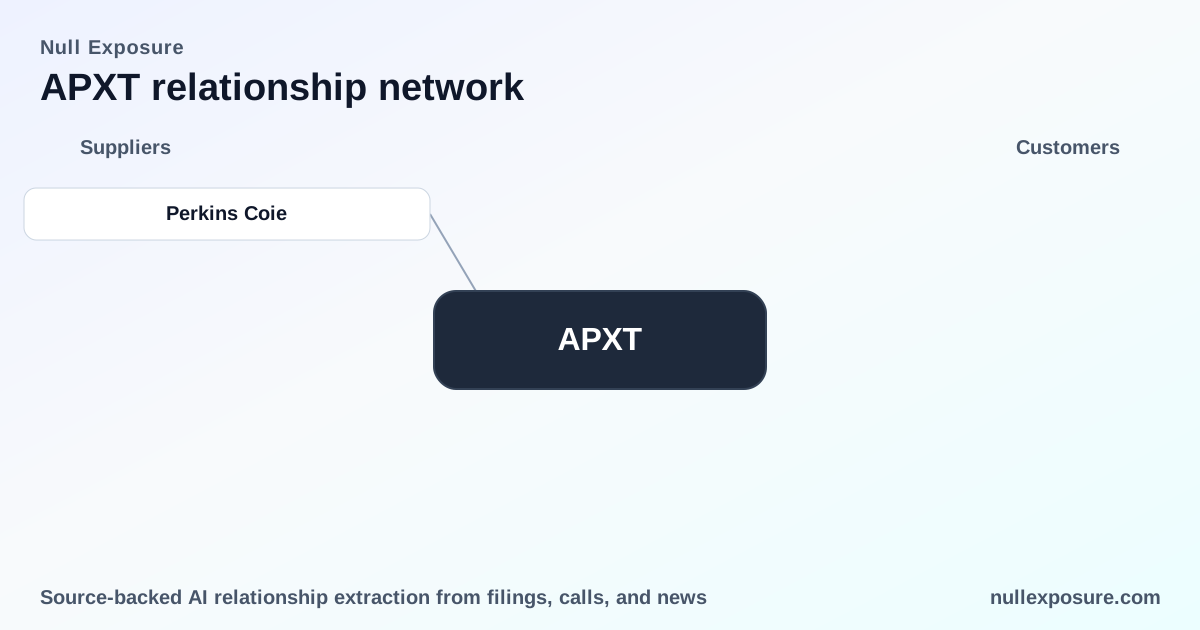
APXT — Supplier Relationships and Strategic Signals for Investors
Apex Technology Acquisition Corporation (APXT) is a special-purpose acquisition company that raises public capital through sponsor-led IPO units and monetizes by completing a de-SPAC merger with a high-growth technology target, capturing value through sponsor economics, public capital deployment, and transaction-driven fees. For investors and operators evaluating supplier relationships, the business model centers on time-bound, high-intensity engagements with legal, accounting, financial and placement agents rather than ongoing operating vendor contracts. If you are mapping counterparty risk or sourcing strategic advisors for a SPAC strategy, this profile highlights where counterparty concentration and criticality live in the structure. For additional supplier intelligence and ongoing monitoring, visit https://nullexposure.com/.
Quick company snapshot investors need to keep front of mind
APXT is a Nasdaq-listed SPAC (CIK 0001777921) with a market capitalization around $539.6 million and zero reported operating revenue, reflecting the pure acquisition vehicle model. The share base is roughly 35.8 million outstanding and institutional ownership is modest at ~8.4%, while insiders hold under 2%. These facts underline a capital structure designed for a single or a small number of transformative transactions rather than a diversified operating business.
How APXT’s supplier posture differs from an operating company
SPACs are fundamentally different purchasers of services:
- Contracting posture is transactional and deadline-driven — engagements for legal, audit, and placement services compress around IPO and de-SPAC timelines.
- Supplier concentration is episodic — a small set of legal/financial advisors deliver the bulk of critical work in short windows.
- Criticality is very high for advisory services — mistakes or frictions in counsel, underwriting, or accounting can derail a deal.
- Maturity of relationships is shallow but intense — long-term supply contracts are uncommon; reputation and track record, not volume discounts, drive selection.
These company-level signals reflect the SPAC model rather than any single supplier relationship disclosed in the supplier results.
The one supplier relationship recorded in our results — what it means
Perkins Coie advised a separate SPAC, Apex Treasury Corp., on an upsized IPO that raised $344.7 million through the sale of 34.47 million units at $10 each. According to a Perkins Coie press release dated March 9, 2026, the firm acted as legal counsel on that transaction, illustrating continued demand for top-tier law firms in large SPAC offerings. Source: Perkins Coie press release, March 9, 2026 — https://perkinscoie.com/news/press-release/perkins-coie-advises-apex-treasury-corp-upsized-3447m-blockchain-and
- Perkins Coie — The entry shows Perkins Coie acting as legal advisor to a peer SPAC (Apex Treasury Corp.) on an upsized $344.7M IPO, demonstrating the law firm’s active role in high-value SPAC equity raises. Source: Perkins Coie press release, March 9, 2026 — https://perkinscoie.com/news/press-release/perkins-coie-advises-apex-treasury-corp-upsized-3447m-blockchain-and
This single recorded relationship is not a direct APXT-vendor contract in the public record provided here, but it is a market signal: elite law firms are core suppliers across SPAC transactions and will be central to APXT when it executes an IPO or de-SPAC process.
For a broader supplier coverage view and continuous updates on counsels and advisors, see https://nullexposure.com/.
What every investor and operator should infer from the record
- Advisory services are mission-critical. Even when not named to APXT directly, legal and capital markets firms operating at scale are the backbone suppliers for SPAC lifecycle events.
- Supplier risk is time-concentrated. The counterparty exposure exists in short, high-value episodes (IPO, diligence, de-SPAC vote), so operational continuity, reputational alignment, and contract terms around deliverables and liability matter more than price.
- Transparency will determine deal execution quality. Public filings and counsel press releases are primary inputs for assessing who is positioned to execute; the Perkins Coie notice is exactly the type of evidence that signals execution capacity in the SPAC ecosystem.
Practical risk checklist for evaluating APXT supplier relationships
- Confirm counsel and auditor integrity: ensure chosen firms have recent SPAC or public M&A experience and clear conflict checks.
- Assess contingency plans: every major service provider should have documented backups for discovery, fairness opinions and IPO underwriting contingencies.
- Monitor counterparty concentration: a single-advisor model accelerates deal speed but heightens single-point-of-failure risk.
- Track public disclosures: legal press releases and filings provide early warnings about market activity and potential supplier commitments.
Constraints and company-level signals (from the supplied intelligence)
No supplier constraint excerpts were provided for APXT in the data set. Treat this absence as a company-level signal: there are no disclosed supplier restrictions or flagged contractual limits in the supplier intelligence reviewed. In practice, the SPAC model produces structural constraints that investors must manage:
- Contracting timelines are finite (SPAC lifecycle forces compressed sourcing windows).
- Transaction concentration amplifies supplier importance (a single failed advisory engagement can destroy deal economics).
- Maturity of vendor relationships is low (SPACs recruit reputation-based suppliers for one-off, high-impact engagements).
How to act — clear next steps for investors and operators
- For investors: validate APXT’s roster of legal, accounting, and underwriting partners before deploying capital; absence of visible advisor commitments elevates execution risk.
- For operators: secure counsel and auditors with demonstrable SPAC experience and documented conflict mitigation; negotiate service-level expectations tied to timeline deliverables.
- For both: use continuous monitoring of counsel market activity as a forward indicator of deal readiness — press releases like the Perkins Coie notice are predictive of ecosystem capacity.
Learn more about supplier mapping and active monitoring for SPAC counterparties at https://nullexposure.com/.
Bottom line
APXT is a capital-raising vehicle whose supplier risk is dominated by short-duration, high-criticality advisory relationships. The recorded Perkins Coie engagement within the SPAC market is a useful proxy: top-tier legal counsel is indispensable and functionally critical to transaction success. Investors and operators should prioritize supplier diligence on counsel, accountants and underwriters and treat those relationships as central to deal execution rather than peripheral procurement decisions.
For ongoing supplier intelligence and targeted alerts on APXT counterparties, visit https://nullexposure.com/ and subscribe for updates.