Apyx Medical (APYX): supplier relationships that shape risk and runway
Apyx Medical sells radiofrequency and plasma-based medical devices into cosmetic and surgical markets and monetizes through product sales, recurring consumables, and targeted capital markets activity to support manufacturing and commercial expansion. Revenue comes from device and accessory sales; working capital and short-term finance are supported by periodic equity offerings and capital markets placements. For investors and operators evaluating supplier exposure, the company’s supplier posture combines short-duration purchasing with a single, partially owned China manufacturing partner and manageable, mid-single-digit supplier spend relative to revenue.
If you want a concise supplier map and operational signals for deal diligence, visit https://nullexposure.com/ for the full supplier intelligence feed.
How Apyx runs the supply side Apyx outsources components and contract manufacturing for proprietary devices and maintains a hybrid sourcing model: short-term purchase orders drive flexibility for inventory and product development, while the company carries a long-term real estate commitment (a 10-year initial lease) that signals fixed overhead and a stable operating footprint. Apyx’s supplier relationships combine a controlled manufacturing dependency in China with professional service providers for audit and investor communications, and periodic underwritten equity offerings to fund growth.
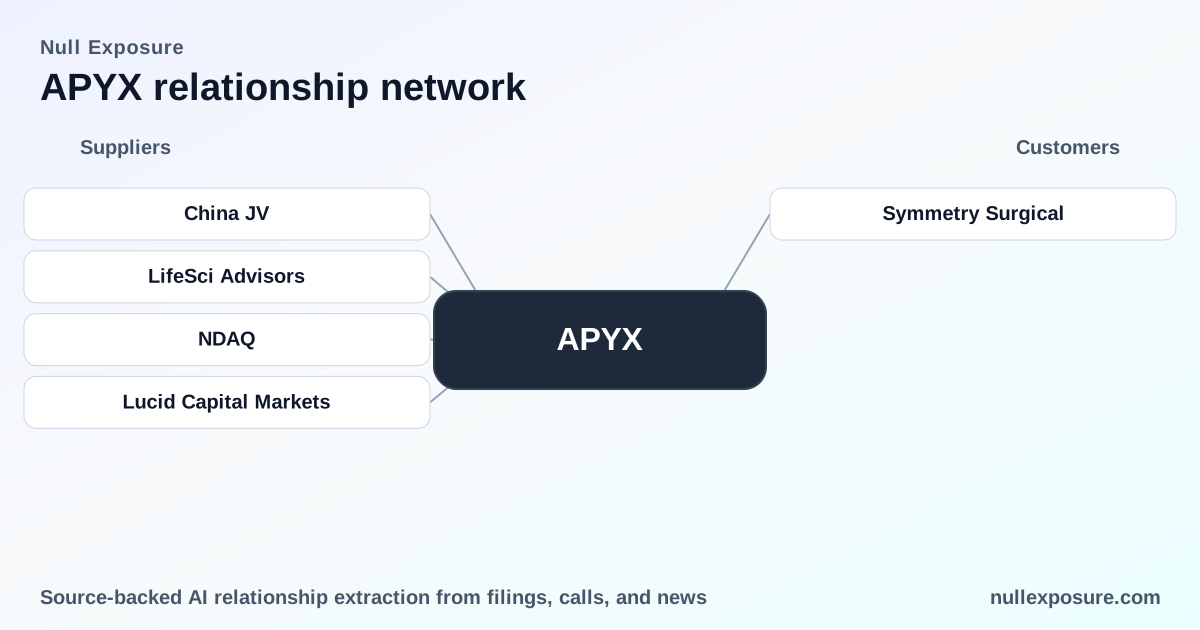
Supplier relationships that matter (brief summaries) A clear picture of counterparties helps prioritize counterparty diligence. Below are every relationship surfaced in the filings and news captures, each summarized with source context.
China JV — manufacturing partner and 51% owned joint venture
Apyx holds a 51% ownership interest in a joint venture formed in 2019 with a Chinese supplier, and that partner also supplies components to Apyx; purchases from this partner totaled approximately $1.0 million in 2024 and $0.6 million in 2023. This structure creates both aligned incentives via ownership and concentrated manufacturing exposure in Ningbo, China. (Source: Apyx FY2024 Form 10‑K disclosure.)
LifeSci Advisors — investor relations and PR contact
LifeSci Advisors serves as Apyx’s investor relations contact, repeatedly listed in 2025–2026 press releases and filings as the public liaison (Jeremy Feffer, Managing Director). This relationship indicates a consistent PR/IR channel used in tandem with capital raises and regulatory communications. (Sources: LifeSci Advisors contact listings in Apyx press releases and news items, FY2025–FY2026 via StockTitan and Yahoo Finance.)
Lucid Capital Markets — sole book‑running manager on public offering
Lucid Capital Markets acted as sole book‑running manager on a $10 million public offering and was similarly named in connection with a proposed offering in 2025, demonstrating Apyx’s reliance on boutique capital markets execution for near-term funding. This positions Lucid as a material counterparty for equity access. (Source: StockTitan report on the pricing of a public offering, FY2025.)
NASDAQ — listing venue and visibility partner (historic)
Apyx transitioned its public listing and branding in prior years and publicly welcomed NASDAQ for enhanced liquidity and visibility as part of a rebranding and listing effort reported in 2018; the exchange relationship underpins trading access and corporate visibility rather than supplier services. (Source: MassDevice article on the rebrand and NASDAQ listing, FY2018.)
Operating constraints and what they signal for investors Apyx’s documented constraints reveal a mixed contracting posture and concentrated but manageable supplier spend. Read these as behavioral and exposure signals rather than raw statistics.
-
Contracting posture — lean and flexible on inputs: The company’s purchase order commitments are explicitly never more than one year in duration and tied to sales forecasts, which creates operational flexibility and reduces long‑term inventory lockup. This is a corporate-level operating signal drawn from procurement policy statements in the 10‑K.
-
Fixed commitments coexist with short purchase cycles: Apyx carries at least one long-term lease (10‑year initial term with a five‑year renewal option), which anchors facility costs and increases fixed‑cost sensitivity to demand cycles; this underscores the importance of accurate sales forecasting to avoid margin pressure.
-
Geographic concentration — APAC manufacturing dependency: Apyx maintains collaborative arrangements with two foreign suppliers including a contract component manufacturer located in Ningbo, China, and the China joint venture partner is also a supplier. This creates geographic concentration risk and operational criticality around China-based manufacturing and logistics.
-
Spend scale and concentration: Purchases from the China JV supplier were approximately $1.0M in 2024 and $0.6M in 2023, and Apyx reported inventory purchase commitments of about $2.6M expected to be purchased by end of 2025. Relative to FY2025 revenue of roughly $52.8M, these figures indicate supplier spend is material but not dominant, concentrating risk around a small set of vendors rather than broad exposure.
-
Service providers and governance costs: Audit and related fees to RSM US LLP totaled $602k in 2024, a nontrivial governance expense that sits within the company’s professional services spend band and signals regular external oversight and compliance spend.
Mid-article action: for a deeper vendor-by-vendor risk profile and contract timelines, explore our supplier intelligence hub at https://nullexposure.com/.
Risk vs. upside — what matters for valuation and operations
-
Risk: single-region manufacturing concentration. The China JV ownership aligns incentives but centralizes production risk in Ningbo and creates a supplier-counterparty that is partly outside full corporate control. Expect investors to price a premium for that country‑level risk when volatility in logistics or regulation rises.
-
Risk: fixed lease commitment vs. cyclical revenue. The long-term lease increases operating leverage; under slower revenue growth, profitability will compress faster.
-
Upside: flexible purchasing and near-term capital access. Short-term purchase orders reduce inventory writedown risk and the company’s recent use of underwritten offerings (Lucid) and active IR (LifeSci) indicate continued access to equity financing, supporting growth investments and inventory funding.
-
Operational maturity: mid-stage commercial company. Revenue growth is positive (YOY quarterly revenue growth reported), gross margins are healthy relative to total revenue, but the company remains loss-making on EPS and EBITDA, requiring ongoing capital markets activity to fully fund growth and working capital.
What investors and operators should do next
-
For investors: stress‑test scenarios that model supply disruption in China for 3–6 months, and evaluate how quickly alternate suppliers can be qualified given product complexity. Use the company’s purchase‑order policy and inventory commitments as inputs to liquidity modeling.
-
For operators/partners: negotiate visibility into the China JV supply pipeline and enforce manufacturing KPIs; ownership alignment helps, but contractual remedies and dual-sourcing plans reduce execution risk.
-
For diligence teams: incorporate the Apyx supplier ledger into your counterparty scoring and track upcoming capital markets events with Lucid and IR communications through LifeSci to anticipate cash‑inflow timing.
Final thought and next step Apyx’s supplier picture is one of concentrated manufacturing exposure combined with prudent, short-duration purchasing and active capital markets engagement. That blend makes supplier risk measurable and manageable for investors who account for APAC concentration and lease-driven fixed costs.
For a full supplier breakdown and continuous monitoring, visit https://nullexposure.com/ to subscribe and add this supplier profile to your diligence workflow.