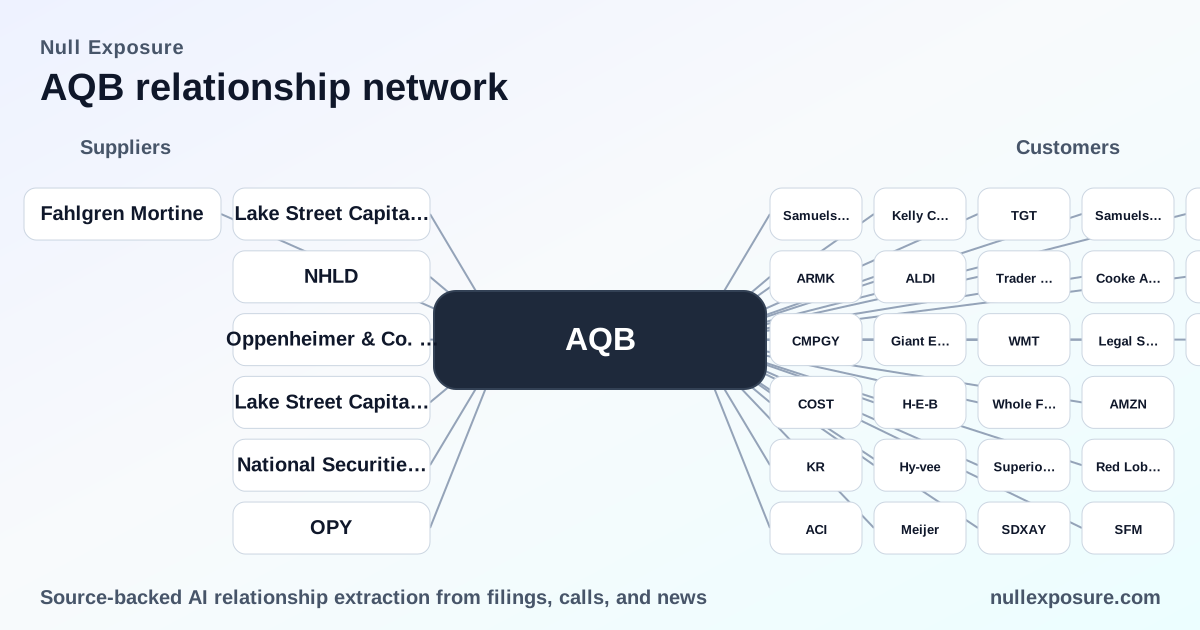
AquaBounty (AQB) counterparty map: underwriters, advisers and vendor signals investors should account for
AquaBounty Technologies operates as a small-cap biotechnology company that commercializes a genetically enhanced Atlantic salmon strain and monetizes through the sale of live fish and licensing of its transgene rights; the business model depends on intellectual property exclusivity, land‑based farming partners, intermittent capital raises, and vendor relationships to complete farm construction. For investors and operators evaluating supplier relationships, the most important signals are financing counterparties (underwriters and lenders), a small roster of service providers, and government grant interactions that have shifted into termination and repayment events.
If you want a concise supplier-risk briefing, visit https://nullexposure.com/ for our full coverage and terminal-quality exposure reports.
What the relationship list actually shows
Below I summarize each counterparty mention captured in public reporting and press releases. Each item is a plain-English description tied to the cited public note.
-
Lake Street Capital Markets, LLC (perishable news mention) — Lake Street is cited as a joint book‑running manager alongside Oppenheimer for a proposed public offering of AquaBounty common stock, underpinning the company’s access to capital markets in that financing event. According to a press release reported by Perishable News (public notice of proposed offering), Lake Street participated as a joint book‑runner (first seen Mar 9, 2026).
Source: Perishable News press release on the proposed public offering (2026). -
National Securities Corporation (Perishable News / National Holdings tie) — National Securities Corp., identified as a wholly owned subsidiary of National Holdings Corporation (NASDAQ: NHLD), acted as a co‑manager for the same public offering, giving AquaBounty a wider distribution channel for retail and regional broker placement. Perishable News’ offering notice lists National Securities Corp. as co‑manager (first seen Mar 9, 2026).
Source: Perishable News article on proposed public offering (2026). -
Oppenheimer & Co. Inc. (Perishable News mention) — Oppenheimer is listed alongside Lake Street as a joint book‑running manager for the 2020/2026 offering notice; its involvement signals engagement with a national investment bank for underwriting and institutional placement. Perishable News’ coverage of the offering names Oppenheimer as a joint book‑runner (first seen Mar 9, 2026).
Source: Perishable News article on proposed public offering (2026). -
Lake Street Capital Markets (Faegre Drinker legal summary) — A separate legal summary recorded that Oppenheimer, Lake Street and National Securities completed the underwriting for a public offering of 8,720,000 AquaBounty shares, confirming the same underwriting syndicate and giving a concrete transaction size. Faegre Drinker’s recap of the transaction documents the completed underwriting (November 2020).
Source: Faegre Drinker client alert summarizing the public offering (Nov 2020). -
National Securities Corp. (Faegre Drinker legal summary) — The Faegre Drinker account repeats National Securities Corp. as part of the underwriting group that completed the 8.72 million share offering, reinforcing National’s role as co‑manager in AquaBounty’s capital raise. Faegre Drinker documents the underwriting completion (Nov 2020).
Source: Faegre Drinker client alert on the underwriting (Nov 2020). -
Oppenheimer & Co. Inc. (Faegre Drinker legal summary, ticker OPY referenced) — Oppenheimer’s repeated inclusion in the Faegre Drinker recap confirms its position as the lead underwriter on the completed offering and establishes a pattern of relying on institutional underwriters for equity financings. Faegre Drinker recorded Oppenheimer’s role in the transaction (Nov 2020).
Source: Faegre Drinker client alert on the underwriting (Nov 2020). -
Fahlgren Mortine (media relations) — Fahlgren Mortine is listed as the media contact for AquaBounty’s First Quarter 2025 financial results release, indicating an outsourced public relations relationship for investor communications and press management. A NewsfileCorp release of AquaBounty’s Q1 2025 results lists Fahlgren Mortine as media contact (2025).
Source: NewsfileCorp release for AquaBounty Q1 2025 financial results (2025).
How these relationships map to the operating model investors need to understand
The relationship set is compact and functionally concentrated around three roles: capital markets underwriters, vendor/service providers, and PR/communications. That composition yields actionable conclusions about contracting posture and supplier risk.
-
Contracting posture: intermittent, financing-led — AquaBounty relies on capital raises underwritten by regional and national banks to replenish liquidity, as evidenced by the repeated underwriting syndicate across public offerings. This creates a rhythm where underwriting relationships are critical around financing windows but dormant between raises.
-
Concentration and criticality: small roster, high criticality — A handful of counterparties (Oppenheimer, Lake Street, National Securities) covered the underwriting; those underwriters are high‑criticality during capital raises because AquaBounty’s market cap and cash flows indicate limited internal funding capacity. Outsourced PR through Fahlgren Mortine demonstrates the company uses third parties for investor communications, a common approach for lower‑scale issuers.
-
Contract maturity and lifecycle signals: mixed and shifting — Public reporting and constraint excerpts reveal short‑term financing events (for example a secured term loan to fund working capital with maturity events in 2024) and longer‑running vendor or term‑note arrangements where waivers were necessary in 2025. The company executed asset sales and loan repayments, and a government loan was explicitly terminated; together these point to a transitionary lifecycle where some relationships are being wound down while others remain active for immediate liquidity.
-
Service provider posture: transactional, vendor dependence on construction/equipment — Public excerpts indicate AquaBounty depends on construction and equipment vendors for farm projects (notably the Ohio Farm Project) and engages investment banks to explore funding alternatives, signaling that operational progress is vendor contingent and that vendor willingness to continue work is strategically important.
If you want to see a full exposure profile and supplier-risk scoring for AquaBounty, visit https://nullexposure.com/ for expanded analysis and downloadable briefings.
Investment implications — concise checklist for operators and investors
- Capital dependency: The underwriting history confirms AquaBounty’s reliance on equity raises; investors should price in dilution risk when liquidity is tight and underwriter syndicates are the primary path to capital.
- Vendor execution risk: Completion of farm projects is conditional on supplier cooperation; any vendor reluctance translates to project delays and impairment charges, which the company has already recorded.
- Government counterparty volatility: The termination of a government loan (Atlantic Canada Opportunities Agency) and repayment of other loans are cashflow events that reduce optionality and can shift counterparty exposure from government grants to private lenders.
- Communications control: Outsourced PR is appropriate for scale but requires scrutiny during financing periods when messaging materially affects execution risk.
Key takeaway: AquaBounty’s supplier map is compact but high‑impact — a few underwriting partners and a small set of service providers dominate near-term execution and financing outcomes.
If you want a tailored briefing on AquaBounty’s supplier concentration and counterparty risk, get the firm-grade report at https://nullexposure.com/.
Final read for investors
For equity and credit investors, the recommended next steps are clear: monitor underwriting syndicate announcements around financing windows, track vendor engagement and construction milestones for the Ohio farm, and incorporate the termination of government support into base-case cashflow models. AquaBounty’s business hinges on IP licensing and successful, vendor‑executed land‑based farming projects financed through episodic capital raises — that combination produces high operational leverage and event-driven counterparty risk.
For more supplier maps and counterparty intelligence on small-cap biotechs and ag‑tech issuers, visit https://nullexposure.com/ for our research products and alerts.