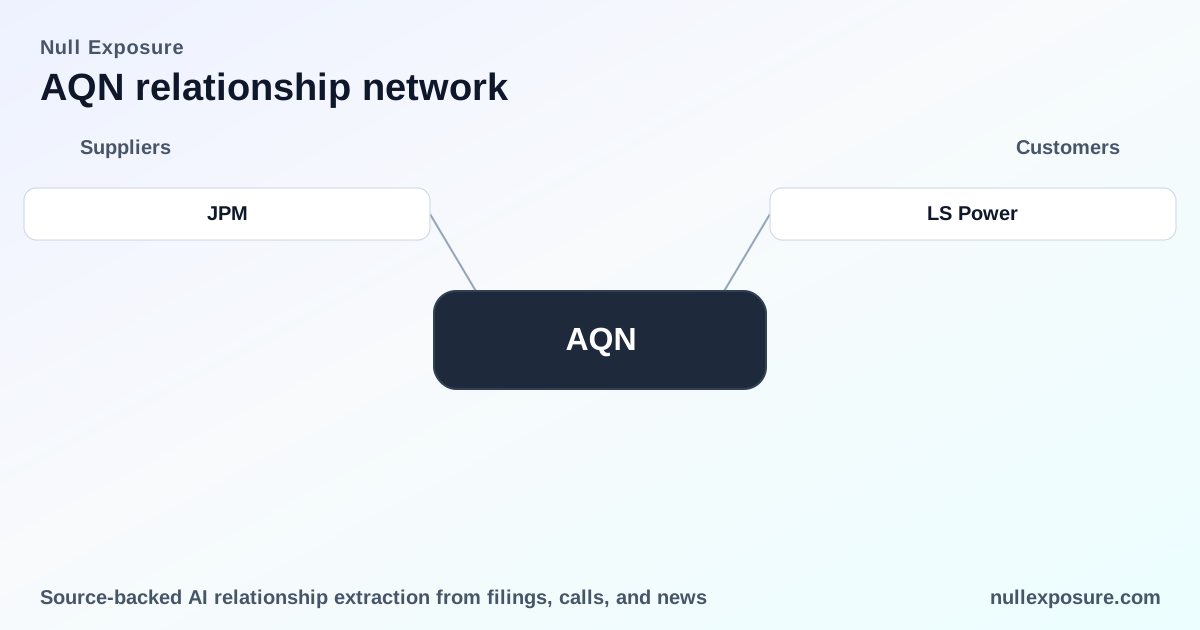
Algonquin Power & Utilities (AQN): Supplier relationships and what a strategic advisor tells investors
Algonquin Power & Utilities Corp. operates and monetizes by owning and operating regulated and contracted utilities alongside contracted renewable generation assets, generating cash through rate-based utility earnings, long-term contracts for energy, and strategic asset sales and portfolio rotations. Revenue scale is material — roughly $2.43 billion TTM — and the company balances recurring utility cash flows with actively managed renewable assets, using external financial advisors to extract value from non-core businesses. For investors evaluating supplier and advisor exposure, the recent deal process and the counterparty map are the most actionable signals. For a full view of supplier relationships and advisory counterparty risk, visit https://nullexposure.com/.
Why the advisor relationship matters for AQN investors
Algonquin’s transaction activity in 2026 crystallizes the company’s operating posture: management treats renewable assets as actively managed, saleable portfolio pieces while preserving utility franchise cash flows. That posture makes the choice of financial advisor a supplier decision with direct implications for valuation execution, timeline, and market reception. J.P. Morgan’s exclusive advisory role on the recent sale is therefore not a cosmetic supplier tie — it is an execution lever that influences proceed timing, deal structure, and counterparty selection.
- Key company context: Market capitalization ~ $4.93 billion; Revenue TTM $2.4336 billion; EBITDA ~$919.7 million; Dividend yield ~4.11%. These figures position Algonquin as a mid-cap utility operator that combines regulated earnings with asset-level monetization strategies.
For more on supplier exposures across utilities and transaction counterparties, visit https://nullexposure.com/.
How to read this supplier map: operating constraints and business model signals
Algonquin’s supplier posture is shaped by the following company-level characteristics (these are company signals rather than relationship-specific readouts):
- Contracting posture — strategic and transactional. The company leverages external advisory firms for M&A and portfolio optimization, indicating a preference to outsource capital-marketing execution while retaining operational control of regulated assets.
- Concentration and counterparty importance — moderate institutional concentration. Institutional ownership is high (about 72% of shares), which creates a governance environment that favors credible, well-known advisors and limit-side counterparties.
- Criticality — advisor selection can materially affect proceeds and timing. Given Algonquin’s blend of regulated and merchant/contracted renewable assets, successful divestitures reduce portfolio volatility and reallocate capital; advisors therefore function as critical suppliers during strategic transactions.
- Maturity and scale — established but still portfolio-active. Financial metrics (EV/EBITDA ~12.5, Forward PE ~18.05) reflect an established utility with growth visible through asset rotations rather than pure organic expansion.
Those signals explain why a top-tier investment bank would be engaged on a marquee sale and why advisor relationships warrant the attention of investors and operators.
The full set of supplier/advisory relationships uncovered
Below is the single supplier/advisory relationship identified in the results. Each entry is summarized in plain English with a source reference.
- J.P. Morgan — J.P. Morgan served as exclusive financial advisor to Algonquin in the sale of the company’s renewable energy business; the transaction was announced as a sale to LS Power for up to $2.5 billion, with J.P. Morgan handling the strategic and execution work on behalf of AQN. (News release, CNW/Newswire, March 9, 2026: Algonquin Power & Utilities Corp. agrees to sell renewable energy business to LS Power for up to $2.5 billion; J.P. Morgan was the exclusive financial advisor.)
What the J.P. Morgan relationship signals for investors and operators
The appointment of J.P. Morgan as exclusive advisor communicates several practical points for stakeholders:
- Execution seriousness: Exclusive advisory mandates concentrate negotiating clout and signal management expects a sizable, structured sale process that will attract strategic and financial buyers alike.
- Valuation and timing implications: Top-tier banks accelerate due diligence and market-testing, which helps crystallize value sooner and reduces execution uncertainty — important for a company balancing dividend commitments with capital redeployment.
- Supplier risk profile: Reliance on a single exclusive advisor for a material sale centralizes execution risk but standardizes the market approach; that is a conscious trade-off between speed and optionality.
Financial backdrop that frames supplier decisions
Algonquin’s operating metrics and market positioning explain why advisor selection is consequential:
- Scale and profitability: Revenue of $2.43 billion and EBITDA of $919.7 million indicate a company with meaningful cash generation capacity that can finance operations and dividends while pursuing strategic disposals.
- Valuation context: Trailing P/E is elevated at 91.71 (reflecting recent EPS dynamics), while Forward P/E of 18.05 suggests the market is pricing in re-rated earnings after asset transactions and operational normalization.
- Investor base and governance: Institutional holders own roughly 72% of the float, which increases pressure for disciplined capital allocation and credible advisor selection during sale processes.
These metrics underscore why Algonquin both needs and can afford high-quality advisory services when monetizing assets.
Practical implications for counterparties and portfolio managers
Operators and counterparties should treat advisory mandates as a signal of imminent portfolio change. For portfolio managers:
- Monitor advisor announcements and press releases closely; an exclusive advisory mandate often precedes binding offers and definitive agreements within quarters.
- Assess counterparty exposure: Sales to strategic players like LS Power, when combined with heavyweight advisors, affect credit profiles and residual business risk for remaining regulated assets.
For counterparties looking to partner on future renewables or utility contracts, engagement timing matters: active sale periods compress procurement windows and shift negotiating power toward large buyers and banks.
For an ongoing, machine-searchable view of supplier relationships and advisory mandates in the utilities sector, explore the curated coverage at https://nullexposure.com/.
Bottom line: advisor choice is a material supplier decision for AQN
Algonquin’s use of J.P. Morgan as an exclusive financial advisor on a transaction sized at up to $2.5 billion is a clear indicator that management executes portfolio rotations through established external partners rather than in-house disposal boutiques. That supplier relationship directly influences realized valuation, deal cadence, and capital redeployment options — all factors that matter to investors and operators.
If you are evaluating counterparty risk, building a watchlist, or preparing for upcoming market-moving disclosures, use the source signals and relationship map at https://nullexposure.com/ to stay ahead of transaction-driven volatility.