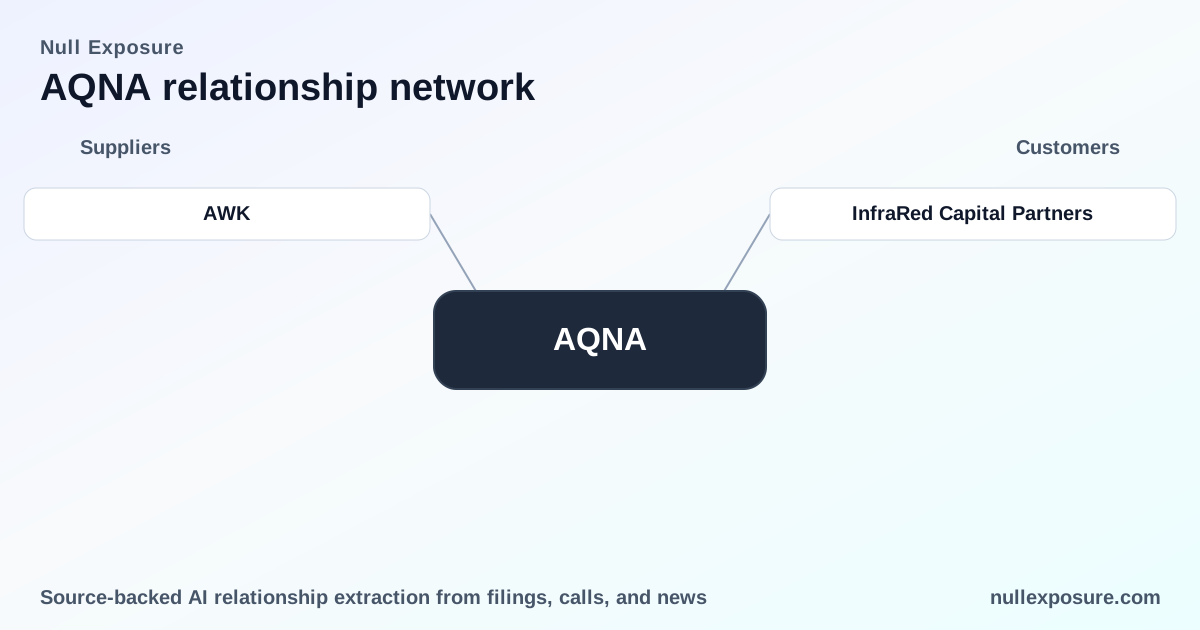
AQNA supplier profile: what Algonquin’s Liberty Utilities purchase of American Water assets reveals
Thesis — AQNA operates and monetizes through regulated utility ownership and asset consolidation: the company acquires regulated local distribution systems and folds them into its Liberty Utilities operating platform, capturing stable rate‑base returns, service revenues, and incremental operational margin from scale. Monetization is driven by regulated cash flows, acquisition-led growth, and utility integration efficiencies—a profile that positions AQNA as a consolidation‑focused supplier/owner in the North American utility space.
If you evaluate counterparty exposure or supplier risk associated with AQNA’s utility platform, this note summarizes the single reported relationship in our feed and frames the operating implications. Explore more supplier intelligence at https://nullexposure.com/ early in your diligence.
The transaction that matters: Liberty Utilities (AQNA) bought American Water’s NY operations
Algonquin’s regulated utility platform, Liberty Utilities, acquired American Water’s regulated operations in New York for $608 million in cash. According to reporting in Smart Water Magazine on March 9, 2026, American Water closed the sale of those operations to a Liberty Utilities subsidiary, making the asset transfer a material consolidation move for AQNA’s regulated footprint. (Smart Water Magazine, March 9, 2026)
This is the only relationship surfaced in the supplier results for AQNA in the current feed, and it is direct: the buyer is a Liberty Utilities subsidiary under the Algonquin Power & Utilities Corp. corporate umbrella. (Smart Water Magazine, March 9, 2026)
Why a single-transaction signal is consequential for supplier posture
The acquisition of American Water’s New York regulated operations is not a routine vendor contract; it is an expansion of AQNA’s underlying utility asset base. That changes supplier dynamics in three ways:
- Contracting posture shifts from transactional to ownership-driven. AQNA assumes full operational and regulatory obligations for acquired systems rather than acting as a third‑party supplier; contracting is therefore long‑dated and embedded in regulated frameworks.
- Concentration and criticality reallocate across the platform. Adding rate base reduces revenue concentration on specific legacy assets while increasing the criticality of integration capabilities—billing systems, customer service, and regulatory compliance become core operating functions.
- Maturity and integration profile accelerate acquisition risk. The company’s maturity as an operator is tested by how quickly it standardizes operations across acquired properties and converts purchased assets into regulated cash flow.
These are company-level operating signals: the dataset provides no separate constraints or supplier‑level contractual caveats in the feed, so the above should be read as the operating reality that follows from asset acquisition rather than as a constraint pulled from vendor contracts.
Relationship detail: all results covered
American Water (AWK) — American Water sold its regulated New York operations to a Liberty Utilities subsidiary for $608 million in cash; the buyer is the regulated operating arm of Algonquin Power & Utilities Corp., making this a direct M&A relationship into AQNA’s utility platform (Smart Water Magazine, March 9, 2026).
No other buyer/supplier relationships for AQNA are reported in this results set.
What investors and operators should extract from this single signal
This transaction functions as both a growth vector and a supplier-risk pivot for AQNA. Investors should treat the purchase as a strategic expansion of regulated earnings with three measurable implications:
- Revenue predictability improves as the acquired assets enter regulated rate frameworks and contribute rate‑base returns.
- Integration execution is now a primary operating risk: failures in billing conversion, regulatory filings, or local stakeholder management will directly affect near‑term cash conversion.
- Regulatory runway and approval cadence determine the speed at which contemplated benefits crystallize; watch state commission filings, cost-of-service decisions, and any transition‑period rider mechanics.
For operators and counterparties, the acquisition transforms supplier relationships: former third‑party vendors to the acquired system become suppliers to Liberty Utilities; contract novation, service-level realignment, and procurement centralization are immediate next steps.
Explore how supplier shifts from acquisitions influence counterparty exposure: https://nullexposure.com/
Key risk and opportunity checklist
- Upside: rate‑base expansion drives long‑term, regulated returns and increases scale benefits across purchasing, staffing, and CapEx programs.
- Integration risk: system consolidation requires IT, HR, and regulatory harmonization; execution deficits will compress near‑term margins.
- Regulatory exposure: state commissions control allowed returns and recovery mechanics; regulatory outcomes determine ultimate cash flow realization.
- Counterparty concentration: acquisition can dilute concentration of any single legacy customer but increases dependence on the regulatory framework and the company’s own operational capability.
Investors should track the integration milestones, regulatory filings, and any transition obligations that will be disclosed in subsequent company reporting or regulatory dockets.
Practical next steps for diligence
- Monitor Liberty Utilities’ regulatory filings and transition plans for the New York operations to quantify timing of rate‑base inclusion and any one‑time integration costs.
- Review procurement and supplier contract novations post-close to understand how vendor relationships are being centralized or retendered.
- Evaluate cash conversion and operating expense trajectories across subsequent quarterly reports to confirm synergy realization.
For a deeper supplier risk readout and ongoing monitoring of AQNA’s counterparties, visit and subscribe at https://nullexposure.com/.
Bottom line
The Liberty Utilities acquisition of American Water’s New York regulated operations for $608 million is a clear, strategic expansion of AQNA’s regulated footprint. This transaction converts supplier relationships into owned operational obligations, amplifying the importance of integration execution and regulatory outcomes. With no separate supplier constraints reported in the current feed, company-level operating characteristics—centralized contracting, acquisition-led growth, and regulatory dependence—are the dominant signals for investors and counterparties.