ARBB: Supplier relationships that drive recurring IoT revenue — what investors need to know
ARB IOT Group Limited builds and monetizes Internet of Things (IoT) system solutions through product sales, systems integration and recurring support contracts. The company sells end-to-end hardware + software solutions into verticals such as palm farming via a combination of in-house subsidiaries and exclusive channel partners, and it recognizes meaningful revenue from large, recurring orders that are routed through distributor/integrator relationships.
For a quick look at supplier intelligence and partner exposures relevant to ARBB, visit the NullExposure homepage: https://nullexposure.com/
How ARB IOT actually makes money and why partner channels matter
ARB IOT is a systems integrator and IoT product vendor that sells both one-time hardware and recurring service subscriptions. Revenue TTM of $197.3M and a Price-to-Sales ratio of 0.04 underscore a business generating meaningful top line while trading at a very low public valuation. Profitability is negative — EPS of -9.81 and EBITDA of -$14.97M — which positions ARBB as a growth/scale story rather than a margin story today.
Channel structure is a central operating lever. ARB’s delivery model relies on exclusive wholesalers, distributors and system integrators in key markets to deploy its agriculture IoT stacks at scale; these partners are how large plantation customers are won, installed and serviced. That contracting posture concentrates commercial risk in a small number of gatekeepers while enabling rapid geographic rollout when partners execute.
The supplier and capital-market relationships you should track
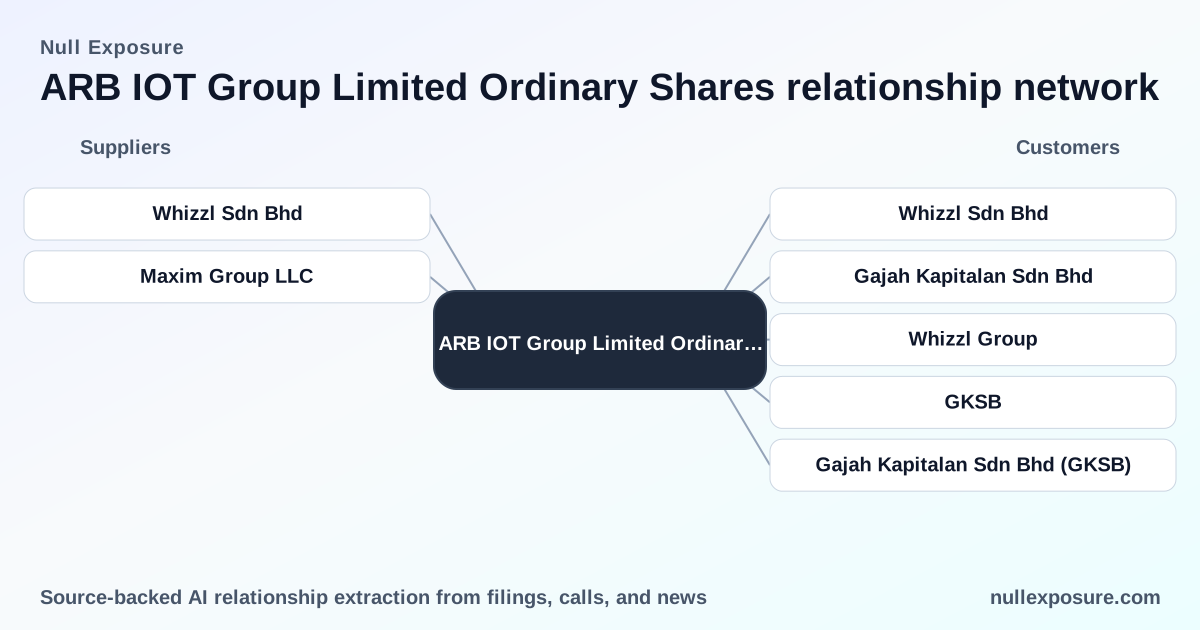
Whizzl Sdn Bhd — distribution and systems-integration partner for palm IoT
ARB Agro Technology Sdn Bhd, an ARB IOT subsidiary, sells its AI Smart IoT Palm Farming System through an exclusive wholesaler, distributor and system integrator, Whizzl Sdn Bhd, which secured an order to manage 3,000 acres of palm oil plantations under a multi-year recurring arrangement. This arrangement is a direct channel that converts ARB’s product capability into stable, recurring revenue streams for the palm farming vertical. (Source: FinancialContent news report, March 11, 2025.)
Maxim Group LLC — capital markets placement and IPO bookrunner
Maxim Group LLC acted as the sole bookrunner on ARB IOT’s earlier financing/registration filings that established its U.S. listing and capital structure. That banking relationship influenced ARB’s access to U.S. markets and the terms of its equity distribution in FY2022. (Source: Renaissance Capital IPO coverage, FY2022.)
Operational constraints and company-level signals that shape supplier risk
There are no explicit third-party contractual constraints disclosed in the supplier relationship payload; however, the company data itself signals several binding operating characteristics that investors must treat like constraints on strategy and execution:
- Concentrated distribution posture. ARB relies on exclusive distribution/integration arrangements (for example, with Whizzl) to reach large plantation customers, which creates single-point-of-failure risk in any market where a single integrator controls channel access.
- Recurring-order reliance. Large recurring orders in verticals such as palm farming drive a meaningful share of near-term revenue; this is positive for predictability but increases exposure to a small number of large contracts.
- Early-stage public maturity. Listed on NASDAQ with a small market capitalization (~$7.9M) and high insider ownership (~35%) and negligible institutional ownership (~0.05%), ARBB trades like an immature public company where insider decisions have outsized influence.
- Profitability and scale mismatch. Negative margins (profit margin -36.2%, operating margin -15.2%) and negative EBITDA reflect the need to scale recurring services and tighten unit economics before free cash flow becomes reliable.
- Low valuation relative to revenue. The firm’s Price-to-Sales of 0.04 signals either a deeply undervalued growth asset or market skepticism about sustainability of revenues and margins — this dichotomy drives the risk/return profile for supplier exposures.
These characteristics function as constraints on capital allocation, bargaining leverage with suppliers and distributors, and on ARB’s ability to underwrite large implementation projects without partner guarantees.
For more granular partner exposure analysis and supplier risk scoring, visit the NullExposure homepage: https://nullexposure.com/
Investment implications: upside drivers and material risks
ARB’s commercial evidence of repeatable, large-scale deployments (3,000 acres of palm farming routed through an exclusive integrator) is the clearest operational validation of its solution-market fit in agritech. If ARB sustains recurring orders at the scale cited, gross revenue durability will be its primary return driver. Low market capitalization relative to revenue also creates asymmetric upside if margins improve and institutional interest increases.
Major risks are concrete and measurable:
- Channel concentration risk — a single distributor/integrator failure would materially disrupt deployments in a region.
- Execution and margin risk — current negative profitability requires operational improvement or pricing shifts to deliver positive cash flow.
- Liquidity and governance risk — small float and concentrated insider ownership decrease liquidity and increase the importance of insider-aligned governance choices.
Analysts provide a target price of $20, but there is no consolidated analyst consensus coverage to provide a wide validation set; this leaves valuation swings sensitive to news about contract wins, partner stability, and quarterly revenue conversion.
What investors and operators should watch next
- Quarterly updates that detail the revenue recognized from the Whizzl-sourced palm farming order and the recurring revenue profile of that contract.
- Any changes to exclusive distribution agreements or the addition of alternative channel partners that dilute concentration risk.
- Signs of margin improvement — reducing negative operating and EBITDA figures through scale or higher-margin services.
To monitor these developments efficiently, use dedicated supplier exposure tools at NullExposure: https://nullexposure.com/
Bottom line
ARB IOT is a channel-dependent IoT systems business with validated large-scale deployments in agriculture and a capital structure that reads like an early-stage public company. The Whizzl partnership is operationally material and converts a product capability into recurring revenue; the Maxim relationship shaped ARB’s entry into U.S. capital markets. Investors should balance the upside of recurring IoT orders against concentrated channel risk, negative profitability and limited institutional participation when sizing exposures.
For targeted supplier intelligence and partner risk reports relevant to ARBB, visit the NullExposure homepage: https://nullexposure.com/