ARCK (ARCK) — supplier relationships that define a SPAC’s market plumbing
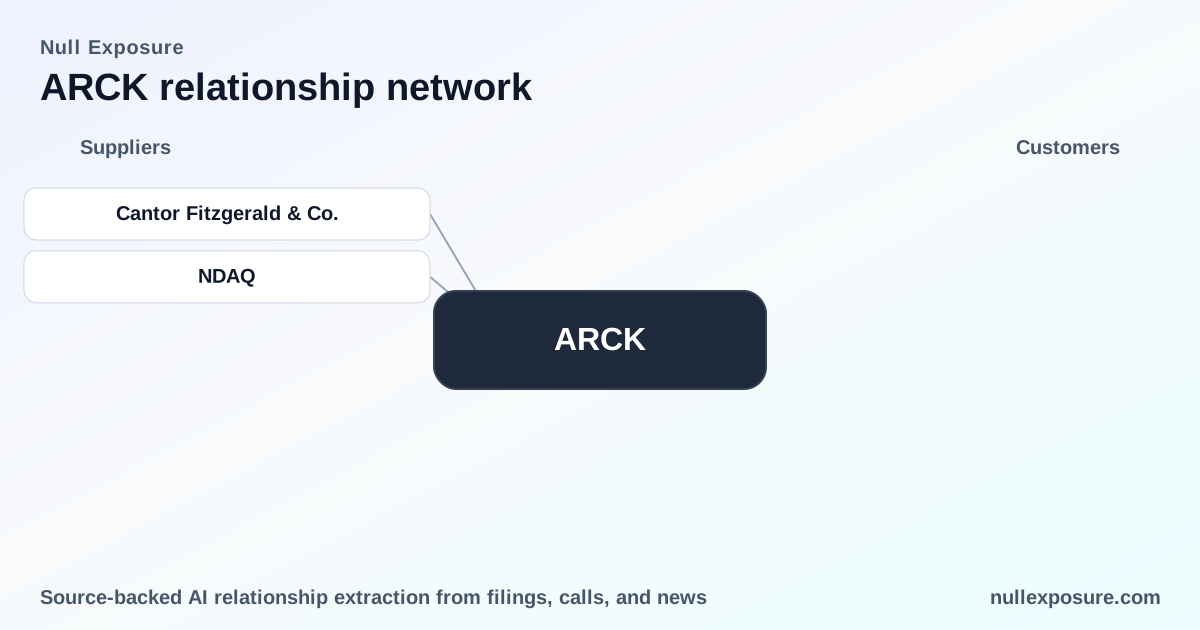
Arbor Rapha Capital Bioholdings Corp I (ARCK) operates as a special-purpose acquisition company that raises capital through a public unit sale and lists those units for trading; it monetizes via sponsor economics and transaction-related fees tied to completing a business combination. For investors and operators assessing counterparty exposure, the public record identifies the principal supplier relationships that establish market access and dealExecution capability: an underwriter/placement partner and the listing exchange. These two relationships are the functional plumbing that enables the SPAC model — capital formation and tradability — and therefore deserve focused attention.
Explore a deeper supplier-risk view at https://nullexposure.com/ to connect relationship signals with deal counterparty analysis.
Market context and what the relationships mean for investors ARCK’s documented suppliers are not recurring operating vendors; they are strategic financial counterparties that determine whether the vehicle can raise capital, list, and execute a business combination. Where those relationships are concentrated, counterparty risk is concentrated. For an investor evaluating sponsor value creation and execution risk, underwriter selection and exchange qualification are first-order signals of market access, pricing power, and regulatory readiness.
Key relationship coverage Below I cover every supplier relationship present in the reviewed records and provide concise, sourced takeaways for each.
Underwriting partner — Cantor Fitzgerald & Co.
Cantor Fitzgerald & Co. acted as the sole book‑running manager for ARCK’s $150 million initial public offering, putting Cantor in the center of ARCK’s capital-formation execution and distribution to public markets. According to the PR Newswire release announcing the offering, Cantor served as the sole book-running manager for the transaction (PR Newswire, “Arbor Rapha Capital Bioholdings Corp I Announces Pricing of $150 Million Initial Public Offering,” FY2021 / posted Mar 9, 2026).
Implication: a single lead manager concentrates execution risk and distribution control with Cantor, making the underwriter relationship operationally critical.
Exchange relationship — The Nasdaq Global Market
The SPAC units were listed on The Nasdaq Global Market and began trading under the ticker ARCKU on October 29, 2021, providing primary market liquidity and continuous price discovery. The PR Newswire offering notice notes the Nasdaq listing and trading symbol for the units (PR Newswire, “Arbor Rapha Capital Bioholdings Corp I Announces Pricing…,” FY2021 / posted Mar 9, 2026).
Implication: Nasdaq listing grants market access and visibility to institutional and retail flows, which is essential for post-IPO liquidity and deal viability.
What the relationships collectively signal about ARCK’s operating model
- Contracting posture — transactional and market-standard. The public record shows classic capital markets counterparties (a sole book runner and an exchange) rather than long-term strategic suppliers, which indicates a market-standard contracting posture focused on discrete capital-raising events.
- Concentration — high at the execution layer. With Cantor recorded as sole book-running manager, ARCK exhibits concentration risk in underwriting distribution; a single underwriter carries most of the placement and pricing responsibility.
- Criticality — elevated for deal success. Both relationships are mission-critical: underwriting execution determines funding size and pricing; exchange listing determines tradability and investor access. Disruption or reputational damage at either counterparty would immediately affect deal timelines and liquidity.
- Maturity — transaction-stage relationships. These ties reflect early post-formation, transaction-stage maturity rather than enduring supplier ecosystems; their lifecycle is tied to the IPO and eventual business combination timeline.
Constraints and contract signals The reviewed relationship records contain no explicit contractual constraints (no disclosed restrictive covenants, vendor exclusivities, or long-term procurement obligations) in the available excerpts. This absence is itself a company-level signal: the supplier set, as reported, is not accompanied by disclosed contractual limitations that would restrict sponsor flexibility or introduce hidden operational encumbrances. Treat this as a neutral to positive signal for operational agility, while recognizing it does not eliminate standard market or regulatory obligations tied to underwriting and listing agreements.
Operational and investment risks tied to these suppliers
- Single-lead underwriter risk. Relying on a sole book-runner centralizes pricing and distribution power; underwriter withdrawal or change in market appetite can delay or downsize funding.
- Market-liquidity dependence. Nasdaq listing provides access to deep pools of capital but also exposes the units to market volatility and delisting thresholds that can alter the SPAC’s timeline and negotiating leverage.
- Reputational linkages. The underwriter and exchange reputations are effectively shared with the SPAC; regulatory reviews or negative press affecting either party can have immediate spillover effects on pricing and investor confidence.
- Limited vendor diversification. The supplier set as reported is narrow; sponsors and operators should monitor whether additional placement agents, PIPE investors, or market makers are engaged to reduce concentration risk.
Practical recommendations for investors and operators
- Conduct counterparty due diligence on the lead underwriter’s recent SPAC performance, pricing outcomes, and distribution reach; a strong underwriting partner materially improves deal execution odds.
- Monitor exchange compliance filings and post-listing liquidity metrics to assess the market’s reception; liquidity is a second-order price setter for post-IPO valuation and sponsor negotiating leverage.
- Insist on transparency around any undisclosed placement commitments or side agreements that could alter capital structure or governance before a business combination.
Continue exploring supplier-readiness and counterparty exposure for SPACs at https://nullexposure.com/ — the homepage has consolidated workflows for relationship due diligence.
Conclusion — what investors should take away ARCK’s supplier footprint in the public record is narrowly focused but strategically essential: Cantor Fitzgerald as sole book-runner and Nasdaq as the listing venue together enabled ARCK’s $150 million IPO and market access. That combination delivers the core capabilities a SPAC requires — capital formation and tradability — but also concentrates execution risk. No explicit contractual constraints were disclosed in the reviewed excerpts, which signals operational flexibility but does not remove counterparty or market risk. For investors prioritizing execution certainty, counterparty profile and diversification beyond the initial underwriting syndicate are the most actionable signals to monitor.
For a consolidated view of counterparty exposures and supplier relationships across SPACs and other issuers, visit https://nullexposure.com/.