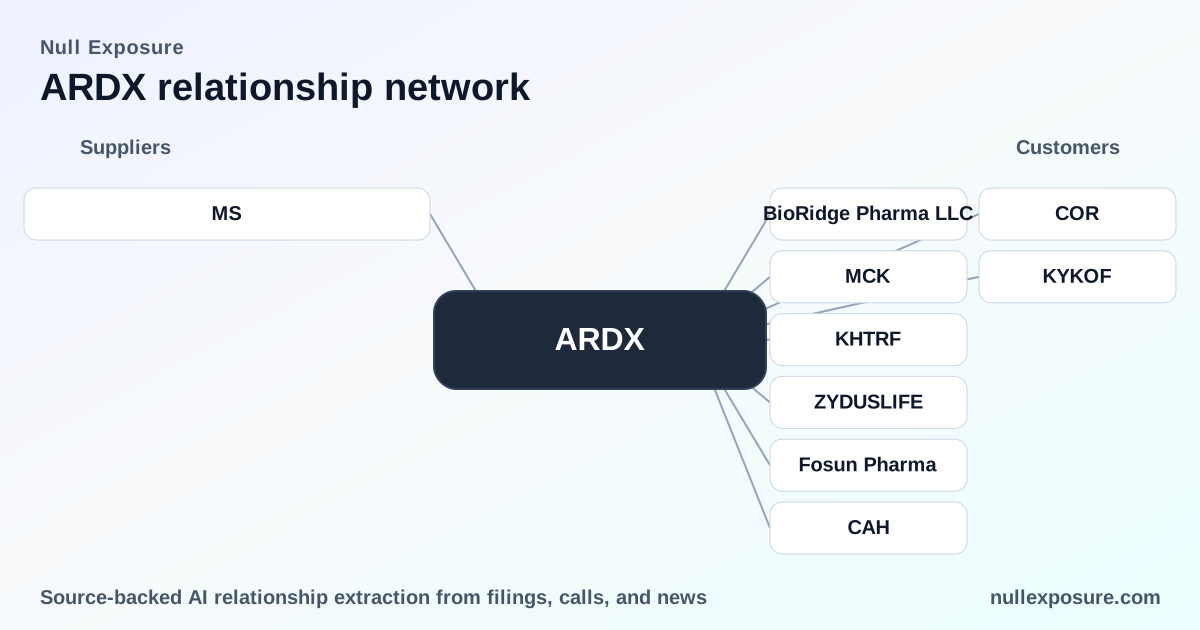
Ardelyx (ARDX): Supply relationships that determine commercial durability
Ardelyx develops and sells therapies for kidney and cardiorenal diseases and monetizes primarily through product sales of marketed drugs and supply-dependent commercialization of IBSRELA and XPHOZAH, supplemented by strategic partnerships and licensing where appropriate. The company's revenue base is product-driven, while margins and growth are tightly coupled to third-party manufacturing capacity and regulatory compliance of contract manufacturers. For investors evaluating supplier risk, the key thesis is simple: Ardelyx’s commercial performance is controlled as much by its CMOs’ operational integrity as by market demand. Learn more about supplier exposures and relationship intelligence at https://nullexposure.com/.
Why the supply chain is the investment lever you cannot ignore
Ardelyx is not vertically integrated for manufacturing. The company relies on third-party contract manufacturing organizations for both active pharmaceutical ingredient and final drug product for its marketed products and clinical material. That contracting posture creates a set of structural characteristics that define upside and downside for shareholders:
- Concentration and criticality: Company disclosures classify manufacturing relationships as critical; several excerpts state Ardelyx is “completely dependent” on CMOs for regulatory compliance and supply continuity. A failed inspection at a CMO can delay or block approvals and restrict commercialization.
- Operational immaturity at the company level: Ardelyx oversees but does not control manufacturing processes. This is a strategic choice that reduces capital expenditure but increases exposure to third-party operational risk and regulatory remediation.
- Financial exposure and commitment: Prepaid commercial manufacturing not recorded as inventory totaled $16.4 million at December 31, 2024 (down from $23.2 million in 2023), a signal of multi‑million-dollar contractual commitments to CMOs consistent with a spend band of $10M–$100M.
According to the company’s public filings covering 2023–2025, Ardelyx explicitly cites dependence on third-party CMOs for IBSRELA and XPHOZAH and flags the risk that manufacturing failures or regulatory noncompliance at those facilities would materially harm commercialization and regulatory timelines.
What the constraints tell investors about business model risk
The filings give explicit constraints rather than abstract fears. Treat these as company-level signals about how Ardelyx runs its business:
- Manufacturer role confirmed: The company consistently states that CMOs produce both API and finished dosage forms, and that Ardelyx expects to continue this model for commercial supply and clinical materials.
- Materiality rated critical: Multiple excerpts classify the relationship with CMOs as critical to product approvals and market supply.
- Contracted spend scale: Prepaid manufacturing balances and the disclosed spend band indicate meaningful contractual obligations with third-party manufacturers that will affect cash flow timing and operational flexibility.
These are not theoretical issues: the company’s own disclosures describe real dependencies and cash commitments that shape investor risk — regulatory inspections, single-source suppliers, and manufacturing remediation are first-order events for Ardelyx’s valuation.
Commercial relationships you should track right now
Below is every supplier/partner relationship identified in the public results for ARDX, with concise plain-English descriptions and a source note.
- Morgan Stanley Smith Barney LLC — The filing identifies Morgan Stanley Smith Barney LLC as a broker associated with a prior sale; the seller executed a transaction on November 21, 2025. According to the SEC filing mirrored by StockTitan, this is a market-facing brokerage entry rather than a manufacturing or supply relationship (SEC filing reported in March 2026). Source: StockTitan capture of Ardelyx SEC filing, FY2026.
(That completes the relationship inventory drawn from the available results.)
Operational implications for operators and procurement teams
For operators, the constraints imply a practical operating checklist to protect commercialization:
- Prioritize redundancy planning for single-source suppliers and negotiate rapid contingency supply terms with alternate CMOs.
- Tighten contract language around regulatory remediation responsibilities and timelines; require audit rights and rapid corrective action plans.
- Rigorously monitor prepaid manufacturing balances and enforce deliverable milestones to protect cash and inventory recognition.
From a corporate finance perspective, prepaid manufacturing of $16.4 million is a visible, measurable exposure that investors should reconcile with quarterly cash flow and revenue conversion timing. According to Ardelyx’s reporting for the 2024 fiscal year, prepaid commercial manufacturing not included in inventory was $16.4 million at year-end, underscoring the company’s ongoing contractual commitments to CMOs.
If you are assessing counterparty risk, focus on three operational KPIs: regulatory inspection history for each CMO, capacity constraints versus demand forecasts for IBSRELA and XPHOZAH, and the legal stance of manufacturing contracts regarding single-source events.
Explore a structured supplier risk view for ARDX at https://nullexposure.com/ to convert these signals into actionable monitoring.
Risk vs. reward: how supplier dynamics affect valuation
Ardelyx’s revenue of roughly $407 million TTM and gross profit margin indicate the company has built a commercial foothold. However, the value of that commercial franchise is contingent on uninterrupted, regulatory-compliant supply. A single failed pre-approval inspection or prolonged CMO outage would be a binary event with outsized valuation impact because regulatory delays effectively pause revenue recognition for new launches and can impair existing supply.
Investors should therefore embed supplier-readiness scenarios into valuation models rather than treating manufacturing as a back-office detail. Specifically:
- Stress-test revenue under partial supply constraints and include potential remediation costs and lost sales timelines.
- Model capex or strategic investment if Ardelyx elects to de-risk by bringing manufacturing in-house or investing in capacity expansions.
Practical monitoring cadence for investors
Active surveillance will materially reduce downside surprise:
- Quarterly: review SEC filings for any mention of CMO inspections, remediation, or supply disruptions.
- Event-driven: monitor FDA inspection reports and press releases related to IBSRELA and XPHOZAH.
- Financials: reconcile prepaid manufacturing balances and note directional changes relative to production forecasts.
Bottom line: supplier risk is a core valuation lever
Ardelyx’s commercial success is a function of market demand and of third-party manufacturing integrity. The company has intentionally outsourced manufacturing, creating concentration and regulatory-critical exposures that are documented in its filings and quantifiable through prepaid manufacturing balances. Investors should treat supplier continuity as a primary risk factor and incorporate it into due diligence and valuation.
For deeper supplier relationship intelligence and ongoing monitoring tools for ARDX and similar issuers, visit https://nullexposure.com/. Make supplier risk part of the investment thesis rather than an afterthought.