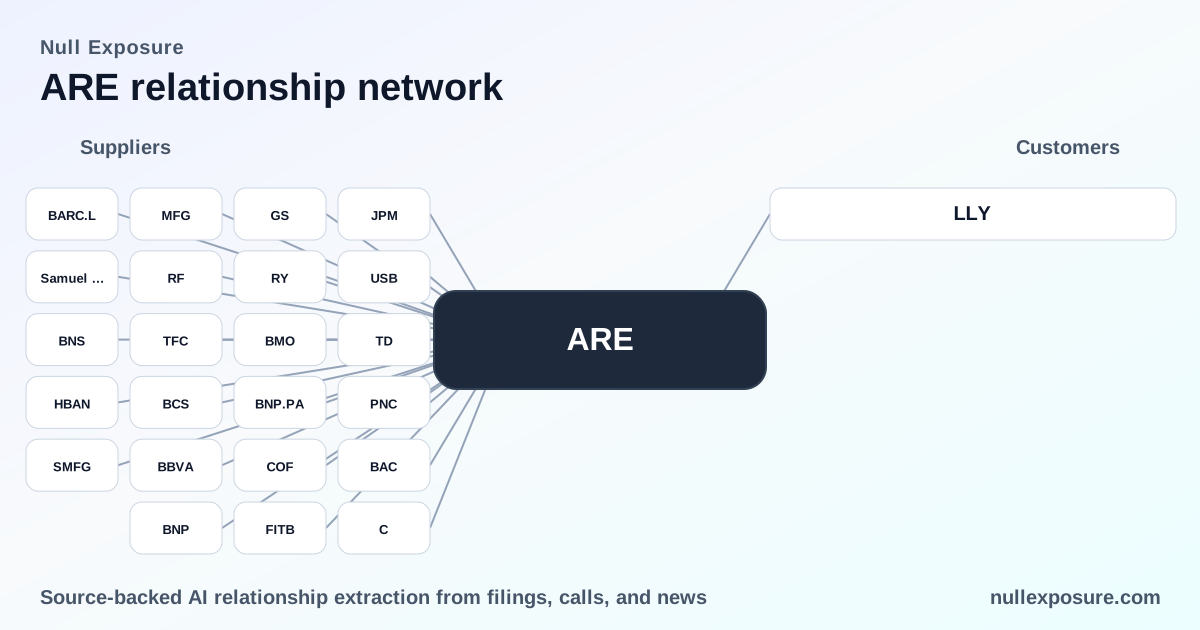
Alexandria Real Estate Equities (ARE): What investors need to know about the supplier and capital markets relationships behind the latest financing
Thesis — Alexandria Real Estate Equities operates a specialized REIT model concentrated on life-science and tech office/lab space and monetizes through long-term leases, development yields and recurring rent cash flows; its financing and vendor relationships structure liquidity and execution risk as tightly as its tenant book. The company recently tapped the debt markets with a $750 million senior note issuance and used a broad syndicate of investment banks and trustees to place the paper, reflecting a high-touch capital markets execution model. Learn more at https://nullexposure.com/.
Why the financing roster matters to owners and operators
Alexandria’s capital partners double as suppliers: underwriters distribute risk and provide market access, trustees administer indentures, and construction/service vendors deliver the built product that generates rent. A diverse syndicate reduces placement risk while large contractual construction commitments concentrate spend and operational dependency. For a quick view of the platform that tracks counterparties and market signals, visit https://nullexposure.com/.
Every relationship flagged in the public releases — plain-English takeaways
-
J.P. Morgan Securities LLC acted as a joint book-running manager on the $750 million senior notes offering, handling distribution and pricing tasks. (SAHM Capital press release; Feb 2026 / Aspen Daily News; Feb–Mar 2026)
-
U.S. Bank Trust Company serves as the indenture trustee for the new senior notes, responsible for trustee administration and covenant enforcement under the indenture. (TradingView reporting on the issuance; Mar 2026)
-
TD Securities (USA) LLC participated as a joint book-running manager, contributing to syndicate underwriting and bookbuilding activity. (SAHM Capital press release; Feb 2026)
-
PNC Capital Markets LLC is listed as a co-manager on the offering, supporting distribution to institutional channels. (Aspen Daily News press release; Feb 2026)
-
BofA Securities, Inc. functioned as a joint book-running manager, providing underwriting capacity and market execution for the notes. (SAHM Capital press release; Feb 2026)
-
Citigroup Global Markets Inc. was named a joint book-running manager, anchoring institutional placement and syndicate leadership. (Aspen Daily News / SAHM Capital releases; Feb 2026)
-
Goldman Sachs & Co. LLC participated as a joint book-runner, handling pricing and investor allocation responsibilities. (SAHM Capital press release; Feb 2026)
-
U.S. Bancorp Investments, Inc. appears as a co-manager supporting the distribution effort to its client base. (SAHM Capital press release; Feb 2026)
-
BBVA Securities Inc. participated as a joint book-running manager/co-manager in the underwriting group for the transaction. (Aspen Daily News / StockTitan reporting; Feb–Mar 2026)
-
BMO Capital Markets Corp. served in the syndicate as a joint book-runner / co-manager on the notes sale. (Aspen Daily News / StockTitan; Feb–Mar 2026)
-
BNP Paribas Securities Corp. was included among the joint book-running managers, bringing cross-border distribution capability. (Aspen Daily News / StockTitan; Feb–Mar 2026)
-
Fifth Third Securities, Inc. appears as part of the underwriting group, providing regional distribution support. (Aspen Daily News / SAHM Capital; Feb 2026)
-
RBC Capital Markets, LLC participated as a joint book-runner, expanding institutional reach into Canadian and U.S. investor pools. (StockTitan reporting; Mar 2026)
-
Regions Securities LLC is listed as a joint book-runner on the offering, contributing to syndicate placement. (Aspen Daily News / SAHM Capital; Feb 2026)
-
Truist Securities, Inc. acted as a joint book-running manager, supporting pricing and allocation. (Aspen Daily News / SAHM Capital; Feb 2026)
-
Barclays Capital Inc. is included in the syndicate as a co-manager, offering additional distribution breadth. (SAHM Capital / StockTitan; Feb–Mar 2026)
-
Capital One Securities, Inc. appears as a co-manager on the transaction, assisting with investor outreach. (Aspen Daily News / SAHM Capital; Feb 2026)
-
Huntington Securities, Inc. joined as a co-manager, supporting placement among regional institutional accounts. (StockTitan / Aspen Daily News; Mar 2026)
-
Mizuho Securities USA LLC served as a co-manager in the offering, providing additional fixed-income distribution channels. (StockTitan / SAHM Capital; Mar 2026)
-
Samuel A. Ramirez & Company, Inc. appears as a co-manager, contributing niche sales coverage for the deal. (StockTitan / Aspen Daily News; Mar 2026)
-
SMBC Nikko Securities America, Inc. joined the co-manager list, offering access to Asian institutional investors and balance sheet support. (SAHM Capital / StockTitan; Feb–Mar 2026)
-
Scotia Capital (USA) Inc. participated as a joint book-runner, adding distribution depth to the underwriting syndicate. (SAHM Capital / StockTitan; Feb–Mar 2026)
-
BBVA (alternate listings) — BBVA’s regional entities appear across the syndicate disclosures, reflecting international dealer participation in the placement. (StockTitan / Aspen Daily News; Mar 2026)
(Each of the above engagements is documented in the press releases and market reports distributed in Feb–Mar 2026 via SAHM Capital, Aspen Daily News, StockTitan and TradingView.)
What the constraint signals tell investors about ARE’s operating model
The company disclosures included several contract- and spend-related constraints that function as operational signals:
-
Contracting posture is long-term and capital-intensive. Alexandria carries ground and operating leases with very long remaining terms (weighted averages cited as decades-long), which aligns landlord economics but also locks in long-duration obligations and gives development vendors long lead visibility.
-
There is concentrated vendor dependency for critical services. Management explicitly states reliance on a limited set of vendors for utilities and construction services; that centralization increases single-point-of-failure risk for operations and project delivery.
-
Capital spending is large and lumpy. Public filings show construction commitments and development contracts aggregating north of $1.0 billion in remaining contractual costs, and annual construction spending exceeded $1.4 billion in 2025, indicating material near-term cash outflows tied to third-party contractors.
-
Contract maturities span both long and short horizons. While most leases and ground agreements are long-term, certain payment obligations and development payments are scheduled over one to three years, creating a mix of medium-term liquidity needs.
These characteristics combine to make Alexandria a company where credit-market relationships (the underwriter syndicate and trustee) and construction/service providers are both strategic suppliers: capital markets counterparts supply liquidity; vendors supply the physical assets that generate revenues.
Implications for risk, sourcing and due diligence
-
Underwriter breadth reduces placement risk but does not remove counterparty diligence requirements. A large syndicate lowers distribution concentration, but investors must track counterparty exposures, particularly where regional banks are co-managers.
-
Execution risk is operational as well as financial. Large remaining contractual construction costs elevate the importance of vendor performance, timing, and cost control for near-term cash flow and valuation.
-
Monitor covenant and trustee administration. With U.S. Bank Trust Company as trustee, investors should review indenture terms and trustee powers in the event of covenant discussions or enforcement.
For a focused counterparty scoring and supplier-monitoring framework tied to these exact relationships, visit https://nullexposure.com/.
Final view and investor action points
Alexandria’s latest notes issuance was executed via a broad syndicate and a formal trustee arrangement, reflecting professionalized capital markets execution that supports ARE’s development-heavy model. However, large construction commitments and concentrated service providers create execution risk that is as material as financing structures. Investors evaluating ARE should prioritize counterparty exposure mapping across both banks and vendor ecosystems and review indenture language administered by the trustee.
Actionable next steps:
- Review the SAHM Capital / Aspen Daily News syndicate disclosures (Feb 2026) and the TradingView trustee note (Mar 2026) for primary terms and roles.
- Model near-term cash flow impacts from the $1.03 billion remaining construction commitments and 2025 construction spend figures.
- For a consolidated supplier and counterparty risk view tailored to institutional decision-making, explore https://nullexposure.com/.
Key takeaway: Alexandria’s capital markets relationships are broad and institutional, supporting large-scale development, but the company’s supplier concentration and multi-hundred-million dollar contractual commitments are the operational levers investors must watch most closely.