Argus Capital Corp (ARGU): What investors should know about its bank relationships
Argus Capital Corp operates as a Special Purpose Acquisition Company that raises capital through a public offering and then executes a business combination; the vehicle monetizes through the IPO proceeds it holds for target acquisition and through the standard SPAC sponsor economics and transaction-related fees that accrue when a merger is completed. The near-term commercial imperative for Argus is successful capital formation and distribution execution, which is why its engagement with major investment banks as book-running managers is a central operational signal for investors and operators evaluating counterparty risk and execution capacity.
For a deeper look at supplier exposures across similar issuers, visit https://nullexposure.com/.
Why the choice of bookrunners matters for a SPAC like Argus
Book-running banks determine not only placement success but also pricing, investor reach, and syndicate structure. Using two global bulge-bracket firms signals a priority on distribution scale and execution reliability, while also concentrating critical execution risk in a small number of counterparties. That concentration is beneficial for speed and access to institutional demand, but it creates a single-event dependency for the offering window.
- Contracting posture: transactional and event-driven — the relationship is structured around a discrete capital raise rather than a long-term supply contract.
- Concentration: high — the current public record shows two bookrunners, which centralizes placement and underwriting execution.
- Criticality: elevated — the banks’ execution capability is essential to completing the IPO and the initial capital pool; failure or poor performance would materially delay or impair Argus’s strategy.
- Maturity: nascent — the public record reflects an early-stage SPAC registration and therefore early-stage supplier relationships rather than entrenched vendor integration.
These are company-level operational signals rather than attributes of a specific counterparty. For a view of comparable supplier footprints across the market, see https://nullexposure.com/.
What the public record shows about Argus’s bank partners
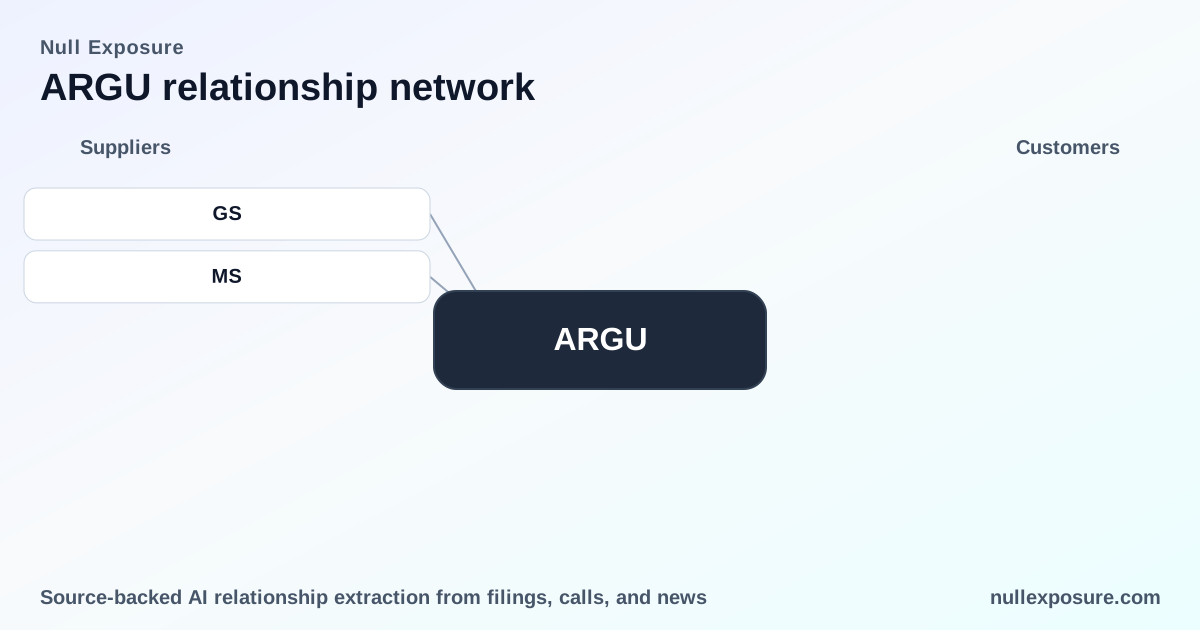
According to the registration statement announcement filed to the public record in March 2026, Argus has engaged two global investment banks as joint book-running managers for its offering.
Goldman Sachs & Co. LLC
Goldman Sachs & Co. LLC is listed as a joint book-running manager for Argus’s SPAC offering, positioning Goldman to lead distribution and pricing efforts for the initial capital raise. According to the PR Newswire release on March 9, 2026, Goldman Sachs shares joint book-running duties with Morgan Stanley for this registration filing.
Morgan Stanley & Co LLC
Morgan Stanley & Co LLC is listed alongside Goldman Sachs as the co–book-runner for the offering, supplying complementary distribution channels and institutional client access for the IPO. The PR Newswire announcement dated March 9, 2026, identifies Morgan Stanley and Goldman Sachs as the joint book-running managers for the offering.
Both relationships are documented in the same PR Newswire release announcing Argus’s SPAC registration filing (PR Newswire, March 9, 2026). These entries are limited to the book-running role and do not currently disclose fee schedules, overallotment arrangements, or any ancillary commitments.
How these supplier links translate into investor risk and opportunity
Engaging Goldman Sachs and Morgan Stanley as joint book-runners provides clear upside in distribution reach and reputational support, which reduces execution risk on the capital raise relative to using smaller underwriters. However, the arrangement also concentrates the issuer’s execution dependency across two firms. From a risk-management standpoint, investors and counterparties should treat these relationships as high-impact and time-sensitive:
- Execution risk surfaces during pricing, stabilization, and aftermarket support; monitor offering terms closely.
- Counterparty diligence should focus on underwriting syndicate breadth beyond the two leads, and on any forward purchase or PIPE commitments that will determine post-IPO liquidity.
- Governance and conflict-of-interest disclosures in the registration statement will reveal whether sponsor economics or preferred allocations materially favor specific investor classes.
Key takeaway: the choice of two bulge-bracket bookrunners is a positive signal for market access but creates a binary event risk around the offering window.
Practical due diligence checklist for operators and buy-side teams
- Confirm offering terms and any forward purchase agreements disclosed in the registration statement to understand post-deal capitalization.
- Monitor syndicate composition and anchor investors; broad syndication reduces concentration risk even when two banks lead.
- Track aftermarket stabilization plans and lock-up provisions to assess short-term liquidity and volatility risk.
- Review any disclosed fee structures or underwriting discounts to quantify direct transfer of value to the banks.
For a comparative supplier-risk view and to map these relationships in your portfolio, visit https://nullexposure.com/.
Bottom line: how to position around ARGU’s bank relationships
Argus’s public filing links it to two of Wall Street’s largest dealers as joint book-runners, which is a strong operational choice for distribution and speed, but it concentrates critical execution exposure across a small set of counterparties and compresses the time frame for successful execution. Investors should treat the offering as an event-driven catalyst: track registration updates, syndicate details, and any PIPE or anchor commitments that will ultimately determine the transaction’s funding sufficiency and post-combination capital structure.
If you want continuous monitoring of supplier linkages and a practical view of counterparty concentration across issuers, start here: https://nullexposure.com/.
Actionable recommendation: prioritize verifying the registration’s detailed disclosures (underwriting discounts, selling restrictions, and anchor commitments) and maintain active engagement with any syndicate-level communications — the bookrunners will materially influence both price discovery and the ultimate success of Argus’s capital raise.