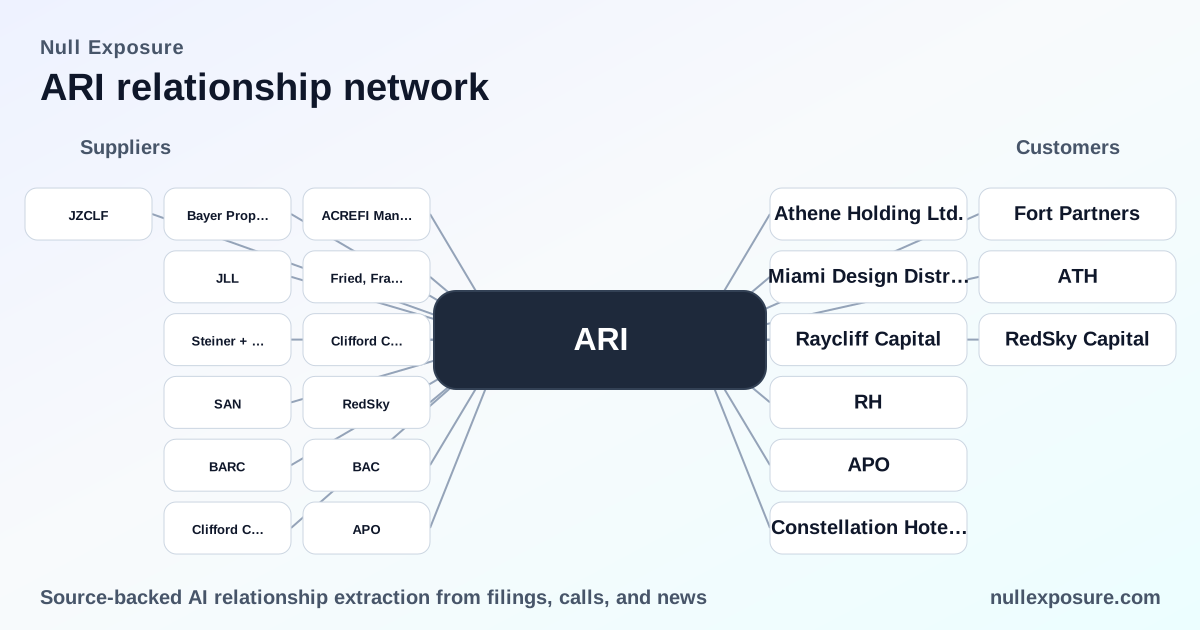
ARI’s supplier map: who runs the engine behind Apollo Commercial Real Estate Finance
Thesis: Apollo Commercial Real Estate Finance (ARI) is an externally managed mortgage REIT that originates, acquires and services commercial real estate credit while monetizing via net interest and fee income under a management agreement with ACREFI, an Apollo affiliate; the REIT’s economic profile is therefore tightly coupled to its external manager’s origination platform, financing counterparties and a small set of legal and advisory firms that structure portfolio transactions. For investors and operators evaluating supplier risk, the key question is not whether ARI can source loans, but how concentrated and contractual its vendor relationships are and how those relationships affect liquidity and strategic optionality.
For a deeper supplier-risk profile visit https://nullexposure.com/.
The business model in plain English: management-driven REIT economics
ARI is a mortgage REIT with no internal employees; it outsources investment sourcing, underwriting, asset management and day‑to‑day operations to ACREFI Management, LLC, an indirect subsidiary of Apollo Global Management. Revenues flow from interest spread on originated and acquired mortgage loans plus fee income tied to portfolio actions, while operating leverage and capital access derive from the REIT’s financing facilities and Apollo’s broader platform. According to ARI filings and multiple press releases in 2025–2026, ARI relies on this external management relationship for nearly all operational capability (Globe and Mail; MarketBeat, 2025–2026).
Supplier and advisor map — the relationships you need to track
Below is a concise, itemized run‑through of every counterparty flagged by market and press coverage. Each entry is a 1–2 sentence commercial summary with a source reference.
-
ACREFI Management, LLC — ACREFI is ARI’s external manager and advisor, providing investment and operational services under a standing management agreement; ARI discloses that all officers are employees of the Manager and that the agreement renews annually (Globe and Mail press releases and company announcements, FY2025–FY2026; MarketBeat, 2025–2026). (Source: https://www.theglobeandmail.com/ — company press releases, 2025–2026)
-
Apollo Global Management, Inc. (APO) — Apollo is the ultimate owner of ACREFI and the strategic platform ARI leverages for origination and balance-sheet capacity, with hundreds of billions in assets under management referenced in ARI communications (MarketBeat; Globe and Mail, FY2025–FY2026). (Source: MarketBeat and Globe and Mail coverage, 2025–2026)
-
Fried, Frank, Harris, Shriver & Jacobson LLP — Fried Frank is serving as the independent legal advisor to ARI’s board special committee on a portfolio disposition, providing independent counsel in a transaction review context (Globe and Mail press release, Mar 2026). (Source: https://www.theglobeandmail.com/ — press release, Mar 9, 2026)
-
Clifford Chance US LLP (Clifford Chance US / Clifford Chance US LLP) — Clifford Chance is advising ARI on legal matters related to the sale of a commercial loan portfolio and other transaction execution tasks (Globe and Mail & ConnectMoney coverage, Mar 2026). (Source: Globe and Mail press release and ConnectMoney, Mar 2026)
-
BofA Securities (Bank of America, BAC) — BofA is acting as independent financial advisor to ARI’s special committee and is also referenced as administrator of a revolving credit facility; that places Bank of America in both advisory and financing roles for the company (Globe and Mail press release; CityBiz coverage, FY2023–FY2026). (Source: Globe and Mail press release, CityBiz, 2023 & 2026)
-
Barclays Bank — Barclays is noted in filings as a counterparty in ARI’s secured credit and private securitization activity, indicating its role as a financing partner on structured transactions (Quartz / QZ reporting on filings, FY2025). (Source: QZ article summarizing filings, 2025)
-
Banco Santander, S.A. New York Branch — Identified as a counterparty under a master repurchase agreement in ARI financing arrangements, providing repurchase facility capacity (CityBiz reporting on financing facilities, FY2023). (Source: CityBiz, 2023)
-
RedSky — Mentioned in historical reporting as a prior bidder/owner that lost a portfolio to Apollo, RedSky appears as a market participant in ARI-related asset trades rather than a standing supplier to ARI (The Real Deal, FY2022 reporting referenced in later coverage). (Source: The Real Deal, Dec 2022 / referenced 2026)
-
JZ Capital — Like RedSky, JZ Capital shows up in asset‑level history as a prior owner in transactions that ultimately involved Apollo/ARI, useful context for competitive dynamics in specific markets (The Real Deal, FY2022). (Source: The Real Deal, Dec 2022)
-
Bayer Properties — Identified as a property manager brought in to manage a mixed-use asset owned by ARI, indicating ARI contracts third-party property managers for asset-level operations where relevant (Journal-News, FY2019). (Source: Journal-News local coverage, 2019)
-
JLL (Jones Lang LaSalle) — JLL was previously the leasing and property manager for an ARI-owned mixed-use development prior to a vendor switch; this documents a precedent of ARI changing property management vendors at the asset level (Journal-News, FY2019). (Source: Journal-News, 2019)
-
Steiner + Associates — Cited in local reporting as a co-developer removed from leasing and management responsibilities in favor of other vendors, showing past re-allocation of operational responsibilities at asset level (Journal-News, FY2019). (Source: Journal-News, 2019)
-
Barclays Bank (private securitization counterparty) — Barclays’ role extends to private securitization execution noted in filings, reinforcing its placement among ARI’s structured financing partners (QZ, FY2025). (Source: QZ article, 2025)
(Entries above are drawn from public press releases and market reporting across 2019–2026; see cited coverage for transaction-level detail.)
What the supplier map implies about ARI’s operating constraints
ARI’s vendor ecosystem produces several structural constraints investors must weigh:
-
Contracting posture — externally managed: ARI has no employees and is fully dependent on ACREFI for investment, advisory and administrative functions; the Management Agreement governs fees and services and has automatic one‑year renewals subject to annual termination rights. This creates an operational concentration and contractual dependency at the firm level (company disclosures, FY2025–FY2026).
-
Concentration — platform dependence on Apollo: Multiple disclosures and press releases explicitly link ARI’s sourcing and balance‑sheet capacity to Apollo’s global platform, signaling high counterparty concentration with a very large enterprise as manager and principal strategic partner (company press materials, FY2025–FY2026).
-
Criticality — core services outsourced: Because ARI relies on its manager for underwriting, valuation, and personnel, the manager relationship is mission‑critical; changes to that relationship would directly affect ARI’s ability to operate and deploy capital (Management Agreement language and press disclosures).
-
Maturity and renewal mechanics: The management agreement’s automatic renewal and annual termination windows create predictable continuity but also periodic governance moments when fees or terms could be contested, which is material to long-term fee drag and incentive alignment.
Mid-article resource: for a supplier‑risk scorecard and counterparty monitoring visit https://nullexposure.com/.
Investment implications and closing view
ARI’s economics are levered to the quality and continuity of its external manager and financing counterparties. The presence of major global banks (BofA, Barclays, Santander) and top-tier legal advisers (Clifford Chance, Fried Frank) is a positive signal for transaction execution and financing depth, while the firm’s lack of internal operating capacity raises concentration and vendor‑termination risk. For investors and operators, the next monitoring items are management‑agreement terms at renewal, pipeline activity from Apollo’s real estate credit platform, and any shifts in the composition of secured financing providers.
For ongoing supplier monitoring, model scenarios, and counterparty stress testing, go to https://nullexposure.com/.