ARL Supplier Relationships: Who Runs the Engine Behind American Realty Investors
American Realty Investors (ARL) operates as an asset-light real estate owner and developer that monetizes through rental income, development gains and fee arrangements with contracted managers and advisors. The company acquires, develops and owns multi‑family and commercial properties across the U.S., then outsources day‑to‑day operations and capital markets functions to third‑party firms while retaining asset ownership and leverage. For investors, the economics are driven by occupancy and rent growth on holdings, development project returns and the cost and structure of externally arranged financing and management agreements. Learn more context at https://nullexposure.com/.
How ARL runs its business: outsourced operations, centralized control
American Realty runs a deliberately outsourced operating model. ARL has no employees and relies on an external advisor, Pillar Income Asset Management, for day‑to‑day operations, including asset management, accounting, legal, capital markets and executive services; that arrangement is governed by an Advisory Agreement and a Cash Management Agreement that are automatically renewable annually. This structure produces concentrated operational risk but keeps fixed operating overhead low and aligns incentives through advisory and development fees (company filing, as of December 31, 2024).
Capital structure and financing are equally purposeful: a large portion of ARL’s indebtedness is HUD‑insured mortgage debt, and the company routinely finances developments with construction loans sized in the tens of millions, exposing the firm to SOFR‑linked floating rates on recent credits (company filing, Dec 31, 2024). The contracting mix combines long‑term, rolling advisory relationships (stable and critical) with usage‑based property management fees and project‑based development fees (variable, performance‑linked).
The auditor appointment investors should note
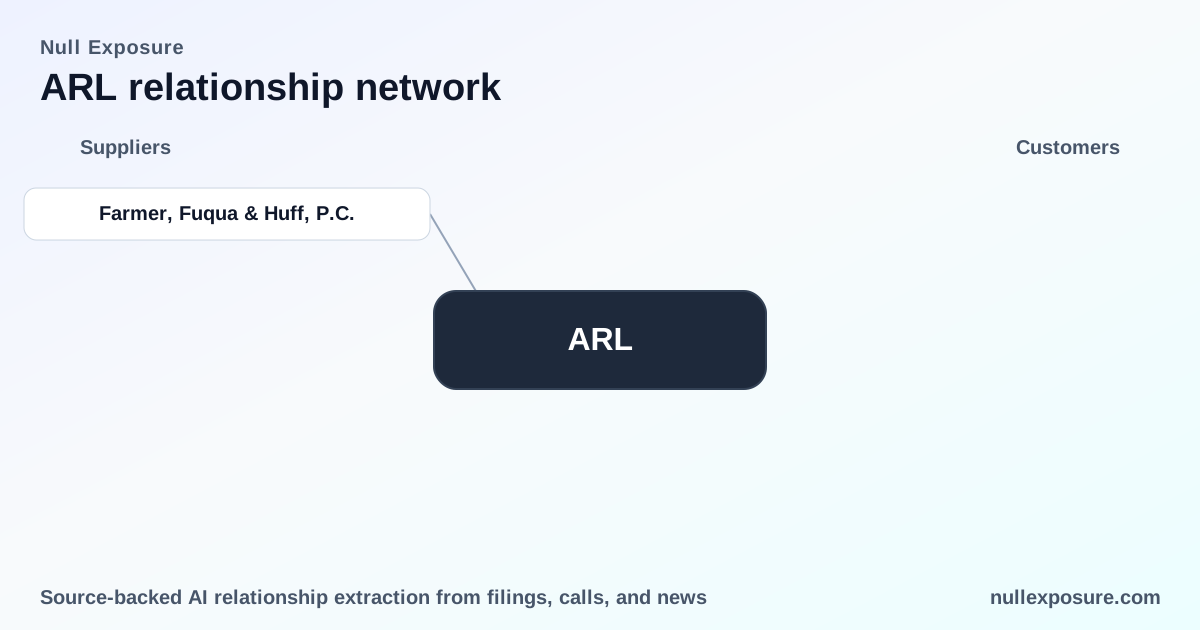
Farmer, Fuqua & Huff, P.C.
ARL’s shareholders ratified the appointment of Farmer, Fuqua & Huff, P.C. as the independent registered public accounting firm for the fiscal year ending December 31, 2025. This audit‑firm ratification was disclosed in press coverage and filings published in March 2026. (Press release covered by The Globe and Mail and a StockTitan SEC filings summary, March 9, 2026.)
Named counterparties and what they do for ARL
Pillar Income Asset Management (Advisor & Cash Manager)
Pillar has served as ARL’s Advisor and Cash Manager since April 30, 2011 under agreements reviewed annually by the board; Pillar performs most day‑to‑day operations and is compensated through advisory, development and reimbursement arrangements. In 2024, Pillar received $8.2 million in advisory fees plus $3.9 million in cost reimbursements and $2.9 million in development fees, making Pillar the company’s largest operational vendor by spend and strategic importance (company filing, 2024).
Regis Realty Prime, LLC (Property Manager / Broker)
Regis operates as an external property manager for a subset of ARL’s commercial assets; Regis manages three commercial properties for a fee of 3.0% or less of monthly gross rents and leasing commissions of 6.0% or less, and is entitled to brokerage commissions under a non‑exclusive agreement. In 2024 ARL paid Regis approximately $0.3 million in property management fees (company filing, 2024).
U.S. Department of Housing and Urban Development (HUD) – debt insurer
As of December 31, 2024, ARL had $126.3 million in mortgage notes payable insured by HUD, representing 68% of total indebtedness, creating concentration of counterparty exposure in federally insured mortgage programs (company filing, Dec 31, 2024).
What the supplier and constraint profile tells investors
- Contracting posture: ARL uses a hybrid model of long‑dated, renewably contracted advisory services (Pillar) combined with usage‑based property management fees (Regis) and project‑level construction financing. The advisory agreement’s automatic renewal creates continuity of execution but concentrates operational control outside the balance sheet.
- Concentration and criticality: Pillar is critical to ARL’s operations — ARL has no employees and depends on Pillar for core functions — representing a single point of failure and a primary vendor concentration risk. Similarly, HUD exposure concentrates credit risk on one counterparty type (government‑insured mortgages).
- Maturity and stage: Several relationships are actively servicing assets today; others are ramping with development projects. ARL reported a ramping development (Mountain Creek, 234 units) with $5.0 million of costs incurred through year‑end 2024 and expected completion in 2026, demonstrating active project pipeline risk and capital commitment (company filing, 2024).
- Spend profile and leverage: Operational spend is dominated by Pillar fees and reimbursements in the single‑digit millions, while financing commitments and construction loans sit in the $10m–$100m band; overall indebtedness was approximately $185.4 million at Dec‑31, 2024 (company filing, 2024). This creates a capital structure where vendor fees are meaningful to earnings and financing terms drive short‑to‑medium term cash flow volatility.
For ongoing diligence on these supplier dynamics, visit https://nullexposure.com/.
Risk implications for investors and operators
- Operational sovereignty risk: With no internal employees, ARL’s execution and compliance posture depend on Pillar’s governance and staffing. Any disruption at Pillar would directly impact ARL’s asset operations, collections and capital markets access.
- Audit continuity: The ratification of Farmer, Fuqua & Huff, P.C. as the independent auditor for FY2025 signals stable audit coverage but also merits scrutiny of audit tenure, audit fees and any audit adjustments in recent SEC filings (press disclosures, March 2026).
- Leverage and interest rate sensitivity: Recent construction loans carry variable rates (prime + spreads; SOFR + spreads) and multiple projects remain in development financing; rising short‑term rates increase interest expense on floating‑rate facilities.
- Counterparty credit concentration: HUD‑insured debt representing the bulk of indebtedness reduces default risk via federal insurance mechanisms, but creates reliance on the terms and availability of HUD programs and the company’s compliance with HUD requirements.
Key takeaways for evaluation
- Pillar controls the engine — no ARL employees; Pillar’s incentives and continuity are the single most important item for investor diligence.
- HUD exposure is material — 68% of indebtedness is HUD‑insured, concentrating financing risk.
- Spend is lumpy — operating fees are mid‑single to low‑double digit millions annually; development and construction loans drive capital intensity.
- Audit has been ratified for FY2025 — Farmer, Fuqua & Huff, P.C. will serve as independent auditor per shareholder action and press filings (March 2026).
If you are modeling ARL’s cash flows or underwriting acquisitions, verify the terms and renewal mechanics of the Advisory Agreement and the maturity and covenant schedules of HUD and construction loans. For a deeper supplier relationship view, visit https://nullexposure.com/ to see how these dynamics map to vendor criticality and spend bands.
Actionable next steps
- Request and review the Advisory and Cash Management agreements with Pillar for fee structures, termination rights and affiliate‑transaction protections.
- Audit the HUD loan covenants and compliance history; confirm the timing and rate mechanics on SOFR‑linked construction loans.
- Monitor audit commentary and any subsequent filings related to Farmer, Fuqua & Huff, P.C. for financial reporting risk signals.
For tailored diligence packages and supplier concentration analysis, go to https://nullexposure.com/.