ARLO supplier posture: what investors need to know before underwriting exposure
Arlo Technologies sells smart, connected security devices and supports those products through a hosted platform; the company monetizes primarily through device sales and the operational platform that connects devices over Wi‑Fi and cellular networks. Investors should evaluate two distinct supplier vectors: cloud hosting for the platform and a small set of third‑party manufacturers and logistics providers that actually produce and distribute devices. For a deeper view of supplier risk and contract posture, visit https://nullexposure.com/.
The business model in plain English: hardware-led, platform-enabled revenue
Arlo is a hardware company with an attached connectivity and services layer. The balance sheet and revenue run‑rate reflect a device-first monetization supported by platform operations that require continuous cloud hosting and global logistics. Fiscal metrics show scale (TTM revenue roughly $529 million and market cap about $1.48 billion), and operational leverage is concentrated in two supplier domains: cloud infrastructure and contract manufacturing/distribution. These supplier relationships materially influence product availability, margins and regulatory compliance.
One relationship from the filings every investor must account for
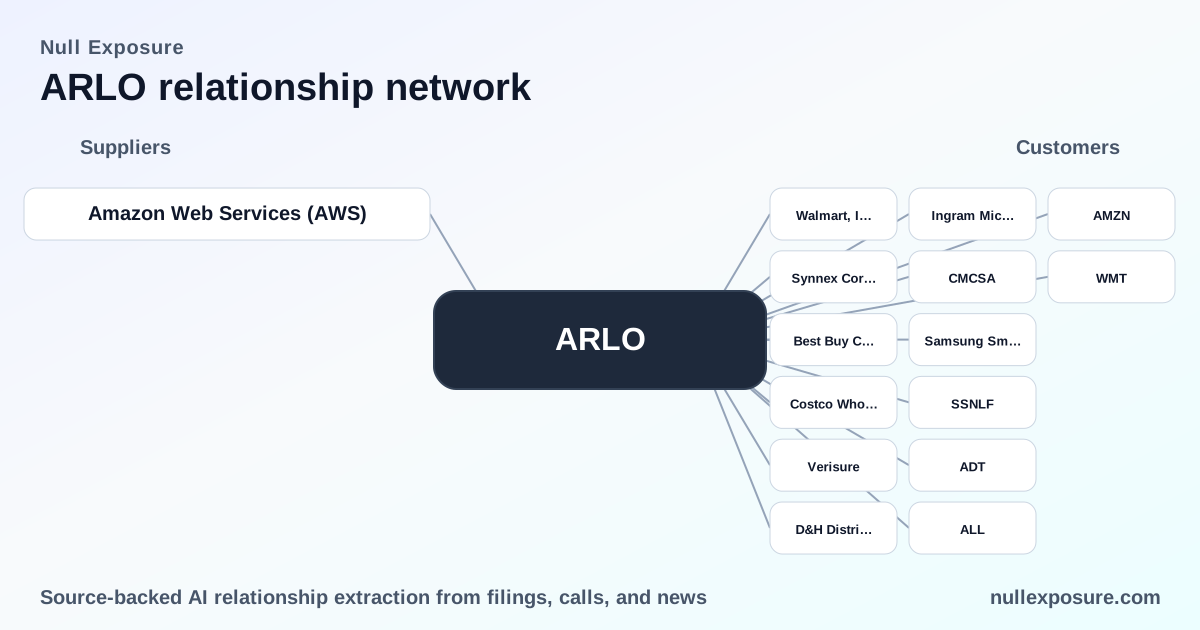
Amazon Web Services — Arlo's platform host
Arlo hosts its platform using Amazon Web Services data centers, which provide the cloud infrastructure that underpins device connectivity and customer services. According to Arlo’s FY2024 Form 10‑K, the company explicitly states it “host[s] our platform using Amazon Web Services (AWS) data centers.” (Arlo FY2024 10‑K)
Manufacturing and logistics: where the real counterparty concentration lives
Arlo outsources nearly all manufacturing to a limited set of third parties and locates production in Southeast Asia. The company’s filings identify key manufacturers and geographies: production is mostly in Vietnam, Thailand and Indonesia and is outsourced to suppliers including Foxconn Cloud Network Technology Singapore Pte. Ltd., Alpha Networks Inc., Pegatron Corporation and Chicony Electronics Co., Ltd. The company ships finished goods to logistics hubs in the United States, Hong Kong, and Australia, and it uses third‑party warehousing in regions such as Southern California, Texas, Tennessee, Mexico, Hong Kong and Australia. Arlo’s FY2024 disclosures frame these relationships as foundational to product supply and distribution (Arlo FY2024 10‑K).
Key commercial posture: Arlo does not maintain long‑term purchase contracts for all suppliers; instead, it relies on master product supply agreements with manufacturers that provide IP indemnification, quality requirements and other framework terms while preserving operational flexibility. The filing states the company “do[es] not have any long‑term purchase contracts, although we have executed master product supply agreements with these manufacturers.” (Arlo FY2024 10‑K)
How these supplier characteristics translate into investor risk and opportunity
- Concentration risk is high. The manufacturing base is concentrated in a small number of Asia‑based suppliers and a few geographic production centers. That concentration elevates single‑event supply disruption risk (factory incident, geopolitical action, regional logistics outage) but also gives Arlo negotiation leverage if demand is balanced.
- Contracting posture is flexible but operationally critical. The absence of long‑term purchase commitments combined with master supply agreements gives Arlo flexibility to shift volumes but leaves it exposed to short‑term capacity competition when component shortages arise. Master agreements mitigate legal/IP exposures but do not eliminate supply timing or capacity risk.
- Cloud hosting is critical but fungible. AWS provides essential platform hosting. The relationship is critical to customer experience, but cloud providers are substitutable in theory; migration cost and operational risk are nontrivial in practice, especially for latency and regional compliance.
- Global regulatory and logistics complexity matters. Arlo operates globally and explicitly notes ongoing compliance requirements—this elevates both operating cost and the likelihood of supplier compliance audits or forced changes in sourcing.
Financial context: Arlo’s operating margins and valuation multiples (forward P/E ~17.1, trailing P/E ~99.1, and EV/EBITDA >100) require that supply chain execution remain steady to protect margin recovery and justify consensus price targets.
Tactical implications for investors and operators
- Stress test earnings models for a two‑to‑three quarter manufacturing disruption in Southeast Asia; a short supply shock propagates quickly into revenue and margin volatility.
- Prioritize management commentary on supplier diversification, capacity allocation, and inventory policy; clarity on switching costs and lead times is essential.
- For operators assessing counterparty resiliency, verify the existence and scope of master supply agreements, IP indemnities, and product quality clauses cited in filings.
If you want a supplier‑centric risk brief for portfolio underwriting, see our detailed supplier reports at https://nullexposure.com/.
Practical takeaways and monitoring checklist
- Monitor shipment cadence from APAC hubs and quarter‑over‑quarter inventory build patterns for signs of supply stress.
- Track AWS uptime, regional availability changes, and any migration planning disclosed by management; platform outages directly affect customer retention and recurring revenue.
- Watch for management statements about supplier concentration mitigation—new supplier addenda, geographic diversification or forward purchase commitments materially reduce downside.
Visit https://nullexposure.com/ for structured supplier exposure analysis and alerts.
Final assessment
Arlo’s supplier profile presents a classic hardware‑platform tradeoff: manufacturing concentration creates tangible supply risk, while cloud hosting is critical to product utility but less concentrated in functional terms. The company’s master supply agreements temper legal risk but do not remove operational vulnerability to regional disruption. Investors should underwrite Arlo with the assumption that short‑term supply shocks will depress revenue and margins before management actions restore equilibrium; conversely, successful diversification or longer‑term capacity agreements would be a clear positive catalyst. For a tailored supplier risk package and ongoing monitoring, start at https://nullexposure.com/.