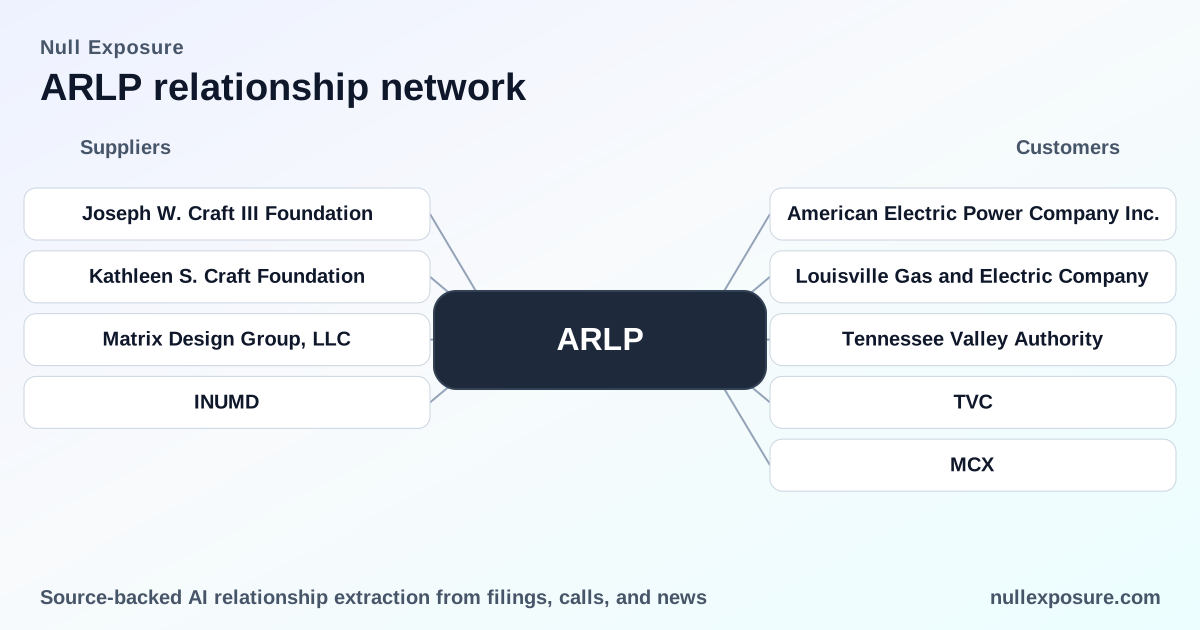
Alliance Resource Partners (ARLP) — supplier relationships that shape margins and operational risk
Alliance Resource Partners is a vertically integrated coal producer that monetizes through coal sales, royalties, transportation reimbursements and selectively leased mineral interests. The business model combines long-lived mining leases with ongoing operating costs for equipment, transportation and safety systems; cash flow is driven by thermal coal volumes sold to industrial and utility customers, with ancillary revenue from transportation services and royalties. For investors, supplier relationships translate directly into margin stability (long-term leases and repeat service providers) and into directional cost risk (fuel, steel and capital equipment). Visit https://nullexposure.com/ for deeper supplier analytics and signal-driven summaries.
What the supplier signal set tells investors about ARLP's operating posture
ARLP operates with contracting maturity and operational continuity. Company filings note that base leases with private owners are structured as long-term arrangements that can be extended until the leased coal is exhausted — a commercial design that converts land/lease relationships into de facto production life agreements. That contracting posture reduces immediate production disruption risk but locks the company into legacy cost structures over many years.
ARLP functions simultaneously as a buyer of inputs (steel, petroleum products, roof bolts and mining supplies) and as a service integrator that reimburses third-party carriers for transportation services. This dual role makes procurement policy central to margin control: purchases for mining equipment and consumables feed directly into operating margins, while transportation passes through as reimbursed fulfillment costs. The company’s stated reliance on multiple carriers (CSX, NS, PAL, truck and barge) indicates a diversified logistics set, which lowers single-carrier concentration but preserves exposure to freight-rate inflation.
Other operational signals: time-sharing agreements with aircraft providers (example spend ~ $0.4M/year) indicate a mid-range vendor spend profile for select services, and a number of supplier relationships are active and programmatic rather than ad hoc. These attributes together point to an operator with mature supplier arrangements, moderate operational concentration, and clear pathways for capitalizing on productivity-enhancing technologies.
Explore ARLP supplier patterns and provenance at https://nullexposure.com/ to prioritize diligence and counterparty risk for portfolio allocation.
Relationship-by-relationship: what to know and where it matters
-
Joseph W. Craft III Foundation — counterparty in purchase-and-sale agreements. TradingView reported that Alliance Resource Partners signed multiple purchase and sale agreements naming the Joseph W. Craft III Foundation as a counterparty in filings disclosed March 9, 2026; that suggests transactional dealings with entities tied to management or ownership interests that can influence asset transfers and related-party dynamics. (TradingView news, Mar 9, 2026)
-
Kathleen S. Craft Foundation — named counterparty in the same asset agreements. The same TradingView item lists the Kathleen S. Craft Foundation as a counterparty to purchase-and-sale agreements disclosed March 9, 2026, indicating parallel transactions with family-affiliated foundations that investors should monitor for governance and related-party alignment. (TradingView news, Mar 9, 2026)
-
Matrix Design Group, LLC — established supplier of safety and productivity systems. A press roundup covering ARLP’s technology partnerships notes that Matrix has supplied collision avoidance and proximity detection systems to ARLP for about 15 years, positioning Matrix as a recurring safety-critical vendor that contributes directly to operational uptime and regulatory compliance. (AIJourn coverage of Infinitum/ARLP partnership, FY2024)
-
Infinitum (INUMD) — joint development partner for motor technology and shuttle car conversions. ARLP has a formal agreement to integrate Infinitum’s lighter, more efficient motor technology into mining equipment and is converting shuttle cars to Infinitum motors under a joint development arrangement; management also referenced shuttle car conversions on the Q4 2025 earnings call transcript, signaling active deployment and production validation. (AIJourn, FY2024; Q4 2025 earnings call transcript, InsiderMonkey)
Why these relationships matter for investors: economics and risk
-
Contracting maturity reduces short-run production risk but preserves legacy exposure. Long-term base leases extend mine life predictability and support stable revenue forecasts; however, extended commitments limit the speed with which ARLP can alter cost structures tied to specific leases.
-
Operational criticality is concentrated in a few service categories. Safety systems (Matrix) and traction/electrification technology (Infinitum) are operationally critical—failures would impair production, but successful implementations improve fuel efficiency and total cost of ownership. Transportation partners represent another critical grouping; although diversified across carriers, freight-cost inflation or network disruption would pass through to realized margins.
-
Spend profile is mixed but manageable. Examples of mid-sized recurring spend (aircraft time-sharing ~ $0.4M/year) suggest ARLP balances large-capex equipment cycles with a steady stream of service contracts in the $100k–$1M band. That pattern indicates procurement sophistication but also exposes the company to many small-to-medium vendor relationships that require vendor management discipline.
-
Governance and related-party scrutiny is necessary. The inclusion of the Craft foundations in purchase-and-sale agreements requires investor scrutiny around arm’s-length terms, given their linkage to principal owners and the potential for transactions to affect asset allocation or distributions.
Practical checklist for diligence
- Confirm economic terms and duration of the Craft-related purchase-and-sale agreements and whether they are arms-length or involve preferential pricing.
- Review Infinitum pilot results and expected capital expenditure to scale motor conversions; quantify projected fuel and maintenance savings.
- Assess continuity and concentration across transportation providers—validate contractual protections against freight-rate hikes.
- Evaluate supplier risk management: are safety and critical equipment suppliers on multi-year support and spare-parts plans?
Conclusion — how to capitalize on the supplier signal set
Alliance Resource Partners runs a mature, asset-backed operating model where long-term leases and a stable set of service providers create predictability, while technology partnerships (notably with Infinitum) offer a pathway to incremental margin improvement. Key risks are related-party transaction oversight, freight inflation pass-through, and the pace of technology adoption.
If your investment thesis depends on predictable cash distributions and downside protection from operational continuity, ARLP’s supplier posture is supportive; if your thesis counts on rapid margin compression risk being low, then focus diligence on the Infinitum pilots and the Craft-related transactions. For an actionable supplier-risk view and to prioritize follow-up targets, visit https://nullexposure.com/ and run targeted counterparty checks.
Next steps for analysts: request the full purchase-and-sale agreement exhibits, operational pilot metrics from Infinitum conversions, and transportation contract indexing provisions to finalize the supplier-side valuation adjustment. For comprehensive relationship intelligence and alerts on ARLP counterparties, see https://nullexposure.com/.